
The bank manager’s voice cut through the marble lobby like a blade.
“Officers, arrest these children.”
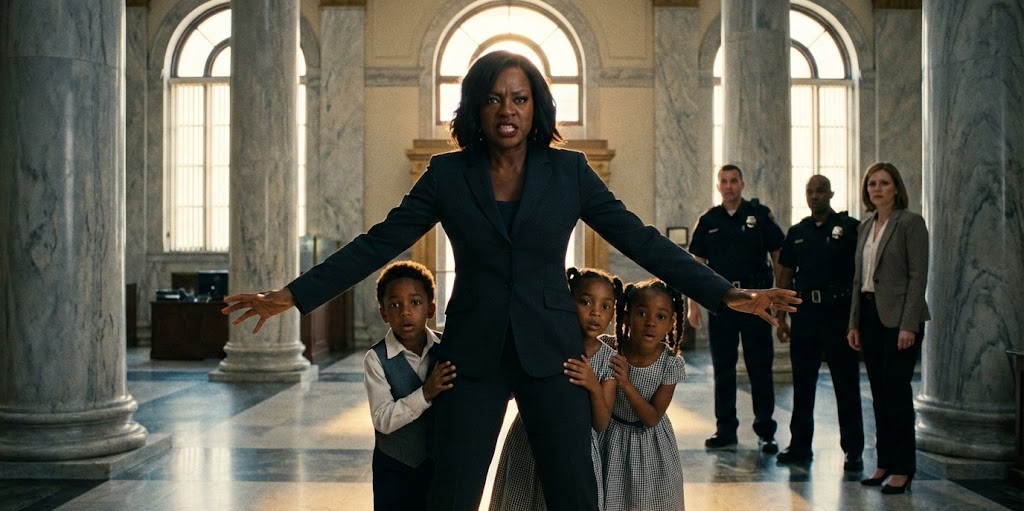
Three eight-year-olds stood surrounded by police in the middle of Westbridge Financial. Two girls were crying. Their brother Marcus stretched his arms around both of them—arms barely big enough to reach.
Officer Reynolds looked down at them with suspicion. “So you’re telling me these kids just happen to have fifteen grand on them? That’s drug money or stolen cash.”
“It’s not,” Marcus said, his voice shaking. “It’s from our grandma.”
“Boy, don’t raise your voice at a police officer. You’re already in enough trouble.”
Maya sobbed. “Please, we didn’t do anything wrong.”
“That’s what they all say.”
A young officer named Mitchell tried to intervene. “Sir, maybe we should just verify their story first.”
“Mitchell, you’re here to observe, not to think.”
Marcus held up a phone with trembling hands. “My mom is coming. She’s going to tell you the truth.”
The officer’s response dripped with mockery. “Your mom? Let me guess—she’s going to have some story about how you’re good kids.”
“We are good kids.” Marcus’s voice cracked with tears.
What these officers and this bank manager didn’t know was that the mother they were dismissing was already on her way. And when she walked through those doors, their entire world would collapse.
One Week Earlier
To understand how three children ended up surrounded by police for trying to make a bank deposit, we need to go back to the funeral of Betty Richardson.
Grandma Betty was everything to Marcus, Maya, and Mia. She told them stories. She taught them that being Black was beautiful. She saved every penny so her grandbabies would have opportunities she never had.
At the reception, Uncle James pulled the children aside. He was carrying three white envelopes.
“Your Grandma Betty left something special for each of you. She saved money your whole lives for this.”
When they opened the envelopes, their eyes went wide.
“Five thousand dollars each,” Mia gasped. “That’s so much money. What should we do with it?”
“Your grandma wanted you to put it in the bank. Start learning about saving. She wrote you each a letter.”
The children opened their grandmother’s letters with reverence. Her handwriting spoke to them one last time:
My precious babies,
By the time you read this, I’ll be watching over you from heaven. This money is to teach you that you’re worthy of building wealth, of having dreams, of taking up space in places that might not always welcome you.
Marcus, protect your sisters, but let them be strong. Maya, your kindness is your power. Mia, your voice matters.
Be brave, my loves.
Places that might not always welcome you. Grandma Betty knew. And she wanted her grandbabies prepared.
Tuesday Morning
Diane Richardson was getting ready for an important board meeting in Manhattan. Her children buzzed with excitement. Today was the day they would honor Grandma Betty’s wishes. Today they were going to the bank like real grown-ups.
“Remember,” Diane said, kneeling to their level, “Uncle James will drop you off. You go straight to Miss Patricia’s window—she’s been our teller for years. Give her the deposit slips I filled out, and Uncle James picks you up in thirty minutes.”
“We got this, Mom,” Marcus said. “We’re responsible.”
Maya bit her lip. “I’m nervous, though.”
“Don’t be nervous,” Mia said. “We’ll be fine.”
Diane handed Marcus her old phone. “Emergency only. It’s charged.”
“This is so cool,” Mia said, hugging her envelope. “We’re like real grown-ups. I’m going to tell my money to grow big and strong.”
Everything was going according to plan until James’s car broke down just blocks from the bank. He was a mechanic—he could fix it, but it would take time. They were on the same block, fifty feet from the door.
“Okay, kids,” Uncle James said. “Marcus, hold your sisters’ hands.”
“Yes, sir. Maya on my right, Mia on my left.”
James hesitated. “Maybe we should just wait.”
But Mia said, “Mom said we’re responsible. We can do this.”
James made a decision. “Okay. Straight there, straight back. Ten minutes.”
The children crossed the street, backpacks bouncing. Marcus in the middle, holding both sisters’ hands. Three children walking into a bank to honor their grandmother’s legacy.
They had no idea what was waiting inside.
The Manager
Sharon Caldwell had worked at Westbridge Financial for twenty years. If you asked her, she would tell you she was good at her job—that she knew how to spot trouble.
Here’s what Sharon really was: a woman who had lost custody of her own children due to neglect and workaholism. Instead of learning from that pain, she became hypervigilant about unattended children. She had called child protective services on customers three times in the past year.
And Sharon had a particular bias against Black families. She saw them as high risk.
The person who might have helped wasn’t there. Patricia, the senior teller who had known the Richardson family for six years—who always had lollipops for the children—was at her daughter’s college orientation. In her place was Derek Martinez, twenty-six, kind-hearted, good with kids, but only six months on the job. He didn’t know the Richardson family.
Derek was a good person. But good people in bad systems sometimes don’t speak up loudly enough.
Inside the Bank
The automatic doors slid open. Marcus, Maya, and Mia walked into the marble lobby. The space felt enormous.
“Okay, remember Miss Patricia’s window,” Marcus said. “Mom said it’s the third one.”
They stood in line behind an elderly white woman named Linda Hartley. She turned and smiled.
“Well, hello there. Are you here with your parents?”
“Our uncle is right outside fixing his car. We’re making a deposit all by ourselves,” Mia said proudly.
“How wonderful. Such responsible young people.”
“It’s from our grandma in heaven,” Maya added.
“That’s lovely, dear.”
Everything was fine. Three children waiting in line, being polite.
But in her glass office, Sharon Caldwell stood up. She had seen them the moment they walked in. Three Black children alone. And in Sharon’s mind, that meant trouble.
She grabbed her clipboard and walked out onto the floor. Before the children could speak to Derek, Sharon was there.
“Excuse me, children. Are you here with an adult?”
“Our uncle is right outside,” Marcus answered politely. “We’re making a deposit.”
Sharon’s eyes narrowed. “And where are your parents?”
“Our mom is at work. She said Miss Patricia would help us,” Maya said nervously.
“Patricia isn’t here today. And I’m afraid children cannot conduct transactions without a parent or guardian present.”
That wasn’t true. It wasn’t bank policy. But Sharon said it with such authority that it sounded true.
Derek tried to help. “Actually, ma’am, bank policy says minors can make deposits to existing accounts with proper identification.”
Sharon cut him off with a look. “Derek, I’ll handle this.”
Derek’s mouth closed. He stepped back. The one person who might have stopped this chose silence.
Marcus held up the deposit slips. “But our mom said we could. She filled out all the papers.”
Sharon took them and examined them with exaggerated suspicion. “These could be forged.”
“Forged?” Mia asked, confused. “What’s forged?”
Maya started to tear up. “Are we in trouble?”
Marcus squeezed his sisters’ hands. “We’re not in trouble. We didn’t do anything wrong.”
But even at eight years old, Marcus could feel it. Something was very wrong. They were being seen not as children, but as threats.
The Interrogation
Sharon stood over the children with her clipboard. “How much money do you have?”
Marcus, still believing truth would protect him, answered honestly. “Fifteen thousand dollars. Five thousand each. From our grandma.”
Sharon’s eyebrows shot up. “That’s a lot of money for children to be carrying around.”
“Our grandma saved it for us our whole lives,” Mia said proudly.
And then Sharon said the words that shattered their innocence: “Is that so? And how do I know you didn’t steal this money?”
All three children gasped. In their world—the world their mother had created for them—stealing was unthinkable. And now this woman was accusing them of it.
“We would never steal,” Maya cried. “Mommy taught us stealing is wrong.”
“That’s mean to say,” Mia added, her brave voice cracking.
Sharon’s face remained cold. “Then you won’t mind if I call the police to verify your story.”
The police. She was threatening eight-year-olds with police.
Marcus tried one more time. “You can call our mom. She’ll tell you.”
Sharon held a phone to her ear, waited, then said, “No answer. Voicemail.”
We don’t know if she really called. We don’t know if she dialed the right number. Sharon had already made up her mind.
She directed them to plastic chairs in the waiting area—hard, cold chairs near the entrance where everyone could see them. Marcus in the middle. Maya holding his right hand. Mia holding his left. Other customers staring, whispering.
Linda Hartley approached Sharon. “Sharon, dear, I spoke to them. They seem like lovely children.”
“Linda, these children are unattended with a suspicious amount of cash. I’m following protocol.”
“But they said their uncle is outside.”
“So they claim. I haven’t seen any uncle.”
Linda backed away. She tried, but she didn’t try hard enough. That’s often how injustice continues—good people speak up once, get shut down, and stay silent.
Twenty minutes passed. Twenty minutes of three small children sitting in those chairs, feeling every eye in the bank on them, feeling like criminals when all they had done was follow their mother’s instructions.
Marcus pulled out the phone with shaking hands and called his mom. It went to voicemail.
“Mom, we’re at the bank and there’s a problem. The lady won’t let us make the deposit and she’s being really mean and I’m scared. Mia’s crying. Maya is trying to be brave. Please come.”
Then Mia had an idea. She pulled out Grandma Betty’s letters from her backpack—the precious words their grandmother had written to them.
“Want to see our grandma’s letters?” she said, holding them up. “They explain everything.”
Sharon snatched them from Mia’s hands.
“I’ll hold on to these.”
“Hey! Those are ours! Give them back!”
“Don’t raise your voice at me, young lady.”
She took them. A bank manager stole the last written words of their deceased grandmother.
Uncle James
Outside, James finally got his car running. He looked at his watch. Twenty minutes had passed. A customer exited the bank.
“Excuse me, did you see three kids in there? Two girls and a boy, about this tall?”
“Oh yes, they’re sitting in the waiting area. The manager was talking to them. Seemed tense.”
“Tense? Why?”
The customer shrugged. “I’m not sure. The kids looked upset.”
James rushed through the doors. He spotted his nieces and nephew and hurried over.
“Hey, what’s going on? You okay?”
Maya leaped up and threw her arms around him. “Uncle James! The lady won’t let us make our deposit.”
“She took Grandma’s letters,” Mia added urgently.
“She said we might have stolen the money,” Marcus explained.
Sharon swooped in. “And you are?”
“James Richardson. I’m their uncle. What’s the problem here?”
“These children were unattended with a large amount of cash. I need to verify their story.”
James’s voice rose. “Unattended? My car broke down right outside. They were supposed to be in and out in ten minutes. Their mom set this whole thing up.”
“Do you have identification?”
James handed over his driver’s license. Sharon examined it like she was looking for forgeries.
“And proof you’re related to them?”
“Proof? They just called me Uncle James!”
“That’s not proof. Children can be coached.”
James was getting angry. “Coached? Lady, what are you implying?”
Marcus looked up at his uncle. “Uncle James, she thinks we stole the money.”
“You what?”
And then Sharon said the quiet part out loud: “I didn’t say that. I said the situation is suspicious. Three Black children alone with fifteen thousand in cash—”
“Oh, so now we’re getting to it. Three Black children.”
“That has nothing to do with—”
“Then why did you say it? Why not just ‘three children’?”
Sharon’s face hardened. “I treat everyone the same.”
“Do you? How many white kids have you called the cops on?”
“I’m not discussing this with you. The police are already on their way.”
James couldn’t believe what he was hearing. “You called the police on children?”
Derek Martinez finally approached again. “Ma’am, I looked up the account. Diane Richardson has been a customer for eight years. High-value account. Everything checks out.”
“Derek, step back.”
“But ma’am—”
“Now.”
Derek stepped back again. Good person, bad system. Silence.
And then they heard it. Sirens getting closer.
Mia whispered, “Is that for us?”
Maya started crying harder.
Marcus said, “Uncle James, I’m scared.”
“It’s okay, buddy. We didn’t do anything wrong.”
But his hands were shaking too as Marcus typed on the phone: Mom help police coming please.
The Officers
Three police officers walked through the doors. Senior Officer Reynolds, white, in his fifties, with an aggressive stance. Officer Washington, Black, mid-forties, with a harsh expression. And Junior Officer Mitchell, white, twenty-four, fresh out of the academy, hanging back and looking uncomfortable.
Sharon greeted them immediately. “Thank you for coming so quickly. These three children came in alone with fifteen thousand dollars in cash. Their stories keep changing, and this man claims to be their uncle but has no proof.”
Reynolds looked at the children, then at James, sizing them up like suspects.
“All right, let’s sort this out. Sir, step over here.”
“These are my nieces and nephew. Their mother is at work—”
“I said step over here. Now.”
Washington turned to the children. “You three, stand up.”
They stood holding hands, terrified.
“Where’d you get the money?”
“Our grandma left it to us,” Marcus answered.
Reynolds’s voice dripped with skepticism. “Your grandma just happened to leave you fifteen grand in cash. That’s convenient.”
“It’s not convenient,” Mia protested. “It’s true.”
“Watch your tone, little girl,” Washington snapped.
“We’re not lying!” Maya cried.
Reynolds leaned down. “Nobody said you were lying. But fifteen thousand is a lot of money. Usually when we see kids with that kind of cash, it’s connected to drugs or theft.”
Marcus’s voice went up an octave. “We don’t do drugs! We’re eight years old!”
The questions kept coming. Where do you live? Brooklyn. What part? Prospect Heights.
Reynolds exchanged a knowing look with Washington.
“And how does a family in Brooklyn come up with fifteen thousand in cash?”
James defended them. “Their grandmother saved for years. She was a teacher.”
Reynolds smirked. “A teacher with fifteen grand lying around? Interesting.”
Mitchell tried quietly. “Sir, maybe we should just verify their account with the bank.”
“Mitchell, what did I tell you about speaking out of turn?”
“Sorry, sir.”
Mitchell fell silent. The one officer who saw this for what it was—silenced by his superiors.
Washington announced, “We’re going to need to search those backpacks.”
“Why?” Marcus asked.
“Because I said so. Empty them. Now.”
The children looked at Uncle James with desperate eyes.
“Do they have to?”
“Unless you want us to do this the hard way.”
And so three eight-year-old children had to empty their backpacks onto a table like criminals.
Marcus’s backpack contained school books, a Captain America action figure, a juice box, and his envelope with five thousand dollars.
Maya’s had a coloring book, crayons, a stuffed animal, and her envelope.
Mia’s held library books, a notebook with careful handwriting, pencils, and her envelope.
The contents of children’s backpacks. Innocent. Normal. Beautiful.
Washington picked up Marcus’s action figure. “What’s this?”
“It’s Captain America.”
Reynolds laughed cruelly. “Funny. Captain America follows the law.”
Washington dumped out the envelopes and counted the money aggressively, slapping each bill on the table. The children flinched with each slap like they were being hit.
Mitchell spoke up again. “Sir, they’re just kids.”
“Mitchell, one more word and you’re on desk duty for a month.”
Reynolds turned back to Marcus. “You seem like the leader. You’re making your sisters do this.”
“What? No! We’re doing it together.”
“Don’t lie to me, son. Where did you really get this money?”
“I told you. Our grandma.”
Washington twisted the knife. “Your grandma’s dead, right? Convenient. She can’t tell us the truth.”
Maya started sobbing uncontrollably.
Mia’s anger overrode her fear. “Don’t talk about our grandma like that!”
“Excuse me?”
“You’re being mean! We didn’t do anything wrong!”
Reynolds pointed at her. “That’s strike two, little girl. One more outburst and we’re taking all three of you down to the station.”
“You’re not taking them anywhere,” James protested.
“Sir, you want to get arrested for obstruction? Because I’ll make that happen.”
Mitchell, trying a softer approach, knelt down to the children’s level. “Hey, it’s okay. Just tell us the truth and we can sort this out.”
Maya looked at him with tear-filled eyes. “We are telling the truth.”
Mitchell looked back at his senior officers, clearly uncomfortable, but he was outnumbered and outranked.
Washington shook his head. “Kids got a mouth on her.”
“Probably learned it at home,” Reynolds added. “Where is their mother anyway? What kind of parent sends kids to carry this kind of cash?”
“A parent who’s teaching them responsibility,” James defended.
“Or a parent who’s using them to move money. We see it all the time.”
They were accusing Diane Richardson—a woman they had never met—of using her children as drug mules. Based on nothing. Based on the color of their skin.
Marcus made one last stand, his voice shaking but determined. “My mom’s name is Diane Richardson. She’s the CEO of Richardson Holdings. She’s going to be here any minute, and when she gets here, you’re going to be in trouble.”
Washington laughed. Actually laughed. “Oh, you’ll tell on us? I’m shaking.”
Reynolds smirked. “CEO, huh? Let me guess—she’s important.”
“She is important,” Mia insisted.
“Sure she is, sweetheart.”
Then Mitchell’s radio crackled to life.
“Dispatch to unit 247.”
“Go ahead.”
“We have a Diane Richardson on the line demanding to speak with officers at your location. She says those are her children. She’s… uh… she’s pretty insistent.”
Reynolds waved it off. “Tell her we’re conducting an investigation.”
“Sir, she says she’s CEO of Richardson Holdings and she’s—”
Mitchell’s eyes suddenly widened. “Wait. Richardson Holdings? Isn’t that the company that—”
And then the glass doors burst open.
The Storm
The sound of expensive heels clicking on marble echoed through the lobby. Sharp. Precise. Powerful.
Everyone turned.
Diane Richardson entered that bank like a storm. Like a hurricane. Like a mother bear whose cubs had been threatened.
She was forty-eight years old, immaculate in her board meeting suit, but her usual composure was completely shattered by mother’s rage. She had dropped everything mid-presentation. Her hair was slightly disheveled from running. Her eyes were wild with protective fury.
Those eyes immediately found her children.
“Mommy!” they screamed, trying to run to her.
Reynolds barked, “Stay where you are!”
Diane’s voice cut through the room like a blade. “Don’t you dare tell my children what to do. Come here, babies.”
It wasn’t a request. It was a command that brooked no argument.
The children ran to her. All three crashed into her arms, crying. Marcus, Maya, and Mia sobbing into their mother’s suit jacket.
Diane dropped to her knees on that cold marble floor, hugging all three of them. “I’m here. I’m here, my loves. I’m here.”
Her hands moved frantically, checking them over—looking for injuries, for bruises, for any sign of physical harm. “Are you hurt? Did anyone touch you? Did anyone hurt you?”
“No, but Mom, they said we’re criminals,” Marcus said through his tears.
“They were so mean,” Mia added.
“They made fun of Grandma,” Maya said.
Diane’s face transformed. Gone was the worried mother. In her place stood a warrior. Her jaw set. Her eyes went cold. She stood up slowly, deliberately, and positioned her children behind her, her hands resting protectively on their shoulders.
She was a shield.
She turned to face the officers.
Reynolds tried to take control. “Ma’am, we’re conducting an investigation.”
Diane cut him off. “Investigation of what? Three eight-year-old children making a bank deposit?”
“They had fifteen thousand dollars in cash,” Washington tried.
“Their inheritance from their late grandmother. What’s the crime?”
“The situation was suspicious.”
“What was suspicious? Be specific.”
“Three unattended minors with a large amount of cash—”
“Their uncle was outside. They told you that. They weren’t unattended.”
“They couldn’t prove he was related.”
“They’re eight. They don’t carry birth certificates. What you mean is you saw three Black children and made assumptions.”
“That’s not what this is about.”
Diane pressed harder. “Then tell me, Officer Reynolds”—she paused to read his name tag—”how many white children have you interrogated for making bank deposits this year?”
Silence.
Mitchell said quietly, “None, ma’am.”
Reynolds shot him a murderous look.
Diane nodded at Mitchell. “Thank you, Officer.”
“Mitchell, ma’am.”
She turned her attention back to Reynolds and Washington. “You treated my children like criminals. You searched their belongings. You mocked their dead grandmother. You threatened to arrest them for doing exactly what their mother told them to do.”
Washington tried to defend himself. “Ma’am, we were following protocol.”
Diane’s voice dripped with sarcasm. “Protocol for what? Banking while Black? Being children while Black?”
Reynolds made the mistake of trying to threaten her. “You need to watch your tone.”
Diane laughed. A cold, dangerous sound. “Or what? You’ll arrest me too? Please try. I would love to add that to the lawsuit.”
“Lawsuit?”
“Oh yes. Civil rights violation. Unlawful detention of minors. Racial profiling. Emotional distress. I’m going to sue you personally, Officer Reynolds. And you, Officer Washington. And this bank. And I’m going to make sure everyone knows exactly what you did to three eight-year-old children.”
“We were doing our jobs.”
“Your job is to protect and serve. You terrorized children. There’s a difference.”
Mitchell tried to speak up. “Ma’am, if I may—I tried to tell them.”
Reynolds snapped, “Mitchell, shut your mouth.”
But Diane intervened. “No, Officer Mitchell. Please continue.”
Mitchell took a breath. “Ma’am, I told them we should just verify the account. The kids weren’t doing anything wrong. They were scared, and they kept telling the truth. But…” He looked at his senior officers. “They didn’t want to listen.”
Reynolds threatened him. “You’re finished in this department, Mitchell.”
Diane shook her head. “No. Officer Mitchell just saved his career. You two ended yours.”
Washington tried to protest. “You can’t—”
Diane pulled out her phone. “I’m calling Police Commissioner Davis. We went to law school together. I’m also calling the mayor—she appointed me to the police reform board last year. And then I’m calling every news station in New York. By tonight, your faces will be on every screen in America.”
Reynolds realized the magnitude of his mistake. His tone changed completely. “Ma’am, maybe we can discuss this calmly.”
Diane’s voice exploded. “Calmly? You want calm? You just terrorized my babies, and now you want calm?”
The Owner
Sharon Caldwell, who had been standing to the side throughout, finally stepped forward. “Officers, maybe I should explain—”
Diane turned to her, and the look on Diane’s face made Sharon step back.
“You. This is your fault. You called the police on three children. My children.”
“I was following security procedures.”
Diane asked a simple question. “Do you know who I am?”
“You’re their mother.”
Diane’s next words fell like bombs. “I’m Diane Richardson, CEO of Richardson Holdings. We own forty-three companies, including—as of six months ago—Westbridge Financial. I own this bank. Every branch. Every policy. Every employee. Including you.”
Sharon’s face drained of all color. Her mouth opened and closed, but no sound came out.
The officers looked at each other, suddenly realizing the magnitude of their mistake. The other bank employees gasped. Uncle James allowed himself a small smile. And the children, even through their tears, felt a surge of pride in their mother.
Diane continued, her voice steady and final. “So let me be crystal clear. You, Sharon Caldwell, are fired. Officers Reynolds and Washington, I’m filing formal complaints, and I will personally testify at any hearing. Officer Mitchell, thank you for trying to do the right thing.”
Mitchell nodded respectfully. “Yes, ma’am.”
Then Marcus tugged on Diane’s jacket. His small voice broke through her warrior mode. “Mom, can we go home now? I don’t like it here.”
Diane’s face immediately softened. She knelt down to his level. “Yes, baby. Just a few more minutes.”
She stood back up and looked at everyone in that bank—officers, employees, customers, Sharon. Her voice was quiet, but everyone heard it.
“Get out of my way.”
And they did. They parted like the Red Sea.
The Reckoning
Diane walked her children to a private area of the bank, away from everyone. She sat them down and checked them over again, more carefully now.
“Did anyone hurt you physically?”
“No.”
“Did anyone touch you inappropriately?”
“No.”
“Okay. I need you to tell me everything that happened.”
And so they told her. How Sharon had accused them of stealing. How the officers had been mean and scary. How Officer Washington had mocked Grandma Betty—had said it was “convenient” that she was dead and couldn’t tell the truth.
With each detail, Diane’s jaw tightened, but she stayed calm for them.
When they finished, she pulled them close. “You did nothing wrong. Nothing. Do you understand me?”
“But the police said—”
“The police were wrong. Sometimes adults are wrong. Even police officers.”
“Can police be wrong?”
“Yes, baby. They’re human. And some humans have bad ideas about people who look different from them.”
Diane asked Derek Martinez to watch the children for a moment. Derek brought them juice and cookies, talking to them gently, trying to make them smile.
Meanwhile, Diane marched to Sharon’s office. She didn’t knock.
Sharon tried to explain. “Miss Richardson, I can explain—”
“Sit down and be quiet.”
Sharon sat.
“Twenty years you’ve worked here.” Diane pulled up files on her tablet. “I’ve been reviewing this branch since we acquired it. Know what I found? Fourteen police calls in the past two years. Every single one on a Black or Latino customer. Not one white customer. Care to explain?”
“I don’t profile people.”
“Transaction approval rates. White customers with questionable deposits get approved ninety-four percent of the time. Black customers with legitimate deposits get approved sixty-seven percent of the time.”
“Those numbers must be wrong.”
“They’re not. I had our forensic accountants verify them. But none of that compares to what you did today. You saw three Black children and immediately assumed criminality. You held them against their will. You called the police. You traumatized them.”
Sharon started crying. “I was trying to protect the bank.”
“From children? From my babies? You were protecting your own prejudices.”
Sharon broke down. “I lost my own children in my divorce. The court said I was neglectful, that I cared more about work than them. I see unattended children and I think someone needs to check on them…”
“So your trauma becomes their trauma. Your pain becomes their nightmare.”
“I didn’t mean to hurt them.”
“But you did. Intention doesn’t erase impact. My son tried to protect his sisters. My daughters cried and begged. And you still called the police.”
“I’m sorry. I’m so sorry.”
“Tell them. Not me. Them.”
“I… I don’t know if I can.”
“Then you’re not really sorry. You’re fired. Clean out your desk. Security will escort you out in one hour.”
The Aftermath
Diane saw that Reynolds and Washington were still in the bank.
“Why are you still here?”
“Ma’am, we need to complete our report.”
“Your report? Here’s what your report should say: ‘We racially profiled three children and violated their civil rights.’ Can you write that down?”
“Miss Richardson, with all due respect—”
“Respect? You want to talk about respect? You mocked my children’s dead grandmother. You threatened to arrest eight-year-olds. You searched their backpacks like they were drug dealers. Where was the respect?”
“We were assessing a potential crime.”
“What crime? Name it. Specifically.”
Silence.
Diane called out, “Officer Mitchell, come here.”
Mitchell approached nervously.
“You tried to do the right thing. You saw three scared children and wanted to verify their story first. That’s good policing.”
“Thank you, ma’am.”
“I’m going to make sure Commissioner Davis knows what happened here today. All of it—including your attempt to de-escalate.”
Reynolds made one last attempt at intimidation. “Are you threatening us?”
Diane smiled coldly. “No, Officer Reynolds. I’m promising you. By tomorrow, your captain will have my formal complaint. By next week, you’ll be sitting across from internal affairs. And I will be there with my children, telling the truth about what you did.”
“This is going to ruin our careers.”
“You ruined them yourselves. When you saw three Black children and decided they were criminals. When you chose intimidation over investigation. You did this.”
Reynolds and Washington left the bank defeated.
Mitchell lingered behind. “Ma’am, I’m sorry about your children. Nobody should go through that.”
“Thank you, Officer Mitchell. That means something.”
The Deposit
Diane gathered the bank staff. “Sharon Caldwell is no longer employed by Westbridge Financial. What happened today can never happen again. Patricia Wu, when you return tomorrow, you’re the new branch manager with full authority and a forty percent raise.”
“Derek Martinez, you showed courage today. You stood up when others stayed silent. You’re now assistant manager. Effective immediately.”
Derek was stunned. “Thank you, Miss Richardson.”
“Don’t thank me. Prove me right. Make sure every child who walks through these doors is treated with dignity and respect—no matter what they look like.”
As Sharon was being escorted out, carrying a box of her belongings, she saw the children sitting with Derek eating cookies. She stopped.
“Miss Richardson, may I?”
Diane looked at her children. “Do you want to hear what she has to say?”
The children looked at each other. Marcus finally said, “Okay.”
Sharon knelt down to their level. “I’m so sorry. I was wrong. I made judgments about you before I even knew you, and that was wrong. You’re wonderful children, and you didn’t deserve to be treated that way.”
Maya said simply, “You were really mean.”
Sharon nodded, tears streaming down her face. “I know. I’m sorry.”
Mia asked, “Do you have kids?”
Sharon’s voice broke. “I did. I lost them because I wasn’t a good mom.”
Mia, with the wisdom children sometimes possess, said, “You should be nice to other kids.”
Sharon looked at this brave little girl. “You’re right. You’re very wise.”
Marcus said, “I hope you learn to be better.”
“I will. I promise.”
After Sharon left, Diane smiled at her children. “Okay, my loves. Let’s finish what Grandma wanted you to do.”
They approached the counter where Derek and Maria, another teller, were waiting.
“Hello, Richardson family. We’re so glad you’re here.”
Marcus held out his envelope. “This is from our Grandma Betty.”
Mia added, “She saved it for us.”
Maya quoted from her grandmother’s letter. “Because we’re worthy.”
Maria’s eyes grew soft. “You absolutely are. Your grandmother must have been an amazing woman.”
“She was,” Marcus said with pride. “She taught us to be brave.”
Derek added, “You were all very brave today.”
The transaction was completed in three minutes. No questions. No suspicion. No drama. Just respect and kindness.
Derek handed each child a special certificate. “First Independent Deposit Achievement Award.”
Maya’s eyes went wide. “We get awards?”
Maria smiled. “You earned them.”
And for the first time all day, all three children smiled. Real smiles. The kind that reached their eyes.
Ice Cream and Hard Truths
Diane took them to their favorite ice cream shop and got them a private booth. Triple scoops for everyone. They needed comfort. They needed to feel like children again.
At first they ate quietly. Then Maya asked the question that was weighing on all of them.
“Mommy, why did those police officers hate us?”
Diane chose her words carefully. “They didn’t hate you, baby. But they had unfair ideas about people who look like us.”
Marcus asked the question he already knew the answer to. “Because we’re Black.”
“Yes, sweetheart.”
Mia said what their grandmother had taught them. “But Grandma said being Black is beautiful.”
Diane smiled through her own pain. “Grandma was right. Being Black is beautiful. The problem isn’t with you. It’s with people who have been taught wrong ideas.”
Maya said quietly, “I was so scared.”
Diane pulled her close. “I know, sweet girl. You were allowed to be scared.”
Marcus, who had been holding everything in, trying to be strong, finally let it out. “I tried to protect them, Mom. I tried to be strong like you said.”
Diane’s voice was full of love. “You were perfect, Marcus. You held your sisters’ hands. You called me. You told the truth even when you were scared. That’s real strength.”
Mia added, “The nice police officer tried to help.”
“Yes. Officer Mitchell did. Not all people are the same, even when they wear the same uniform.”
Marcus asked the question every parent of a Black child dreads. “Mom, will this happen again?”
Diane answered honestly, because she respected her children too much to lie. “It might, baby. I wish I could promise it won’t, but sometimes people will treat you unfairly because of how you look.”
“That’s not fair.”
“You’re right. It’s not fair. But that’s why we have to be prepared. And why we have to be brave—like Grandma said.”
“What should we do if it happens again?”
“Exactly what you did today. Stay together. Tell the truth. Call me. Remember who you are and whose you are.”
“Whose are we?”
“You’re mine. You’re Grandma Betty’s. You come from strength and love and people who fought for you to have better lives.”
Mia said something that made Diane’s heart swell with pride. “I don’t feel small anymore.”
“Why not?”
“Because you came. And you fixed it.”
Diane corrected her gently. “You fixed it first, baby. You were brave before I got there.”
The Reckoning
The story didn’t stay quiet. Within hours, news coverage began. “CEO’s Children Racially Profiled at Bank” dominated every channel. Social media exploded with security camera footage. People watched three small children being interrogated by police, and the public outcry was immediate.
Officers Reynolds and Washington were placed on administrative leave pending investigation. Their careers were over.
Officer Mitchell, the young rookie who had tried to do the right thing, was commended by the department and promoted. His courage in speaking up became an example for other officers.
Derek Martinez was shown training new employees. “We treat every customer with respect. Especially children.”
Patricia Wu returned from her daughter’s orientation to find herself promoted to branch manager. “This branch will be a safe space for all families,” she promised.
Diane Richardson established the Betty Richardson Children’s Financial Literacy Program in her mother’s honor—free banking for minors, financial education in schools, community outreach. Other banks, seeing the public reaction and fearing similar incidents, rushed to implement new protocols. Within three months, five major banks had changed their policies.
The children’s story became a rallying cry for reform. It sparked national conversations about racial profiling, police training, and how society treats children of color.
Six Months Later
Six months of healing. Six months of therapy. Six months of slowly rebuilding trust in a world that had shown them its ugliest face.
And then one day, the children returned to Westbridge Financial. They walked in holding hands, but this time they were confident. They knew they belonged there.
Patricia was at her desk. When she saw them, she stood up with a huge smile. “My favorite customers!”
Marcus greeted her cheerfully. “Hi, Miss Patricia. We’re checking our savings.”
“Our money grew,” Mia added excitedly.
“Compound interest,” Maya explained—she always paid attention in Patricia’s financial literacy class.
Derek brought over their statements, decorated with stickers and stamps. “Look at this. Your grandmother would be so proud.”
The three children smiled at each other. They had honored Grandma Betty’s wishes. They had been brave, just like she asked.
Then something beautiful happened. A young Hispanic girl, about seven years old, walked in nervously with her mother. They were speaking Spanish, and you could see the uncertainty on their faces.
But Patricia greeted them warmly—in Spanish.
The girl’s face relaxed. She smiled. She felt welcome.
Marcus, Maya, and Mia watched this interaction. They exchanged knowing looks. They understood what they were seeing. They were witnessing the change they had helped create.
“We should go,” Marcus said. “Mom’s waiting.”
They waved goodbye to everyone, and everyone waved back. Not as people humoring children, but as people who respected them.
They exited into the sunshine. Diane was waiting outside, her arms open wide. All three children ran into her embrace.
“How’d it go?”
“Perfect,” Mia answered.
“Everyone was so nice,” Maya added.
Marcus summed it up simply. “Just like it should be.”
They walked off together, still holding hands, into the bright New York sunshine.
Remember, my loves, you are worthy of taking up space. Be brave. Be strong. Be you.
—Grandma Betty
Marcus, Maya, and Mia Richardson walked into a bank to honor their grandmother’s memory. They walked out having changed the world—one policy, one conversation, one moment of justice at a time.
They learned that being Black and eight years old and carrying money doesn’t make you a criminal. It makes you a child with dreams and a future and a grandmother who loved you enough to give you a head start.
Three children. One bank. One terrible day that became a turning point for thousands of families who would come after them.