
Scene 1: The Woman Who Cooked Before Dawn
Rosa Delgado woke up at 3:30 AM every morning, not because she wanted to — because the broth had to simmer for four hours before the first customer arrived.
Her food cart sat on the corner of 5th and Mariposa in a part of the city that tour guides skipped. No sign. No menu board. No Instagram handle taped to the side. Just the smell — and the smell was enough.
People lined up in the dark for her birria. Construction workers with dust still on their boots. Nurses ending night shifts with hollow eyes. Old men who swore her consommé could fix a broken heart, a bad back, or a Monday.
Rosa cooked like it was a conversation — adjusting, tasting, whispering to the pot like it could hear her. She’d learned from her grandmother, who’d learned from hers, and the recipe had never been written anywhere except one place: a small leather notebook with a cracked spine and pages stained with years of oil and love. Rosa kept it in her apron pocket like a heartbeat.
Her daughter Camila sat on an overturned crate beside the cart every morning before school, legs swinging, watching her mother’s hands move through steam like a magician who didn’t know she was performing.
“Mama, why don’t you open a real restaurant?”
Rosa smiled without looking up. “This is real, mija. The food is real. The people are real. That’s enough.”
Camila accepted this the way children accept gravity — not because she understood it, but because her mother said it with a voice that didn’t leave room for doubt.
Scene 2: The Man Who Took Notes
He came three Saturdays in a row.
Always alone. Always overdressed for a food cart — pressed jacket, leather shoes that didn’t belong on cracked sidewalk. He ordered everything on the unwritten menu. He closed his eyes when he tasted the consommé, the way people do in movies but rarely in real life.
He watched Rosa’s hands. He asked about the spices. He complimented her like someone studying for a test.
“What’s in the broth? This depth is extraordinary.”
Rosa laughed it off. “Family secret, señor.”
The third Saturday, he introduced himself. Chef Julian Ashford. Two Michelin stars. A cookbook deal with a major publisher. A face that had been on magazine covers and morning talk shows and the kind of billboards you see in airports.
He asked to take a photo with Rosa. She agreed, flattered and suspicious in equal measure. He asked about her process — the timing, the chiles, the way she toasted the aromatics before they hit the liquid. She told him some things — never the real things — because her grandmother had warned her about men with clean shoes and hungry questions.
“The secret isn’t in the ingredients,” Rosa told him, wiping her hands on her apron. “It’s in the patience. You can’t rush love into a pot.”
Julian smiled the way people smile when they’re already planning something.
Then he disappeared. No fourth Saturday. No goodbye. No thank you.
Rosa didn’t think about it. People came and went. The cart stayed.
Six months later, Camila was folding laundry at the laundromat on 7th Street when she looked up at the mounted TV and froze.
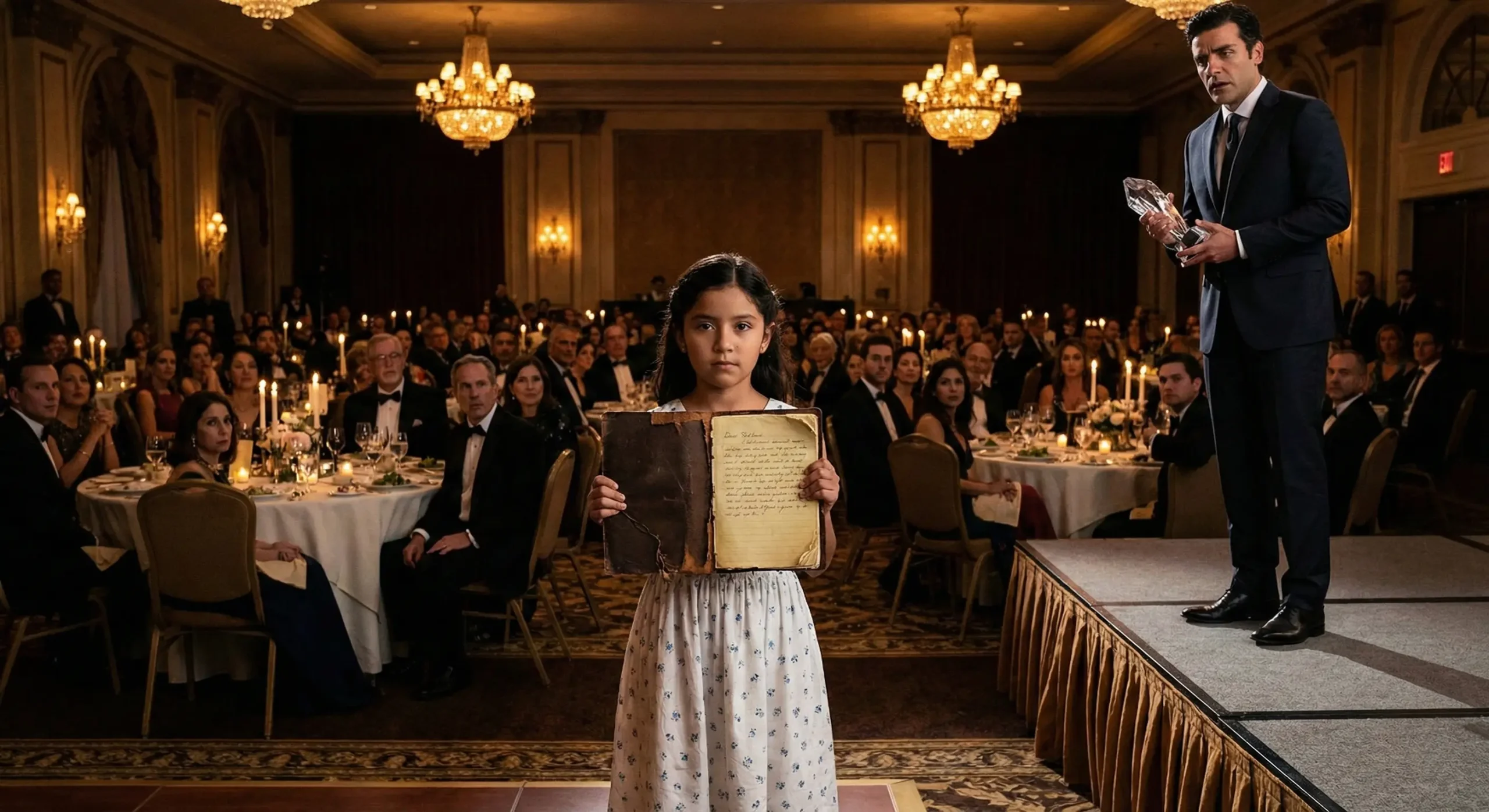
Chef Julian Ashford stood on a stage in a tailored black suit, holding a crystal trophy shaped like a flame. The banner behind him read: GOLDEN PLATE AWARD — DISH OF THE YEAR.
The announcer’s voice filled the laundromat: “…for his groundbreaking slow-braised birria with a consommé that critics have called ‘a revelation’ and ‘unlike anything in modern American cuisine.'”
Julian leaned into the microphone, confident and rehearsed. “This dish came from years of experimentation and a deep respect for tradition. It’s my love letter to the craft.”
Camila stood perfectly still, a warm towel pressed against her chest.
She knew that consommé. She’d watched it simmer since she could stand. She’d tasted it a thousand times. She’d seen her mother cry over it once, the anniversary of her grandmother’s death, whispering, “I hope I’m doing it right, abuelita.”
That wasn’t his dish. That was her mother’s life in a bowl. And he’d put his name on it like a signature on a stolen painting.
Camila walked home and found Rosa at the cart, prepping for the next morning. She told her what she’d seen. Every word.
Rosa listened. Then she turned back to her onions and said quietly: “People like him take, mija. People like us keep cooking.”
Scene 3: The Silence That Grew Teeth
Rosa didn’t fight it. She didn’t know how.
She didn’t have a lawyer. She didn’t have a publicist. She didn’t have a phone that could reach anyone who mattered. She had a cart, a notebook, and a daughter who watched her get quieter every day.
The story spread without Rosa’s help. A food blogger who’d been eating at the cart for years saw the award segment and posted a thread: “I’ve been eating this dish on 5th and Mariposa for six years. This isn’t innovation. This is theft.”
The thread got traction — then got buried. Julian’s PR team released a statement calling the claims “baseless and disrespectful to Chef Ashford’s creative process.” The internet argued for two days and moved on.
But Camila didn’t move on.
She watched her mother wake up at 3:30 AM and cook in silence now — no humming, no whispering to the pot, no stories about abuelita. The joy had been taken out of the ritual, and something bitter had settled in its place.
One night, Camila sat on the kitchen floor while Rosa scrubbed pots.
“Mama, do you still have abuelita’s notebook?”
Rosa paused. Then she pulled it from her apron — the leather notebook, soft and oil-stained, pages filled with her grandmother’s handwriting: measurements, notes, drawings of chiles with arrows pointing to the seeds, and dates that went back forty years.
Camila held it carefully, like it was alive.
“Can I borrow it?”
Rosa looked at her daughter for a long time. Then she nodded once.
Scene 4: Two Buses and a White Dress
Three weeks later, the National Chef’s Gala was held at the Meridian Grand Hotel downtown — the kind of building with doormen who could smell a tax bracket.
Julian Ashford was receiving the Culinary Icon Award. Every food critic, restaurateur, and industry name in the country would be in that room.
Camila woke up early that Saturday. She ironed her white dress with the small blue flowers — the one she wore to church and school picture day. She braided her own hair because Rosa had already left for the cart. She put the leather notebook in a small canvas bag.
She took the 6:15 bus to downtown, then transferred to the 43. She sat in the back and held the bag on her lap with both hands. The man next to her glanced at her and asked, “Where’s your mom, sweetheart?”
“Working,” Camila said. And that was true.
She arrived at the Meridian Grand at 6:50 PM. The gala started at 7. Men in tuxedos and women in gowns floated through the lobby like a different species.
Camila walked straight to the ballroom doors. A security guard stepped in front of her before she could touch the handle.
“Whoa, hey — you can’t go in there, kid. This is a private event.”
Camila looked up at him. She was small, but her eyes were steady in a way that made him hesitate.
“I need to talk to someone inside.”
“Where are your parents?”
“My mom is cooking right now. She always is.”
The guard started to radio for someone, but Camila was already moving — not running, just walking with the kind of calm that adults don’t expect from a nine-year-old. She slipped through a side entrance near the kitchen hallway, past the waitstaff carrying trays, and into the ballroom through a service door that no one was watching because no one expected a child to walk through it.
Scene 5: The Aisle
The room was enormous. Round tables draped in white linen. Crystal glasses catching light. Six hundred people who understood the price of everything and the cost of very little.
On stage, a woman in a black gown was reading Julian Ashford’s introduction from a teleprompter. His photo glowed on the screen behind her — arms crossed, chef’s coat pristine, the kind of confidence that comes from never being questioned.
“…a visionary who has redefined American cuisine…”
Camila stood at the back of the room, the leather notebook clutched against her chest. Her heart was hammering so hard she could hear it in her ears. Her white dress with the blue flowers looked like a whisper in a room full of shouts.
She started walking.
Down the center aisle. Past tables of people who turned and stared. Past wine glasses and bread plates and napkins folded into shapes that probably had names. Past a waiter who reached for her arm and then pulled back when he saw her face — not angry, not lost, just certain.
Someone whispered, “Whose kid is that?”
Someone else said, “Security—”
But Camila kept walking. She didn’t run. She didn’t look around. She walked the way her mother walked to the cart every morning — with purpose that didn’t need permission.
Julian Ashford was climbing the stage stairs when he noticed the ripple in the audience. He turned and saw her — a girl in a white dress, standing at the base of the stage, holding something against her chest like a shield.
The room went quiet. Not polite quiet. Confused quiet. The kind of silence that happens when six hundred people realize they don’t know the script anymore.
Scene 6: Sixty Seconds
Camila looked up at Julian Ashford. He looked down at her. And in that gap between them — three feet of stage, thirty years of tradition, and one stolen recipe — the air went tight.
“Who let this child in here?” someone hissed from the front table.
Camila didn’t flinch. She opened the notebook to a page marked with a faded ribbon — her great-grandmother’s handwriting, dated 1987 — and held it up so the first three rows could see it.
Her voice came out small but clear, the way truth sounds when it doesn’t need volume.
“That’s my mother’s recipe, sir.”
Julian’s smile stayed on his face, but his eyes changed.
“I’m sorry, sweetie, I don’t—”
“My great-grandmother wrote this. In 1987. My grandmother taught my mother. My mother cooks it every day at 5th and Mariposa. You came three times. You watched. You asked questions.”
She turned the notebook so the audience could see the page — the handwriting, the chile sketches, the measurements in grams and pinches, and a small drawing of a hand stirring a pot.
“You said it was yours. But it’s ours. It’s always been ours.”
The silence in the room wasn’t polite anymore. It was the kind of silence that precedes consequence.
A woman at Table 4 — Elena Marcos, the food blogger who’d posted the thread months ago — stood up and said, loud enough for the room: “She’s telling the truth. I’ve been eating that dish on 5th and Mariposa for six years. It’s identical.”
A murmur swept through the tables like a wave that didn’t plan to stop.
Julian’s hand tightened on the trophy. His PR person was already moving toward the stage with a phone pressed to her ear.
But the damage was done — not by volume, not by power, not by lawyers. By a nine-year-old in a white dress with a notebook that smelled like her mother’s kitchen.
Scene 7: The Room Shifts
The gala didn’t recover.
Julian tried to speak — something about “inspiration” and “cultural appreciation” and “misunderstandings” — but the words landed on a room that had already made up its mind.
The event organizer cut the ceremony short. Two board members from the Culinary Association stepped backstage. Three journalists were already typing.
Camila stood at the base of the stage, alone, holding the notebook. Her hands were shaking now — the adrenaline finally catching up to the courage. A woman in a navy suit crouched beside her.
“Sweetheart, are you okay? Can we call your mom?”
Camila nodded. “She’s at her cart. She’s always at her cart.”
Within the hour, Rosa Delgado received a phone call she didn’t understand.
Within two hours, she was sitting in the hotel lobby in her apron, flour still on her sleeve, holding Camila on her lap while a lawyer from the Culinary Association explained what was happening.
Within a week, Julian Ashford’s award was rescinded. His publisher quietly pulled the cookbook. His restaurant issued a statement that said nothing and meant less.
Scene 8: What Gets Returned
But Rosa didn’t want revenge. She wanted the recipe back — not the physical one, she’d always had that. She wanted the story attached to it. Her grandmother’s name. Her mother’s hands. The 3:30 AM mornings that made it real.
The Culinary Association issued a formal acknowledgment: the dish originated with the Delgado family, documented in a recipe notebook dating back to 1987, with a lineage of oral tradition reaching further than anyone could measure.
A restaurateur named David Chen — who had eaten at Rosa’s cart once and never forgotten it — called her the following week.
“I don’t want to change what you do,” he said. “I want to give it a roof.”
He offered her a small brick-and-mortar space six blocks from her corner. Same neighborhood. Same people. Just walls, a kitchen with real ventilation, and a door with her name on it.
Rosa said no the first time. And the second time. The third time, Camila said, “Mama, you always said the food is real. Let the restaurant be real too.”
Rosa signed the lease on a Tuesday morning, still in her apron.
Scene 9: The Door with Her Name
Three months later, the restaurant opened. No press release. No influencer event. Just a hand-painted sign that read: Cocina Delgado — Est. 1987 — the year her grandmother first wrote the recipe.
The line on opening day wrapped around the block. Not because of the scandal — because of the food. The same food. The same broth. The same patience.
Camila had her own crate in the corner of the kitchen — upgraded to a wooden stool — where she sat every morning before school and watched her mother’s hands move through steam.
The leather notebook sat in a glass case by the entrance, open to the 1987 page, so every person who walked in could see where the food came from.
Rosa hummed again while she cooked. She whispered to the pot again. And sometimes, when the kitchen was loud and the line was long and the consommé was perfect, she looked at Camila and said: “You see, mija? The truth doesn’t need a stage. But sometimes it walks onto one anyway.”
Scene 10: The Notebook Stays Open
A year later, Camila wrote a school essay titled “My Mother’s Hands.”
It won a citywide writing contest. The last paragraph read:
“My mom doesn’t have a trophy or a TV show. She has a notebook and a pot and a corner that people come to in the dark. She taught me that the things worth keeping are the things someone tries to take. And the things worth saying are the things that shake when they come out. I was scared that night. But I was more scared of staying quiet. Because quiet is how things get stolen.”
The essay was published in the local paper. A framed copy hung in the restaurant kitchen, next to the stove, where the steam could touch it every morning.
And the notebook — the one with the cracked spine and the oil stains and the forty-year-old handwriting that started everything — stayed open.
Because some recipes aren’t just food. They’re proof that the smallest hands can carry the heaviest truth.