
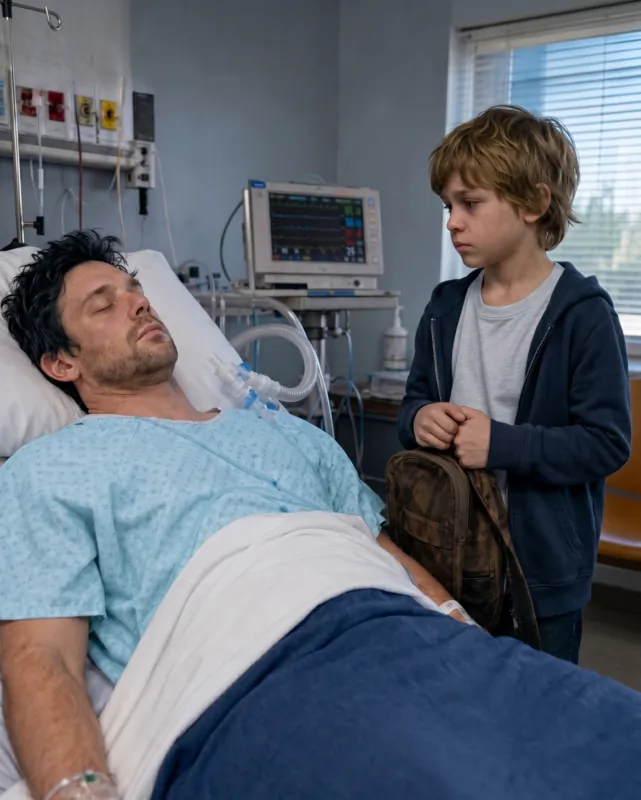
Mark had been lying in that hospital bed for fourteen days, and by then I no longer measured time in hours or minutes. I measured it by the mechanical rhythm of the ventilator breathing for him.
Hiss.
Pause.
Hiss.
Every sound in that ICU room had become part of my bloodstream. The beeping monitors. The soft shuffle of nurses changing shifts. The muted whispers outside the glass doors whenever doctors thought I couldn’t hear them.
My husband looked nothing like the man who had kissed me goodbye that morning two weeks earlier.
The car accident had destroyed almost everything.
Broken ribs. Internal bleeding. Severe trauma to the head.
And now… silence.
A silence so unbearable it felt alive.
I sat beside him every day with my fingers wrapped around his cold hand, praying for the smallest movement.
“Come back to me,” I whispered over and over again until the words lost all meaning. “Please, Mark… just open your eyes.”
But he never did.
Not once.
Our eight-year-old son, Leo, barely spoke anymore either.
He spent most of his time sitting in the corner beside the window, hugging a faded blue backpack against his chest like it contained the last thing keeping him alive. He wouldn’t let anyone touch it. Not me. Not the nurses. Not even his grandmother.
At the time, I thought grief had simply made him clingy.
I had no idea that whatever was hidden inside that bag would change everything.
—
Mark’s mother, Diane, coped with fear by talking nonstop.
One moment she insisted miracles happened every day.
The next, she quietly brought up “acceptance” and “letting him rest.”
I hated those conversations.
Because deep down, I knew why they were happening.
The doctors were losing hope.
And maybe… part of me was too.
On the afternoon of the fourteenth day, the neurologist asked if he could speak with me privately.
The moment I saw his face, my stomach dropped.
He led me into a small consultation room with gray walls and no windows. It smelled like coffee and disinfectant.
That was where he finally said the words I had been dreading since the accident.
“I’m sorry,” he said gently. “The swelling in his brain hasn’t improved. We’re not seeing meaningful neurological activity anymore.”
I stared at him, unable to breathe.
“No…” I whispered. “There has to be something else we can do.”
He hesitated before answering.
“At this stage, continuing life support may only be prolonging the inevitable.”
The inevitable.
Such a cruel, clinical word for the destruction of a family.
I looked down at my trembling hands.
“But there’s still a chance… right?”
The doctor didn’t answer immediately, and somehow that silence hurt more than any sentence could have.
Finally, he sighed softly.
“I think it may be time to consider letting him go.”
The room tilted around me.
I nodded because I didn’t know what else to do.
“I’ll… think about it.”
When I walked back into Mark’s room, Diane immediately knew.
She squeezed my hand tightly.
“You have to think about Leo,” she whispered. “Mark wouldn’t want his son remembering him like this.”
That sentence nearly broke me.
Because she wasn’t wrong.
But I also couldn’t imagine being the person who signed the paper that ended my husband’s life.
So instead, I delayed.
I listened while they discussed timelines and procedures and what would happen “when the family was ready.”
As if anyone could ever be ready for that.
—
That night, the hospital room was dim except for the pale blue glow of the machines.
I sat beside Mark, exhausted beyond words, when Leo finally climbed down from his chair and walked slowly to the bed.
He leaned close to his father’s ear.
“Daddy,” he whispered softly, “don’t worry. I still haven’t told Mommy the secret.”
A cold shiver crawled down my spine.
Leo had barely spoken for days.
I turned toward him immediately.
“Leo?” I said carefully. “What secret?”
His entire body jerked like I had caught him doing something wrong.
“Nothing.”
“Sweetheart—”
“It’s a secret, Mommy.” He hugged the backpack tighter. “I can’t tell.”
I should have pushed harder.
I know that now.
But grief does strange things to the brain. It drains your energy until even simple conversations feel impossible.
Before I could ask again, someone appeared at the doorway.
Caleb.
Our night nurse.
He had spent most of the week caring for Mark, and unlike many others in the hospital, he treated Leo gently instead of speaking around him like he wasn’t there.
Caleb glanced at me while holding Mark’s chart.
“Do you need anything before I change his fluids?”
I rubbed my eyes tiredly.
“No… thank you. I just need a minute outside.”
He nodded quietly and walked toward the machines while I stepped into the hallway trying not to fall apart.
—
The next morning, they brought me the DNR paperwork.
Do Not Resuscitate.
Three words that felt heavier than the entire world.
My hands shook so violently I could barely hold the pen.
“He likely won’t survive the night,” the doctor said softly.
Likely.
Another careful word designed to sound gentle while destroying someone’s soul.
I signed anyway.
The second the pen left the paper, I felt like I had betrayed my husband.
Not long afterward, the room slowly filled with people preparing to say goodbye.
Nurses stood quietly near the walls.
Diane cried into tissues.
The doctor explained the process in a calm voice I hated.
“When you’re ready,” he said, “we’ll begin withdrawing support.”
I knelt in front of Leo.
“It’s time to say goodbye to Daddy.”
His bottom lip trembled, but he still didn’t cry.
“Be strong,” Diane whispered, rubbing his shoulder.
The doctor stepped toward the ventilator.
And suddenly Leo screamed.
“No!”

Everyone froze.
The doctor looked startled as Leo grabbed his wrist with both hands.
“It’s okay,” the doctor said carefully. “Children often react this way—”
“No!” Leo shouted again, tears finally spilling down his face. “I know what to do!”
My heart pounded.
“Leo, baby—”
But he pulled away from me.
Before anyone could stop him, he dropped to the floor and yanked open his backpack.
A nurse stepped forward nervously.
“Honey, you can’t—”
But Leo had already pulled something out.
A black rectangular recorder.
Heavy enough that he needed both hands to hold it.
I stared at it in confusion.
“Leo… where did you get that?”
His face crumpled.
“Dad and I made it,” he whispered. “A man told me it could wake Dad up.”
The room changed instantly.
The grief.
The resignation.
The hopelessness.
All of it shifted into confusion and alarm.
“What man?” I demanded.
Leo turned slowly and pointed toward the doorway.
Caleb stood there wearing his jacket, as if he had just finished his shift.
Diane spun toward him furiously.
“You told him this?”
The doctor stiffened.
“Nurse Caleb,” he said sharply, “explain yourself.”
But Caleb didn’t look at him.
He looked at me.
“Last night I overheard Leo talking to Mark,” he said quietly. “And I noticed something strange.”
“What?”
“Mark’s heart rate changed when Leo spoke.”
The doctor frowned immediately.
“That doesn’t prove awareness.”
“No,” Caleb agreed calmly. “But it happened again this morning. And before we remove support… I think she deserves to see it herself.”
The room fell silent.
Leo walked slowly to the bed.
Then he pressed play.
For a moment, there was only static.
Then—
Mark’s voice filled the room.
“Okay, buddy… is it on?”
My knees nearly gave out beneath me.
I hadn’t heard his voice in two weeks.
Not the cold mechanical sounds of machines.
Not memories inside my head.
His actual voice.
Warm.
Alive.
Real.
Leo’s smaller voice answered proudly through the recorder.
“It’s on, Dad. Say it!”
Then Mark laughed softly.
“Hi, Annie. If Leo kept the surprise like we practiced… then happy anniversary.”
I covered my mouth as tears exploded from my eyes.
Leo held the recorder tightly while his father’s voice continued.
“I know I’ve been working too much lately. I keep promising it’s temporary. But you never complain. You make this family feel safe… and I don’t tell you enough how much I see that.”
A sob escaped my throat.
Even the nurses were crying now.
Mark’s voice softened further.
“This year I’m making two promises. First, I’m finally taking you back to that little place by the lake… the one with the terrible pie you pretend to love.”
A few shaky laughs broke through the tears.
“And second… I’m taking Leo fishing. No phones. No work. Just worms, bad sandwiches, and my brave boy telling me I’m doing everything wrong.”
Leo’s recorded laughter echoed through the room.
“You always do it wrong!”
Then Mark’s tone changed.
Quieter now.
More serious.
“And Annie… if I ever forget to say it… remember our code.”
My entire body froze.
Three squeezes.
Back when we were young and broke and terrified of life, we created that habit for moments words couldn’t reach.
Three squeezes meant:
I’m here.
I’m yours.
We’re okay.
On the recorder, Mark whispered:
“Three squeezes means I’m here.”
Leo repeated proudly:
“Three squeezes means Dad’s here.”
And then, standing beside the hospital bed, my son leaned close to his unconscious father and whispered:
“Daddy… three squeezes means you’re here.”
A nurse suddenly looked up at the monitor.
“Wait.”
The doctor moved closer immediately.
“Hold on…”
I looked down instinctively.
And then I felt it.
The faintest movement against my palm.
Mark’s fingers twitched.
Tiny.
Weak.
Almost impossible to notice.
But it was there.
“Oh my God,” I gasped. “Mark?”
Then it happened again.
A soft pressure against my hand.
Not random.
Not reflexive.
A squeeze.
Caleb pointed toward the monitor.
“There,” he said quietly. “That’s what I saw.”
The doctor’s entire expression changed.
“Stop the withdrawal process immediately,” he barked. “Call neurology. I want another assessment now.”
Diane burst into tears.
“But you said there was no brain activity!”
The doctor looked shaken himself.
“I said we weren’t seeing meaningful response,” he corrected. “Now we are.”
I turned toward Caleb in disbelief.
“You suspected this?”
He nodded slowly.
“I documented every change. But I didn’t know about the recording.”
I collapsed to my knees in front of Leo.
“And you kept this secret because Daddy told you to?”
Leo nodded miserably.
“He said it had to be a surprise.”
I pulled him into my arms so tightly he squeaked.
“You didn’t ruin anything,” I cried. “You saved him.”

Behind us, Diane whispered weakly:
“What if this still means nothing?”
Something inside me snapped.
For two weeks I had listened to everyone else decide how much hope I was allowed to have.
Doctors.
Statistics.
Family.
Fear.
I stood up slowly and looked directly at her.
“Hope hurts,” I said through tears. “But I would rather fight for him than spend the rest of my life wondering if we gave up too soon.”
Then I grabbed the clipboard.
Pulled out the DNR form.
And tore it straight down the middle.
The sound echoed through the room.
“No one talks about removing support again,” I said, “until every single test is repeated—with Leo’s voice in that room.”
The doctor nodded immediately.
Nurses rushed around us making calls and adjusting machines.
But all I could focus on was my husband and my son.
Leo climbed carefully onto the chair beside the bed while I helped place his tiny hand into Mark’s.
“Say it again,” I whispered.
Leo leaned close, tears streaming down his face.
“Three squeezes means you’re here, Daddy.”
For one terrifying second, nothing happened.
Then Mark’s thumb pressed gently against Leo’s fingers.
Another squeeze.
Weak.
Fragile.
But real.
I bent over both of them sobbing uncontrollably, holding onto their hands like I could physically pull Mark back into the world through love alone.
“I hear you,” I whispered through tears. “We both hear you.”
The room stayed completely silent after that.
Even the machines seemed quieter somehow.
When I finally looked up, doctors were already shouting new orders while nurses rushed in and out of the room.
Diane sat collapsed in her chair, crying into her hands.
Caleb stood silently near the foot of the bed, watching everything unfold.
And me?
I kept one hand wrapped around my son.
And the other around my husband.
Because when the entire world had started giving up…
An eight-year-old boy refused to let go.
And somehow, somewhere deep inside the darkness, his father found a way to answer him back.
Note: This story is a work of fiction inspired by real events. Names, characters, and details have been altered. Any resemblance is coincidental. The author and publisher disclaim accuracy, liability, and responsibility for interpretations or reliance. All images are for illustration purposes only.