
Part 1: The Passbook and the Funeral
“That little book is worthless. Let it rot with the old woman.”
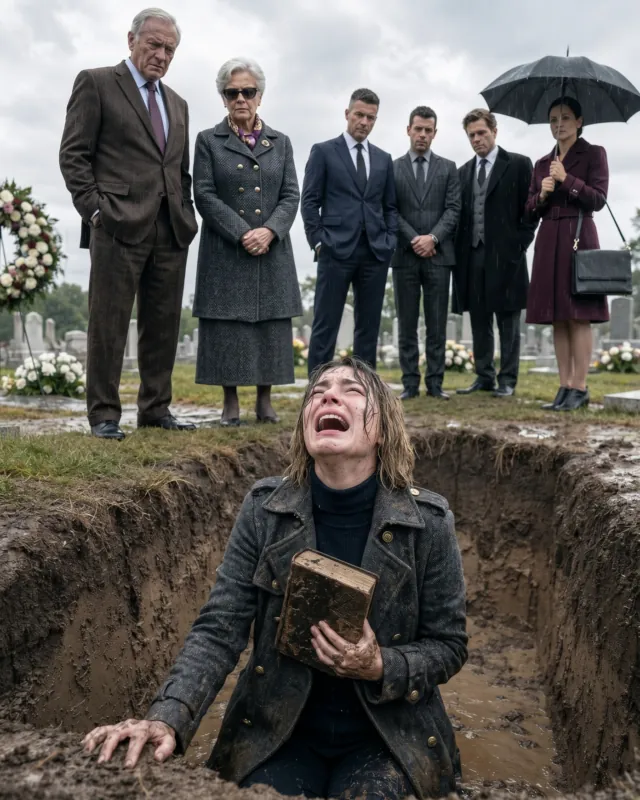
The words hit me first, sharp and cold, as my father flung my grandmother’s faded blue savings passbook onto her open casket.
The rain pelted down relentlessly, turning the freshly dug grave into a quagmire of mud and despair. Seconds later, the coffin sank slowly into the damp earth, the sound of the soil hitting wood echoing in the silence of the cemetery.
No one spoke.
Not my uncles, not my cousins, not even the priest whose soaked robes clung to him as he tried to keep a solemn composure beneath the heavy funeral tent.
Every eye seemed to fixate on the muddy blue booklet lying atop my grandmother’s coffin, as if it were mere trash instead of the deliberate, carefully hidden inheritance Eleanor Hayes had left for me.
I was twenty-seven, draped in borrowed black funeral attire that felt stiff and unfamiliar, my fingers so numb from the chill I barely felt them.
Across the grave, Richard Hayes — my father — adjusted his black gloves and sneered, that familiar contemptuous smile from my childhood creeping across his face.
“There’s your inheritance, Claire,” he mocked.
“No house, no money, no land. Just a worn-out bankbook your grandmother thought she could hide secrets in.”
Behind him, my stepmother, Denise Hayes, smirked under oversized black sunglasses, her voice a soft whisper only I could hear.
“Poor thing,” she said.
“She really thought Grandma was hiding a treasure somewhere.”
My half-brother Tyler leaned toward me with a boyish grin, eyes glinting with mockery.
“If there’s twenty bucks inside,” he whispered, “you’re buying burgers.”
A few cousins chuckled, their laughter ringing hollow.
I didn’t.
Not even Arthur Bennett, who stood at the edge of the tent, unusually pale after having read my grandmother’s will less than half an hour ago.
“To my granddaughter, Claire Hayes,” he had read aloud with a solemn voice, “I leave my savings book and all legal rights attached to it.”
My father had received nothing. That was why he looked so furious, so desperate to assert control in these final moments.
My grandmother had been my mother after my own mother died in a car crash when I was five.
Eleanor taught me how to stretch grocery money, how to read contracts and examine signatures carefully, how to stare down anyone who attempted to intimidate me.
One week before she passed, her frail hand clutched mine in the hospital room. Her voice, weak yet resolute, whispered:
“When they laugh, let them. Then go to the bank.”
I hadn’t understood then. Standing there, watching the muddy passbook settle on her coffin, I felt a tremor inside me — part fear, part anticipation, part the spark of something fierce and unstoppable.
I stepped forward. My father’s hand shot out.
“Don’t you dare.”
I met his gaze. Cold, resolute.
“Let go,” I said.
“Don’t embarrass yourself, Claire. Don’t make a scene.”
“You’ve already made one for me,” I shot back, my voice low, heavy with years of resentment.
Silence fell, heavier than the rain drumming over the cemetery tent.
Carefully, I descended to the edge of the grave, my boots sinking slightly in the wet mud. I picked up the passbook with both hands, feeling its weight — faint, damp, yet significant. The scent of earth, rainwater, and aging paper filled my senses. I pressed it against my chest.
“It belonged to her,” I murmured. “Now it belongs to me.”
My father stepped closer, his whiskey breath sharp against my cheek.
“Your grandmother couldn’t even save her own house,” he sneered.

“And you think she saved anything for you?”
Something inside me hardened.
Something ignited.
I slipped the passbook into my purse and started walking toward the rusted cemetery gates.
Tyler stepped in my path.
“Where are you going?” he asked, a mix of curiosity and mockery.
I looked past the gates, to the rainy streets of Chicago stretching endlessly.
“To the bank,” I replied, unflinching.
They laughed. My father laughed the loudest.
But Arthur Bennett didn’t laugh. His gaze lingered on me as though he had just witnessed someone strike a match in a room full of gasoline.
An hour later, soaked and shivering from the storm, I entered a downtown branch of Chase Bank.
My grandmother’s passbook rested in my palm.
I approached the counter.
Her hands trembled as she picked up the phone.
“Call the police,” she whispered urgently to a colleague. “Lock the doors. She cannot leave.”
The floor seemed to shift beneath me.
My heart pounded.
I had no idea that moment would change everything I thought I knew about my life and my family.
Part 2: The Account My Father Tried to Erase
“Why did you call the police?” I asked, leaning slightly over the counter, staring at the passbook. “Did I do something wrong?”
Linda stepped back, lowering her voice to a cautious whisper.
“No, Miss Hayes. This account has very specific legal instructions attached to it.”
“What kind of instructions?”
Before she could answer, the branch manager appeared.
Diane Porter led me into a small office enclosed with frosted glass walls, closing the door behind us. She carefully placed the passbook onto the desk, her gestures precise, almost reverent, as though it were a dangerous relic rather than a simple bank document.
“Your grandmother opened this account when you were a child,” Diane explained quietly.
“She left written orders: if the original passbook ever appeared in person, the bank was instructed to verify the owner’s identity, immediately notify law enforcement, and secure all related records.”
A chill ran down my spine.
“Protect them from who?” I asked softly.
Diane didn’t answer, but I didn’t need her to.
“My father,” I whispered, the words barely audible. The room seemed to confirm it.
I swallowed hard.
“What exactly did he do?” I asked.
Diane inhaled slowly. “Your father tried to close this account three times over the years.
The first time, he presented a death certificate for Claire Madison Hayes.”
I gasped. “That’s impossible. I was alive.”
“You were thirteen,” Diane continued.
“The certificate was forged. Your grandmother returned to the bank the next day with you in tow, crying. She demanded that nothing related to the account be released without your physical presence.”
Memories hit me instantly. Grandma gripping my hand inside the bank lobby.
A teller handing me a cherry lollipop. My grandmother crying quietly on the bus afterward, whispering that it was “just allergies.”
He had tried to erase me while I was still alive.
Before I could fully process this, the office door opened.
Two detectives entered. One, Vanessa Reed, introduced herself with calm authority.
She reassured me I wasn’t under arrest.
“The alert triggered when the passbook was presented is a protection measure,” she said. “It’s designed to protect you.”
Arthur Bennett entered next, dripping from the rain, clutching a yellow envelope to his chest.
“Your grandmother instructed me to give this to you only if you came here alone,” he said.
I snatched it from his hands. Inside lay a tiny brass key and a handwritten letter in my grandmother’s meticulous script:
My sweet girl,
If you are reading this, you were braver than they expected.
That passbook is not money. It is a door.
Your father stole what your mother left behind.
He spent years convincing you nothing belonged to you. Do not believe him.
Tears pricked my eyes. Diane led us downstairs to the bank vault.
Safety deposit box 117. Two keys opened it: mine and the bank’s. Inside were no jewels, no cash, only envelopes.
The first envelope: FOR CLAIRE — FINANCIAL RECORDS. Trust agreements, insurance documents, property papers, and account summaries.
At the bottom, a number too large to believe: $4,800,000. My mother had built wealth, hidden and protected by my grandmother from my father’s greed.
The second envelope: THE HOUSE. My childhood home in Oak Park, white brick, blue shutters, lilac bushes. My father had sold it fraudulently.
The documents proved it legally belonged to me, protected in a trust by my mother and grandmother. My father and Denise Hayes had conspired, forging signatures, using shell companies.
Suddenly, a pounding at the doors.
Shouting.
My father.
Denise.
Tyler filming everything on his phone.
“Open up!” my father screamed. “She’s stealing family property!”
Detective Reed remained calm. “Richard Hayes, you need to come with us.”
Denise tried to escape; an officer intercepted her.
Tyler lowered his phone, the laughter gone.
The final envelope: FOR LAW ENFORCEMENT — MADISON FILE. Photos, invoices, handwritten notes, a flash drive.
Detective Reed opened it carefully.
“Claire,” she said, gravely, “this may change everything you thought about your mother’s death.”
Outside, my father screamed my name from the back of the police car, futile, defeated.
Part 3: The Truth My Grandmother Refused to Bury

The flash drive contained recordings.
The first audio: my grandmother in her kitchen years ago.
“I know about the accounts, Richard,” she said softly. “And I know you tried declaring Claire dead.”
“You can’t prove anything, old woman,” he replied coldly.
“I also know Madison wanted to leave you.”
Silence.
His voice low, dangerous. “Some women learn too late what happens when they try.”
My lungs froze.
My mother hadn’t died entirely by accident.
The investigation reopened.
Payments to a mechanic weeks before the crash, altered repair reports, hidden photos of damaged brake lines, shell company transfers tied to Denise’s family.
The mechanic eventually confessed: my father paid him to sabotage my mother’s car to prevent her from leaving.
Vanessa Reed explained it all to me.
I didn’t cry immediately. I stared at the muddy passbook, the same one thrown into the grave.
Justice was slow.
Months of hearings, audits, lawyers.
Relatives insisted on secrecy. But the evidence was irrefutable.
Arthur Bennett confirmed the house sale was illegal.
Tyler eventually testified, revealing that he mocked me to gain our father’s approval:
“My dad hated Claire,” he whispered. “Because she looked exactly like Madison.”
The courtroom listened to all recordings.
The final one: my grandmother confronting my father.
“Why, Richard?”
“Because she was taking what belonged to me.”
“Madison wasn’t yours.”
“She wasn’t going to belong to her either.”
“Did you cut the brakes?”
Silence. His answer: “She chose to drive.”
Nobody breathed.
Richard Hayes was convicted of fraud, forgery, financial exploitation, and second-degree murder.
Denise went to prison for conspiracy; her brother too.
I held the blue passbook in court.
“My father said it was worthless,” I told the judge.
“But this passbook protected my grandmother’s courage, my mother’s love, and the truth.”
Months later, my Oak Park house returned to me.
Faded paint, overgrown garden, but the pencil marks on the wall — my growth marks, my mother’s notes — restored memories and ownership.
I founded the Eleanor & Madison Hayes Foundation to help women and children escaping abuse.
The first woman, Rachel Simmons, arrived carrying a baby and a hidden bruise. I handed her a folder.
“You never need to apologize for surviving,” I said.
The passbook was framed, dirt stain untouched, a symbol of courage and inheritance. My grandmother’s final words engraved beneath:
When they laugh, let them. Then go to the bank.
The lesson: what is protected with love may be hidden for years — but once it reaches the light, no lie can bury it.
Note: This story is a work of fiction inspired by real events. Names, characters, and details have been altered. Any resemblance is coincidental. The author and publisher disclaim accuracy, liability, and responsibility for interpretations or reliance. All images are for illustration purposes only.