
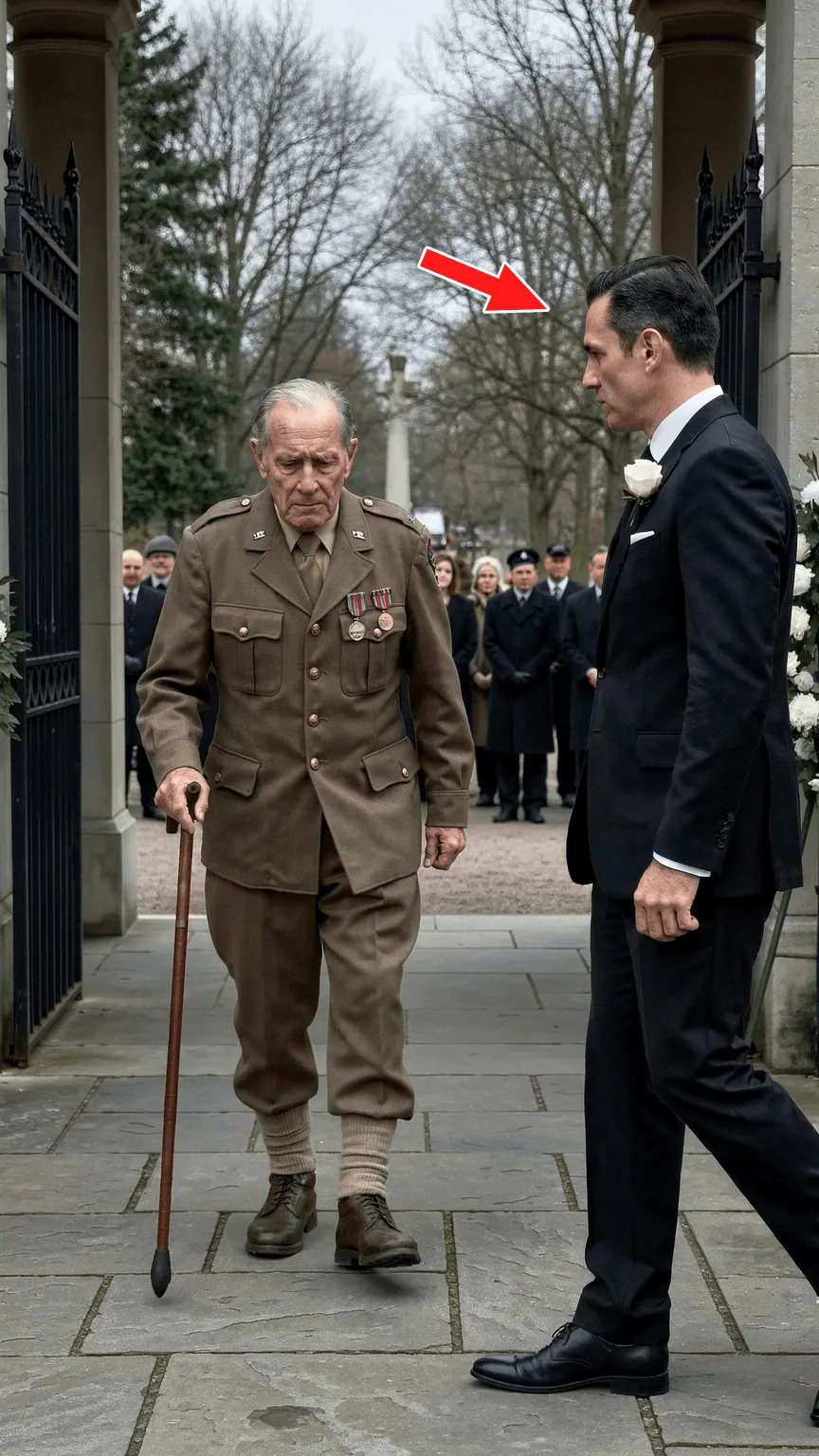
The Gatekeeper at the Entrance
An elderly man in a faded, olive-drab military uniform shuffles across the stone walkway, his wooden cane clicking against the pavement with every measured step. He approaches a set of iron gates where a man in a sharp black suit and a white rose pinned to his lapel stands blocking the path. The man in the suit raises a flat palm toward the veteran, halting his progress before he can reach the funeral gathering.
The man in the suit speaks, his voice firm and clipped. He tells the veteran that the ceremony is reserved only for family and invited guests. He keeps his shoulders squared, his gaze fixed level with the veteran’s eyes. He does not step aside, effectively pinning the older man to the pavement outside the gate.
A Claim of Shared History
The veteran grips the handle of his cane tighter, his knuckles whitening against the dark wood. He speaks slowly, his voice raspy but steady, stating that he served alongside the man’s father. The man in the suit stiffens. His jaw muscles jump, and he shakes his head sharply, cutting the veteran off. He declares that his father did not fight alongside men who look as forgotten as the veteran standing before him.
The man in the suit gestures toward the entrance, his finger pointing firmly away from the event. He tells the veteran to leave before he makes the funeral look like a charity line. The veteran remains silent for a moment, his gaze shifting downward to the medals pinned to his chest. He repeats that he only came to say goodbye. The man in the suit dismisses him again, telling him he arrived too late for his presence to matter and that his father would not have wanted him there.
The Power of a Written Word
The veteran’s eyes remain locked on the man in the suit. He reaches into his jacket pocket and pulls out a single, folded sheet of paper. He holds it out toward the man. The man in the suit hesitates, then snatches the paper from the veteran’s hand. He unfolds it, his eyes scanning the lines of text. As he reads, the muscles in his face slacken and his grip on the paper loosens.
The man in the suit looks up from the paper, his expression shifting as he processes the words. He reads the letter aloud to the gathering, his voice trembling slightly. The letter states that before anyone else speaks, the man who saved the father’s life must stand by the coffin. The man in the suit turns back to the veteran, the paper shaking in his hand. He realizes he has been barring the very person his father requested to be present.
A Change in Course
The man in the suit steps back and extends a hand, inviting the veteran to move forward. He tells him that his seat is waiting at the front of the gathering. The man in the suit lowers his chin and speaks in a low, somber tone, admitting that he was wrong. He offers the paper back to the veteran, his movements slower and more deliberate than before. The veteran accepts the paper, placing it carefully inside his coat.
They begin to walk together along the path. The man in the suit keeps his pace matched to the older man’s slow, deliberate gait. He looks down at the ground, his eyes avoiding the gaze of the guests lining the path. The veteran walks steadily past the rows of chairs, his head held high and his back straightened. He walks past the gates and toward the front of the service, leaving the entrance behind.
Share this with someone who needs to be reminded that you cannot judge a person by their appearance. Everyone has a story worth hearing.