
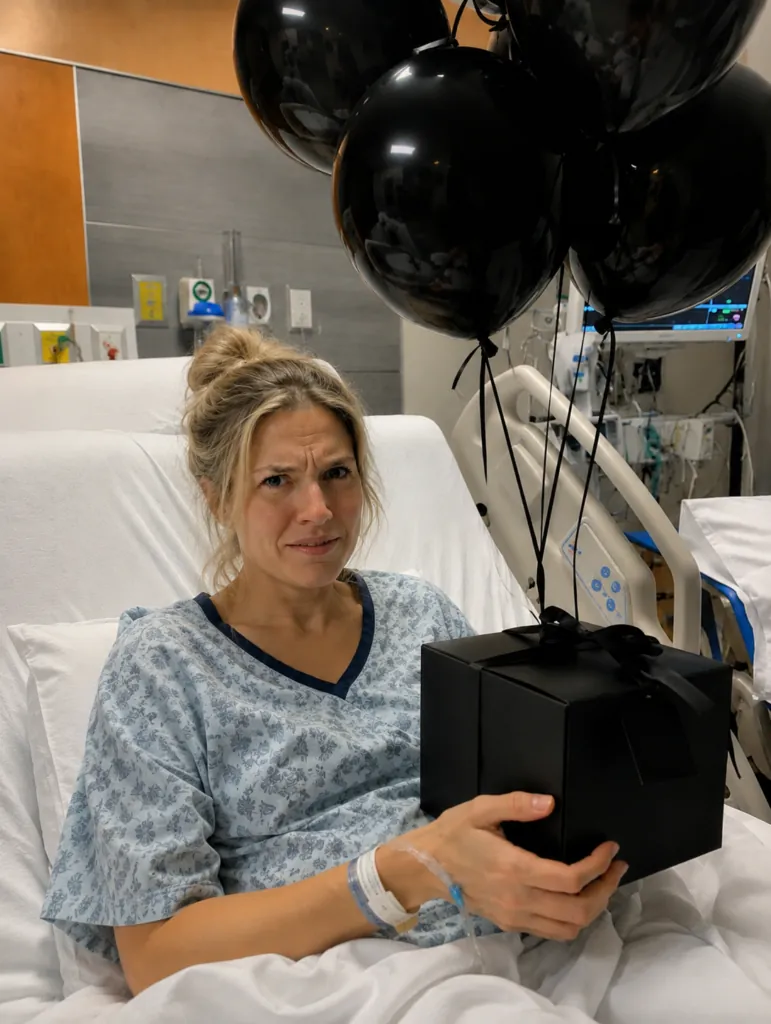

The morning after I gave birth to my daughter, I was learning that joy and heartbreak could exist inside the same heartbeat.
One moment I was staring at the tiniest face I had ever seen, amazed that she was finally here.
The next, I was fighting back tears because the one person who had dreamed about this moment even more than I had would never get to see it.
Then a nurse walked into my hospital room carrying a bouquet of glossy black balloons.
Every conversation stopped.
Every smile disappeared.
And when I saw the small black gift box hanging beneath those balloons, I felt my stomach twist with fear.
I had no idea that inside that box was the final promise my husband had made before he died.
A promise that would stay with me—and with our daughter—for the rest of our lives.
It all began nearly a year earlier.
The morning I discovered I was pregnant was the happiest morning of our marriage.
It was barely six o’clock.
The sun hadn’t fully risen yet, and our little kitchen was still wrapped in that sleepy blue light that comes just before dawn.
I stood barefoot on the cold tile floor, staring at the pregnancy test in my trembling hands.
Two bright pink lines.
I blinked several times.
Then looked again.
Surely my exhausted eyes were playing tricks on me.
“Steve?” I called quietly.
From the bedroom I heard his sleepy voice.
“What happened?”
“I… I think you need to come here.”
A few seconds later he shuffled into the kitchen wearing old plaid pajama pants and one of my oversized sweatshirts he’d stolen years earlier because he claimed it was “luckier” than any of his own clothes.
His hair pointed in every direction.
He rubbed one eye.
“You look like someone just told you aliens landed.”
“I don’t know what this means.”
I handed him the test.
He frowned.
Held it closer to the window.
Turned it sideways as though changing the angle would somehow change reality.
For nearly five full seconds he didn’t say a word.
Then his eyes became impossibly wide.
“Oh…”
He looked at me.
Then back at the test.
Then at me again.
“Oh my God.”
His voice cracked.
He laughed.
Then immediately started crying.
“No…”
He shook his head.
“No way.”
I couldn’t help laughing.
“What?”
“We’re…”
He pointed helplessly toward my stomach.
“We’re having a baby?”
“I think so.”
“You think so?”
He grabbed another unopened pregnancy test from the box.
“No. Absolutely not. We need another one.”
I blinked.
“Steve…”
“I refuse to trust a single plastic stick with news this important.”
He waved the first test dramatically.
“It looks smug.”
“It looks… smug?”
“It knows something.”
I burst into laughter.
“You’ve officially lost your mind.”
“Probably.”
He grinned through tears.
“But we’re confirming it.”
And then a third…
The bathroom counter looked like we’d opened a tiny diagnostic laboratory.
Three positive results.
Three undeniable answers.
Steve leaned against the wall, covering his face with both hands.
When he finally lowered them, tears streamed freely down his cheeks.
“I can’t believe this.”
Neither could I.
He crossed the room in two quick steps, cupped my face with both hands, and kissed me so hard I nearly lost my balance.
When we finally pulled apart, neither of us could stop smiling.
He rested his forehead against mine.
“I already love this baby.”
“You don’t even know if it’s real yet.”
He laughed.
“Oh, she’s real.”
I raised an eyebrow.
“She?”
“I have a feeling.”
“If it’s a girl, you’re not naming her after one of your science-fiction heroes.”
His expression became dramatically offended.
“You don’t know my plans.”
“I absolutely know your plans.”
“I have many respectable names.”
“Like?”
He looked upward as though consulting invisible experts.
“…Leia.”
I stared.
He shrugged.
“What? Strong leadership skills.”
I laughed so hard my stomach hurt.
“No.”
“Ripley?”
“No.”
“Seven?”
“Steve.”
“What?”
“You’re proving my point.”
He surrendered with exaggerated disappointment.
“Fine.”
Then he knelt in front of me.
Very gently…
Almost reverently…
He rested both hands against my still-flat stomach.
“Hi, little bean.”
His smile softened into something I’d never seen before.
“I’m your dad.”
“I don’t know who you are yet.”
“But I already think you’re the greatest thing that’s ever happened to me.”
Something inside my chest melted.
That moment never left me.
Neither did the look in his eyes.
For the next several weeks our entire lives revolved around dreams.
We argued playfully over baby names.
We spent hours walking through furniture stores pretending to compare cribs when we both knew we’d already picked the first one.
Steve downloaded three pregnancy apps onto his phone.
Every Monday morning he’d announce our baby’s latest fruit comparison with ridiculous excitement.
“She’s the size of a blueberry!”
The following week…
“Now she’s a strawberry!”
Another week…
“She’s officially an avocado.”
I laughed every single time.
He talked to my stomach every evening.
Sometimes about baseball.
Sometimes about books.
Sometimes about absolutely nothing.
One night I woke up just after midnight and found him sitting alone in the nursery we’d begun preparing.
The room was only half finished.
Paint cans covered one wall.
The crib still sat inside unopened boxes.
I leaned against the doorway.
“What are you doing?”
Without embarrassment he smiled.
“Practicing.”
“For what?”
“I don’t want my first bedtime story to sound awkward.”
“You know babies don’t critique performances.”
“You don’t know that.”
He pointed toward my stomach.
“She could have very high literary standards.”
I walked over and wrapped my arms around him from behind.
He leaned into me.
“I’ve never wanted anything this much,” he whispered.
Neither had I.
For a while, life felt almost unfairly perfect.
We painted the nursery ourselves.
Steve insisted sunshine yellow would make the room feel happier.
I argued for soft sage green.
He claimed yellow built optimism.
I accused him of secretly wanting to recreate a cartoon.
We compromised.
Mostly.
There was still one bright yellow wall he proudly referred to as “the wall of hope.”
Then everything changed.
At first it was nothing.
Just headaches.
Steve blamed stress.
Too many late nights.
Too much coffee.
Not enough sleep.
I believed him because I wanted to.
A week later he started rubbing his temples almost constantly.
“You okay?”
“Just another headache.”
“You’ve had one every day.”
“I’ll survive.”
But they kept coming.
Then dizziness.
Then moments when he’d stop speaking mid-sentence because he’d forgotten what he intended to say.
One evening while washing dishes, a drinking glass slipped from his hand and shattered across the kitchen floor.
He stared at the broken pieces in confusion.
“I don’t know what happened.”
“What do you mean?”
“My hand…”
He flexed his fingers.
“It was like my brain forgot how to tell it what to do.”
A chill raced through me.
“We’re calling the doctor.”
He smiled weakly.
“You’ve become very bossy.”
“I’m pregnant.”
I folded my arms.
“My hormones have officially promoted me to Chief Executive of Worry.”
He laughed.
“Fair enough.”
But when I reached for my phone…
He gently took it from my hand.
“Tomorrow.”
“No.”
“Please.”
He kissed my forehead.
“I promise.”
I wish I’d insisted.
I wish I’d driven him to the emergency room that night.
I wish love could rewrite history.
Instead…
Tomorrow came too late.
Tomorrow never came the way we imagined it would.
The dizziness was worse.
He struggled to focus during conversations.
Sometimes he would stop halfway through a sentence, searching for a word that had always come naturally to him. Other times he would reach for something sitting right in front of him and somehow miss it entirely.
The emergency room physician ordered a series of scans.
I still remember the silence while we waited.
Hospitals have their own language.
The hurried footsteps.
The distant beeping monitors.
The forced smiles from nurses who already know more than they’re allowed to say.
Steve squeezed my hand.
“Whatever happens,” he whispered, “we’ll be okay.”
I wanted to believe him.
An hour later, a neurologist walked into the room carrying a folder that suddenly seemed far too heavy for the amount of paper inside it.
His expression told us everything before he spoke.
“There appears to be a serious abnormality in your brain.”
The room became strangely quiet.
I heard the words.
I understood none of them.
More scans followed.
More specialists.
More waiting.
The diagnosis came faster than anyone expected.
An aggressive, previously undetected brain condition had already caused significant damage. Emergency treatment began immediately, but complications appeared one after another with frightening speed.
Everything we had planned vanished overnight.
Only a week earlier we had been arguing over which stroller folded more easily.
Now I was learning medical terminology I had never wanted to know.
Every day became another race against time.
Steve tried chemotherapy.
He endured surgeries.
He smiled through treatments that left him exhausted because every time he caught me crying, he reached out to comfort me instead.
“I hate seeing you like this,” I whispered one evening while helping him sit up in his hospital bed.
He smiled despite the pain.
“I hate seeing you carrying our daughter and worrying about me.”
“You don’t have to protect me.”
“I’ll always try.”
That was who he was.
Even while his own body was failing, he worried about everyone else first.
Months passed in a blur of hospital corridors and endless uncertainty.
The nursery remained unfinished.
The yellow wall he had insisted on painting stayed covered with masking tape because he kept promising he’d finish it himself.
“I’ll get to it,” he’d say.
“You’ll see.”

At twenty-six weeks pregnant, I practically lived beside his hospital bed.
I read books aloud because he said hearing my voice made the headaches feel smaller.
Sometimes we watched old movies.
Sometimes we simply held hands in silence.
Those quiet moments became more precious than words.
One rainy afternoon he asked me to wheel him toward the hospital window.
We stood there watching drops of rain race down the glass.
“You know,” he said softly, “I’ve always loved watching storms.”
“I know.”
“If she’s anything like you…”
He smiled.
“…she’ll probably stop to watch the rain too.”
I rested my head on his shoulder.
“She’ll get that from you.”
He looked down at my stomach.
“I wish I had more time.”
The words shattered something inside me.
“You will.”
“I don’t know if I will.”
“You have to.”
“I know.”
His voice barely rose above a whisper.
“But if I don’t…”
He placed one trembling hand against my belly.
“…promise me you’ll tell her everything.”
“I will.”
“Tell her I talked to her before she was born.”
“I promise.”
“Tell her I loved her long before I ever saw her.”
Tears filled my eyes.
“I promise.”
“And don’t let her think I left because I wanted to.”
“You would never.”
He smiled sadly.
“I know.”
The last week came faster than anyone expected.
Machines slowly replaced conversations.
Visitors spoke in whispers.
Doctors avoided making promises.
Every morning I walked into his room pretending today would be different.
Every evening I left with less hope than I had brought in.
On his final afternoon, the room was quiet except for the steady rhythm of the heart monitor.
He reached for my hand.
His grip was weaker than it had ever been.
He looked at my stomach first.
Then at me.
“I love you.”
My tears began falling immediately.
“I love you too.”
“I love both of you…”
His breathing became uneven.
“…in this lifetime…”
He paused, struggling for air.
“…and the next.”
Those were the last clear words he ever spoke.
A few hours later…
He was gone.
I don’t remember leaving the hospital.
I don’t remember driving home.
I only remember unlocking the front door and standing inside our silent house while wondering how a place could still exist after the person who made it feel alive no longer did.
The nursery door was half open.
The paint roller still sat exactly where Steve had left it.
His coffee mug remained on the workbench.
His jacket still hung behind the kitchen chair.
Everything looked like he might walk back in at any moment.
He never did.
The rest of my pregnancy felt less like living and more like surviving.
People reminded me to eat because I forgot.
Friends drove me to doctor’s appointments because I wasn’t sure I trusted myself behind the wheel.
I bought diapers, bottles, tiny pajamas, and a car seat while feeling like I was watching another woman prepare for motherhood.
Sometimes I’d catch myself smiling over a tiny baby outfit.
Then guilt would hit me like a wave.
How could I feel happy when Steve wasn’t here?
Eventually I realized grief doesn’t replace love.
It simply learns to live beside it.
My parents stayed close.
Friends checked on me constantly.
Steve’s coworkers mowed the lawn, fixed broken cabinets, and quietly left casseroles on the porch.
Almost everyone wrapped me in kindness.
Almost.
Steve’s mother, Eileen, seemed to become someone I barely recognized.
At first she simply withdrew.
She stopped returning calls.
She ignored messages.
When we finally spoke, her voice had become colder than winter.
“I still can’t understand how none of you noticed he was that sick.”
The accusation stunned me.
“We didn’t know.”
“You were his wife.”
“I tried to get him to the doctor.”
“But you didn’t.”
Every conversation ended the same way.
Another accusation.
Another cruel suggestion.
Another reminder that, somehow, she had decided I carried the blame for a tragedy neither of us could stop.
“You had time for every prenatal appointment.”
Her voice was sharp.
“But somehow not enough time to save my son.”
The words sliced straight through me.
“I lost him too.”
Silence.
Then she hung up.
At Steve’s funeral she barely acknowledged me.
When our eyes met across the chapel, there was no shared grief.
Only judgment.
Only anger.
As though mourning itself had become evidence against me.
After that day, I stopped trying.
I no longer had the strength to defend myself.
I was exhausted.
Heartbroken.
Eight months pregnant.
Every ounce of energy belonged to the little girl still growing inside me.
Three weeks after the funeral, labor began unexpectedly.
I reached for my phone while contractions grew closer together.
Part of me—despite everything—still hoped Eileen would come.
This was Steve’s daughter.
His only child.
His last living piece left behind.
Maybe seeing her granddaughter would melt whatever bitterness grief had hardened inside her.
Maybe we’d finally remember we were mourning the same man.
I called.
No answer.
I left a message.
Nothing.
Hours passed.
My daughter entered the world surrounded by nurses, doctors, and my parents.
But her grandmother never came.
Not during labor.
Not after delivery.
Not even a simple text asking whether the baby was healthy.
If Eileen wanted nothing to do with us…
I couldn’t force her to love the child her son had already loved with his whole heart.
I looked down at my sleeping daughter.
She had Steve’s tiny smile already.
That same gentle curve at the corners of her mouth.
The sight filled my chest with equal parts joy and unbearable sorrow.
I brushed one finger across her tiny hand.
“You look just like your daddy,” I whispered.
A tear slipped onto the blanket.
Then another.
I wasn’t crying because I regretted anything.
I was crying because happiness after loss has sharp edges.
Every beautiful moment reminds you of the person who should have been standing beside you to witness it.
A soft knock interrupted my thoughts.
“Come in,” I called quietly.
The hospital door opened.
A nurse stepped inside.
In one hand she carried a bouquet of glossy black balloons.
In the other was a small black gift box tied with a dark blue ribbon.
The entire room seemed to freeze.
Black balloons.

In a maternity ward.
Nothing about them made sense.
My heartbeat instantly quickened.
After everything that had happened with Eileen…
My mind rushed toward the worst possibilities.
The nurse hesitated after noticing my expression.
“These were just delivered for you,” she said gently. “Would you like me to take them back if they’re upsetting?”
I opened my mouth to say yes.
Then something caught my attention.
The ribbon wasn’t black.
It was deep navy blue.
And suddenly, Steve’s voice echoed inside my mind.
“People always think black means sadness.”
He had laughed when he said it years earlier.
“But black is elegant.”
“It goes with everything.”
“If we ever have a daughter, I’m buying her the tiniest black baby shoes I can find.”
My throat tightened.
I stared at those balloons for several long seconds.
Then I whispered,
“No…”
I swallowed hard.
“They belong here.”
The nurse smiled softly before placing the gift on the tray table beside my bed.
She quietly left the room.
I looked from the balloons…
…to my sleeping daughter…
…then to the white envelope taped carefully to the top of the box.
My hands began to tremble as I slowly reached for it.
My fingers trembled so badly that I nearly dropped the envelope before I even opened it.
For several seconds, I simply stared at my own name written across the front.
Shirley.
I knew that handwriting.
Even before I unfolded the paper, I knew.
Steve had always leaned slightly to the right when he wrote, as though every sentence was in a hurry to reach the next one.
The sight of those familiar letters stole the air from my lungs.
I unfolded the page.
The first line shattered me.
“Shirley,”
“If you’re reading this, then two things are true.”
“First, I’m deeply sorry I couldn’t stay.”
“Second, our little girl arrived safely… and so did you.”
“Good.”
“I was counting on you.”
My vision blurred instantly.
Tears spilled onto the page before I could wipe them away.
I pressed my lips together, trying to steady my breathing.
It felt impossible.
Every word sounded exactly like him.
Warm.
Calm.
Gentle.
Even now, after death had stolen his voice from this world, I could still hear him speaking inside my mind.
I continued reading.
“Black balloons were non-negotiable.”
“You know I would never celebrate my daughter with pastel balloons.”
“Besides… I wanted everyone else to be confused before you smiled.”
A broken laugh escaped through my tears.
Even now…
He was making jokes.
Even now…
He was trying to make me laugh first.
“Inside this box is everything I could think of that would let me keep showing up, even if I couldn’t physically be there.”
I lowered the letter for a moment.
My heart pounded against my ribs.
Slowly…
I untied the dark blue ribbon.
Inside the box, resting neatly on white tissue paper, was the very first thing Steve had ever promised our daughter.
A tiny pair of black baby shoes.
No bigger than my palm.
Perfectly polished.
Perfectly ridiculous.
Exactly the sort of thing only Steve would have insisted on buying.
A sob escaped before I could stop it.
I pressed one hand over my mouth.
“You actually did it,” I whispered.
“You really found them.”
Beneath the shoes sat a framed photograph.
Steve stood in the half-finished nursery, holding a stuffed giraffe with an expression so serious it looked like he was announcing national policy.
On the back he’d written:
“For Ivy’s room.”
“Your dad had excellent taste.”
I laughed again through tears.
The nurse passing in the hallway glanced inside the room.
She smiled quietly before pulling the door closed to give me privacy.
I reached deeper into the box.
This time my fingers found a small flash drive.
A white label covered the front.
FOR IVY
Birthday Videos — Ages 1 Through 20
I stared at it in disbelief.
Twenty birthdays.
Twenty years.
He had recorded twenty separate messages.
My husband had known.
He had known he would miss every birthday.
Every first day of school.
Every Christmas morning.
Every graduation.
And instead of surrendering to despair…
He had spent the little strength he had left preparing to stay in our daughter’s life anyway.
I was shaking.
Underneath the flash drive rested a thick stack of sealed envelopes.
Each one carried the same careful handwriting.
For Ivy — Age One.
For Ivy — Age Five.
For Ivy — Age Ten.
For Ivy — Age Sixteen.
For Ivy — Age Twenty.
Letter after letter.
Birthday after birthday.
Milestone after milestone.
He had imagined conversations with a daughter he would never meet.
He had written advice she would receive years after he was gone.
My chest ached so deeply it felt impossible to breathe.
At the bottom of the box rested a leather folder.
Inside were legal documents.
Life insurance policies.
Investment accounts.
Trust agreements.
Property transfers.
A letter from his attorney explained everything.
The moment Steve understood his illness might take his life, he had quietly reorganized every part of our financial future.
The house.
Our savings.
Retirement accounts.
Insurance.
Everything had been transferred into protections that ensured Ivy and I would never have to worry about losing our home or our security.
I stared at the paperwork.
Then laughed through tears.
Of course he had.
While I had been spending every waking hour trying to save his life…
He had been spending every ounce of strength preparing ours.
There was one final envelope.
It rested alone beneath everything else.
Across the front he had written:
For Shirley.
Open Last.
My hands shook so violently that I accidentally tore one side while opening it.
Inside was another letter.
Longer than the first.
“My love,”
“I know exactly what you’re trying to do.”
“You’re surviving by making lists.”
“You’re pretending to be practical because practical feels safer than broken.”
“You’ll remember to drink water because I kept reminding you.”
“You’ll convince yourself there’s no time to fall apart because there’s a baby depending on you.”
I stopped reading.
He knew me too well.
Even now.
Even after everything.
He still understood me better than anyone else ever had.
I looked over at Ivy sleeping peacefully beside my bed.
“Your daddy always knew exactly what I was thinking,” I whispered.
Then I returned to the letter.
“Listen carefully.”
“You are allowed to fall apart.”
“You are allowed to be angry.”
“You are allowed to hate what happened.”
“You are even allowed to hate me sometimes, even though leaving wasn’t my choice.”
“Most importantly…”
“You are allowed to laugh again.”
“The day you laugh without guilt won’t mean you’ve stopped loving me.”
“It will mean love did exactly what it was supposed to do.”
Fresh tears blurred every line.
“Please don’t turn our daughter into a memorial.”
“Let her climb trees.”
“Let her wear clothes that don’t match.”
“Let her scrape her knees.”
“Let her sing loudly even when she’s completely off-key.”
“Tell her I spoke to her every night while you slept.”
“Tell her I loved her before I knew what color her eyes would be.”
“Tell her I cried standing inside a hardware store while buying screws for her crib because I suddenly realized I was going to be somebody’s dad.”
I couldn’t stop crying.
Every sentence made him feel alive again.
Every memory hurt.
Every memory healed.
Then I reached the final page.
The final paragraph.
“There’s one more thing I need you to know.”
“When my illness became serious, my mother began blaming you.”
“She thought I didn’t notice.”
“I noticed every word.”
“If she ever tells you that my death was somehow your fault…”
“I need you to remember this for the rest of your life.”
“You loved me completely.”
“You loved me faithfully.”
“You loved me until my very last breath.”
“None of this belongs to you.”
“None of it.”
I read those final words once.
Then again.
Then a third time.
Each reading loosened something that had been wrapped tightly around my heart ever since Steve died.
For months I’d carried guilt I couldn’t explain.
I’d replayed every doctor’s appointment.
Every headache.
Every decision.
Every “what if.”
His words cut through every one of them.
I folded over the letter.
Bent forward.
And cried harder than I had at the hospital.
Harder than I had at his funeral.
Harder than I had in the silent nights after everyone else had gone home.
It wasn’t only grief anymore.
It was relief.
Relief that the man I loved most had left this world knowing he was loved exactly as fiercely in return.
Hours later, after the room had become quiet again and Ivy stirred awake for her feeding, I remembered the flash drive.
The hospital television had a USB port.
With trembling hands, I plugged it in.
A folder appeared on the screen.
The very first video was titled:
IF YOU’RE WATCHING THIS… THEN APPARENTLY I FIGURED OUT TECHNOLOGY.
Despite everything, I laughed.
The video began.
Steve appeared sitting in the nursery glider.
He wore the faded gray sweater I had stolen from him so many times that he eventually declared it “our sweater.”
He looked thinner.
Paler.
But his smile…
His smile was exactly the same.
He waved awkwardly at the camera.
“Hi, Bug.”
He chuckled.
“If this video is actually playing, I deserve some kind of award because computers and I have always had a complicated relationship.”
I laughed and cried at the same time.
Then his expression softened.
“I don’t know you yet.”
“Right now, you’re still growing inside your mom.”
“I haven’t held you.”
“I haven’t heard your laugh.”
“I don’t know whether you’ll have my nose or your mother’s smile.”
“But I already love you more than I ever thought it was possible to love another human being.”
I pulled Ivy against my chest.

She slept peacefully while her father’s voice filled the room.
“I hope you’re kind.”
“I hope you’re brave.”
“I hope you always know how deeply wanted you were.”
“And if your mom is showing you this…”
He smiled toward the camera.
“…then listen to her.”
“She is the strongest person I’ve ever known.”
I completely lost whatever composure I had left.
For the next twenty minutes I watched my husband introduce himself to the daughter he would never meet.
He laughed.
He told stories.
He made terrible jokes.
He talked about rainstorms, books, camping trips he hoped she would one day take, and how proud he already was of someone who hadn’t even been born when he recorded the message.
When the video ended, I finally understood.
The black balloons had never represented death.
They represented Steve.
His favorite color.
His stubborn sense of humor.
His refusal to let sadness have the final word.
They floated above my hospital bed like one last wink from the man who had spent every remaining day of his life finding new ways to love us after he was gone.
He couldn’t stop death.
But he refused to let death stop him from being a husband.
Or a father.
Three months have passed since that morning.
Some days are still unbearably hard.
Sometimes I reach across the bed before remembering I’m alone.
Sometimes I hear a joke and instinctively turn to tell Steve before reality catches up with me.
There are still mornings when grief greets me before the sun does.
Eileen’s words occasionally return too.
They still sting.
But they no longer define me.
Whenever doubt creeps in, I open Steve’s letter.
I read the same sentence.
“You loved me well. All the way to the end.”
The tiny black baby shoes now sit on a shelf in Ivy’s nursery beneath that framed photograph of Steve holding the stuffed giraffe.
The birthday letters are locked safely away.
The videos exist in three separate backups because I know exactly what my husband would say if technology ever betrayed us.
Every rainy afternoon, I carry Ivy to the living room window.
We watch raindrops race down the glass together.
I tell her stories.
About the morning her father cried over three positive pregnancy tests.
About how he talked to her before she was born.
About the yellow wall he insisted belonged in her nursery.
About the ridiculous black baby shoes he was determined she’d own.
About the man who loved her long before he ever had the chance to hold her.
And every time I finish, I kiss the top of her head and whisper the same words.
“Your daddy kept every promise he possibly could.”
“He found a way to be here.”
“And as long as we keep telling his story…”
“He always will.”
Source: amomama.com
Note: This story is a work of fiction inspired by real events. Names, characters, and details have been altered. Any resemblance is coincidental. The author and publisher disclaim accuracy, liability, and responsibility for interpretations or reliance.