

The first rays of morning sunlight slipped through the dusty nursery blinds, stretching pale golden stripes across a crib that had never truly become a baby’s bed.
I stood frozen in the doorway.
Every instinct urged me to walk inside.
Every ounce of strength I had left begged me to turn around instead.
For several long moments, I did neither.
Three weeks had passed since we buried my son.
Three weeks since Noah entered the world with tiny fingers, soft eyelashes, and a heartbeat that disappeared before I could memorize its rhythm.
Three weeks since I had carried home a memory instead of a baby.
Nothing inside the room had changed.
The tiny outfits were still folded neatly on the changing table exactly where I’d left them before rushing to the hospital.
Packages of unopened diapers sat stacked against the wall.
A box of baby wipes remained sealed beneath the dresser.
The rocking chair waited patiently in the corner beside the window, untouched except for the thin layer of dust beginning to gather on its wooden arms.
Across the room, the stroller still rested inside its original cardboard box near the closet.
Thomas and I had assembled it once, laughing as we pushed it down the hallway like two nervous first-time parents pretending we already knew what we were doing.
After our practice run, we’d carefully packed it away again.
“We’ll save the first real ride for Noah,” Thomas had said with a grin.
That ride never came.
Now Thomas was gone too.
A week earlier, I had walked into our bedroom and found him kneeling beside an open suitcase.
At first, I thought he was organizing clothes.
Then I noticed the dresser drawers hanging open.
His winter coat was missing from the closet.
The framed photograph from our honeymoon was gone from his nightstand.
My stomach tightened.
“You’re… leaving?”
He didn’t answer immediately.
He folded another shirt with slow, mechanical movements before placing it into the suitcase.
Finally, he sighed.
“I can’t stay here anymore.”
I stared at him.
“You’re really leaving me?”
“I can’t do this, Kate.”
His voice sounded exhausted rather than angry.
“Every time I walk past that nursery, I feel like I’m being buried alive.”
My throat burned.
“He was your son, Thomas.”
He closed the suitcase halfway and leaned both hands against it.
“That’s exactly why I can’t look at any of it.”
I took one step closer.
“He was our son.”
“I know.”
“No, you don’t.”
My voice cracked.
“Because if you knew, you wouldn’t be packing.”
He rubbed both hands across his face.
“I asked you weeks ago to pack up the nursery.”
I shook my head immediately.
“I couldn’t.”
“You wouldn’t.”
“It’s his room.”
“It’s an empty room.”
The words struck harder than any scream.
“It’s an empty room,” he repeated quietly, “and it’s killing both of us.”
Something inside me snapped.
“How do you think I feel?”
The tears finally came.
“I’m the one who carried him for nine months. I felt every kick. Every hiccup. Every little movement.”
I pressed trembling hands against my stomach.
“He was alive inside me.”
The memory stole my breath.
“He came into this world…”
I swallowed hard.
“…and then he was gone.”
Thomas looked away.
His own eyes glistened, but he refused to let the tears fall.
“I know.”
“No, you don’t.”
“I do.”
“Then stop acting like he never existed.”
His jaw tightened.
“I never said that.”
“You called his room empty.”
“Because that’s what it is now.”
I flinched.
For a long moment neither of us spoke.
The silence between us felt louder than any argument.
Finally he gestured toward the hallway.
“You can’t keep preserving it forever.”
“I’m not preserving a room.”
“What are you preserving?”
“Our son.”
His shoulders sagged.
“Kate…”
“No.”
“If we leave everything exactly where it is, we’re only pretending he’ll come home.”
“I know he isn’t coming home.”
“Then why keep doing this?”
“Because moving one blanket…”
My voice became barely audible.
“…feels like erasing him.”
Thomas stared at me with an expression I’d never seen before.
It wasn’t cruelty.
It wasn’t anger.
It was surrender.
“I can’t live inside a museum,” he whispered.
I felt something cold settle deep inside my chest.
“So that’s it?”
“I don’t know how to survive here.”
“You survive with me.”
“I’ve been trying.”
He looked toward the nursery door.
“But every day I fail.”
His words landed like stones.
Then, without warning, frustration overtook his grief.
“So what?”
he said, raising one hand helplessly.
“You want to leave everything exactly like this forever?”
“I don’t know!”
“You want the nursery waiting for his ghost?”
The sentence hit me so hard I physically stepped backward.
“My God, Thomas…”
“I can’t do this anymore.”
He zipped the suitcase shut.
The sound echoed through the bedroom.
He lifted it from the floor.
Just before reaching the doorway, he stopped.
“I called a realtor.”
I stared at him.
“What?”
“I want to sell the house.”
“No.”
“We can’t stay here.”
“No.”
“You can’t live here alone.”
“I said no.”
His expression hardened.
“Kate—”
“You are not taking my home.”
“I’m trying to save us.”
“There isn’t an ‘us’ if you walk out that door.”
For several heartbreaking seconds he simply looked at me.
That single glance carried weeks of grief, exhaustion, disappointment, helplessness, and love that neither of us knew how to hold anymore.
“I’ll come back next week,” he said quietly.
“I still have things to collect.”
I didn’t answer.
He reached for the front door.
It closed behind him with a soft click.
That tiny sound somehow hurt more than a slammed door ever could.
The house became impossibly quiet.
I wandered down the hallway almost without thinking.
When I reached Noah’s room, I stepped inside for the first time in days.
The mobile above the crib turned lazily beneath the gentle breeze from the air vent.
Little stars drifted in slow circles.
I lowered myself onto the floor beside the crib until my forehead rested against the wooden rails.
The room still smelled faintly of baby powder.
“I’m sorry,” I whispered.
The words dissolved into sobs.
“I’m so sorry, sweetheart.”
I wrapped both arms around the side of the crib as though I could somehow hold him through it.
“I would’ve given anything.”
Another tear slid onto the hardwood floor.
“Anything.”
The mobile continued its silent dance overhead.
That night I survived on crackers eaten over the kitchen sink.
I ignored three calls from my mother because I couldn’t bear hearing someone ask if I was okay.
I walked past the nursery twice before finally forcing myself to close its door.
When bedtime came, I climbed into the enormous bed alone.
Without thinking, I rolled onto Thomas’s side.
His pillow still smelled faintly of cedarwood aftershave.
I stared at the ceiling until dawn.
Sleep never came.
The following afternoon, after leaving fresh flowers at Noah’s grave, I deliberately took the long route home.
The cemetery had become the only place where silence felt appropriate.
The house felt different.
It wasn’t merely empty anymore.
It felt like something underwater, heavy and impossible to breathe inside.
So I drove.
Without any destination.
Traffic drifted lazily through town.
Families crossed sidewalks carrying grocery bags.
Children laughed outside an ice cream shop.
The world had somehow continued spinning while mine had stopped.
As I passed the grocery store near the strip mall, something caught my attention.
A young woman sat quietly on the curb.
She looked barely twenty-five.
Her clothes were clean but worn thin, and her sneakers had holes near the toes.
Beside her rested a cardboard sign.
It simply read:
PLEASE HELP.
BABY NEEDS FORMULA.
Strapped securely against her chest slept a tiny infant wrapped in a faded blue blanket.
The baby couldn’t have been more than a few months old.
The carrier’s buckles looked frayed.
Its fabric sagged from years of use.
Without realizing it, I slowed the car.
Then I pulled into a parking space several rows away.
I watched.
Customers walked in and out of the grocery store carrying overflowing shopping bags.
Some glanced at the young mother before looking away.
Others never noticed her at all.
A few dropped dollar bills into the paper cup beside her feet.
She thanked every single person with the same quiet smile.
Even when no one stopped, she gently rubbed the baby’s tiny back.
Every few minutes she kissed the top of his head.
An hour passed.
Maybe longer.
Time had become meaningless since Noah died.
I couldn’t explain why I stayed.
Maybe because she refused to stop protecting her child despite having almost nothing.
Maybe because, for the first time since the funeral, my grief wasn’t the only sorrow I could see.
Eventually I drove home.
The idea followed me the entire way.
I walked past Noah’s nursery door once.
Then twice.
Then a third time.
On the sixth pass, I finally stopped.
Slowly, I turned the brass handle.
The room greeted me exactly as I’d left it.
I crossed to the rocking chair we had bought for late-night feedings that would never happen.
Resting my hand on its back, I closed my eyes.
“You’re never coming home,” I whispered into the stillness.
The words shattered something inside me.
“I’ve been pretending if I leave everything exactly where it belongs… maybe somehow you’re still here.”
Tears blurred the soft blue walls.
“I’ll never get to be your mom the way I dreamed.”
I looked toward the unopened stroller.
“But today I saw another little boy.”
My voice trembled.
“He needs these things.”
The mobile above the crib turned gently again.
“I want your life to mean something, Noah.”
Silence answered.
Yet somehow the room no longer felt quite as heavy.
“I hope you won’t mind.”
I wiped my eyes.
Then, for the first time since bringing home an empty hospital bag, I began to pack.
The unopened diapers went into large shopping bags.
Tiny onesies followed.
Bottles.
Blankets.
Burp cloths.
The boxed stroller.
The changing supplies.
The baby monitor.
Everything.
Only two things stayed behind.
The tiny knitted hat my mother had made during her final weeks of pregnancy.
And the little dinosaur onesie Noah had worn during the precious hours I was allowed to hold him in the hospital—the only outfit he had ever truly worn.
I folded both carefully into a memory box.
Everything else went into my trunk.
As the sun dipped lower across the neighborhood, I closed the hatchback.
For the first time in weeks, I felt terrified.
And strangely certain.
Tomorrow, Noah’s nursery would finally begin giving life to someone else.

The next afternoon, I found the young mother exactly where I had seen her the day before.
She was sitting on the same stretch of curb outside the grocery store, her back resting against the brick wall. Her cardboard sign leaned beside her leg, and the little boy slept peacefully against her chest, completely unaware of how fragile his mother’s world had become.
When my car rolled to a stop nearby, she looked up immediately.
The guarded expression in her eyes told me she expected another stranger to apologize for not helping before walking away.
Instead, I climbed out and opened the trunk.
“I brought something,” I said softly.
She stood slowly, instinctively tightening one arm around the baby.
“I… I don’t have any money.”
“I’m not asking for any.”
She hesitated.
I walked to the back of the car and lifted the trunk.
The moment she saw what was inside, she froze.
Boxes.
Shopping bags.
Brand-new baby supplies.
An unopened stroller.
Stacks of diapers.
Formula.
Blankets.
Tiny clothes still folded with their original tags attached.
For several seconds she simply stared.
Then she shook her head.
“No.”
I smiled gently.
“Yes.”
“I can’t take all of this.”
“You can.”
Her eyes darted from the supplies to me.
“This has to cost…”
“It doesn’t matter.”
“No…”
She took another step backward.
“I can’t accept something this expensive.”
I swallowed the lump rising in my throat.
“Please.”
She looked confused.
“I don’t understand.”
“My name is Kate.”
She nodded politely.
“I’m Elena.”
“My son was named Noah.”
The smile disappeared from her face.
I continued before I lost my nerve.
“He never came home from the hospital.”
Silence settled between us.
The noise of shopping carts rolling across the parking lot suddenly seemed very far away.
“He was supposed to sleep in those blankets.”
I pointed toward the trunk.
“He was supposed to wear those clothes.”
My voice cracked.
“He was supposed to ride in that stroller.”
Elena covered her mouth.
“I’m so sorry.”
“I kept everything exactly where we left it.”
I forced myself to breathe.
“I thought if I packed his room away… I’d be saying goodbye.”
A tear slid down my cheek.
“But yesterday I watched you holding your son.”
I looked at the sleeping baby.
“And I realized something.”
She waited quietly.
“If Noah can’t use these things…”
I paused.
“…maybe another little boy can.”
Elena’s eyes filled instantly.
She looked back into the trunk.
“I can’t.”
“You have to.”
“I couldn’t ever repay you.”
“I’m not asking you to.”
She shook her head again.
“No one gives away things like this.”
“My little boy only lived a few hours.”
The words came out almost as a whisper.
“I don’t have birthdays to celebrate.”
“I don’t have first steps to remember.”
“I don’t have first words.”
I looked directly into her eyes.
“Please.”
“My son never got to grow up.”
“If his things can help yours…”
My voice broke completely.
“…then maybe his life mattered a little longer.”
Elena burst into tears.
Not loud tears.
Not dramatic sobs.
She simply lowered her head and cried with the kind of exhaustion that comes after carrying too much for too long.
Without saying a word, she gently knelt and laid her baby carrier beside her feet before covering her face with both hands.
Her shoulders trembled silently.
Watching her somehow hurt almost as much as my own grief.
I stepped closer.
“You don’t have to say anything.”
After several moments she lowered her hands.
“My son’s name is Mateo.”
I smiled through tears.
“He’s beautiful.”
She looked down at him with overwhelming tenderness.
“I tell him every night we’re going to have a better tomorrow.”
Her voice trembled.
“Sometimes I don’t even know if I believe it.”
I reached out and carefully touched the edge of the faded blue blanket wrapped around him.
“You’re already giving him everything that matters.”
She frowned slightly.
“I don’t have much.”
“You keep him warm.”
I smiled gently.
“You hold him.”
“You love him.”
I looked into her tired eyes.
“That counts for more than anything money can buy.”
Fresh tears escaped down her cheeks.
“Why me?”
The question lingered between us.
I thought about it honestly before answering.
“I wish I knew.”
I glanced toward the parking lot where I’d first seen her.
“I drove past yesterday.”
“I couldn’t stop thinking about you.”
“I kept imagining Noah.”
“I kept imagining this room in my house that had become nothing but grief.”
I inhaled shakily.
“And somehow…”
I looked back at Mateo.
“…I felt like helping you might also help me breathe again.”
Elena stepped forward.
Without asking permission, she took both of my hands into hers.
They were cold.
So were mine.
“I’m sorry your little boy didn’t get to stay.”
For a second I couldn’t speak.
Nobody had said it quite like that before.
Not “I’m sorry for your loss.”
Not “He’s in a better place.”
Not “Everything happens for a reason.”
Simply…
I’m sorry he didn’t get to stay.
The words broke something open inside me.
“Thank you.”
Together we began unloading the trunk.
Every item seemed to stop Elena in her tracks.
She unfolded each tiny sleeper with unbelievable care.
She ran her fingertips across every blanket.
She smiled through tears at the miniature socks.
“I’ve never owned this many baby clothes.”
I laughed softly.
“I bought everything because I thought I’d need it.”
She looked at me apologetically.
“I’m sorry.”
“Don’t be.”
I handed her another shopping bag.
“I loved buying them.”
Her smile grew sad.
“I used to walk through department stores when I was pregnant.”
She laughed quietly through her tears.
“I’d look at all the expensive strollers and pretend.”
She glanced toward the unopened box.
“I never imagined…”
Her sentence disappeared.
When I finally lifted the stroller box from the trunk, she gasped.
“No…”
“It’s yours.”
She shook her head immediately.
“I’ve been carrying Mateo everywhere.”
“Exactly.”
“I couldn’t.”
“You can.”
“I don’t even know how to put it together.”
I smiled.
“I’ll show you.”
For nearly half an hour we assembled it together in the grocery store parking lot.
It felt strangely familiar.
Only weeks earlier Thomas and I had laughed while building the exact same stroller inside our hallway.
Now another mother stood beside me, learning how to adjust the wheels and fold the frame.
Life had somehow found its own painful symmetry.
When we finished, Elena carefully placed Mateo inside.
The little boy stretched, yawned, and continued sleeping.
She stared at him.
“He looks like he belongs there.”
“He does.”
A quiet smile spread across her face.
The first genuine smile I’d seen from her.
“I don’t know how I’ll ever thank you.”
“You already have.”
“I haven’t done anything.”
“You accepted.”
She looked confused.
“I needed someone to.”
She nodded slowly.
Then she bent over the stroller and gently kissed Mateo’s forehead.
“When he gets older…”
she said quietly,
“…I’ll tell him about Noah.”
I blinked.
“I’ll tell him a little boy he never met gave him his very first stroller.”
Tears instantly blurred my vision.
“I’ll tell him another mother loved her son so much…”
Her own voice cracked.
“…that she chose to help a stranger.”
I couldn’t stop crying.
I reached into the stroller and gently adjusted Mateo’s blanket.
“Thank you.”
Elena looked surprised.
“I should be thanking you.”
“You are.”
“But so am I.”
For several long seconds neither of us spoke.
The parking lot continued buzzing with ordinary life around us.
Shopping carts rattled.
Car engines started.
Children laughed.
Yet inside that tiny space between two grieving mothers, the entire world seemed to stand still.
Eventually Elena wrapped her arms around me.
It wasn’t awkward.
It wasn’t polite.
It was the embrace of two women whose lives had been permanently divided into “before” and “after.”
She held me tightly.
“So much love was waiting for your little boy.”
I closed my eyes.
“Yes.”
“And today…”
She looked at Mateo sleeping peacefully inside Noah’s stroller.
“…some of that love found another place to go.”
I drove home with an unfamiliar feeling settling quietly inside my chest.
Not happiness.
I wasn’t ready for that.
Not relief.
Grief doesn’t disappear in an afternoon.
But something had shifted.
The unbearable weight I’d been carrying felt just a little lighter.
For the first time since Noah died, I didn’t avoid passing his nursery.
I even opened the door.
The room echoed with emptiness now.
The crib remained.
The rocking chair stayed by the window.
But the piles of unopened boxes were gone.
Instead of looking abandoned, the room somehow looked peaceful.
As if it had finally fulfilled the purpose it had always been waiting for.
That evening I cooked myself an actual dinner instead of eating crackers over the sink.
I finished every bite.
Later, I curled beneath a blanket on the couch and watched an old movie without paying much attention to the screen.
Before bed, my mother called again.
This time I answered.
We didn’t talk about grief.
We didn’t talk about Thomas.
She simply stayed on the line while we listened to each other breathe.
For the first time in weeks, silence no longer felt unbearable.
When I finally went to sleep, I didn’t climb into Thomas’s side of the bed.
I slept on my own side.
And sometime during the night, without realizing it, I fell into the first deep, uninterrupted sleep I’d had since my son died.
I had no idea that before dawn, while I slept peacefully for the very first time, dozens of strangers were quietly arriving outside my house.
Nor could I have imagined that by sunrise, Noah’s name would belong to something far greater than a nursery that had once stood empty.

The doorbell rang just after dawn.
At first I thought I had dreamed it.
I opened my eyes slowly, disoriented by something I hadn’t experienced in weeks.
I had actually slept.
Not for an hour.
Not in broken fragments interrupted by nightmares or memories.
I had slept through the entire night.
The afghan was tangled around my legs as I pushed myself upright on the couch.
The doorbell rang again.
Whoever stood outside wasn’t impatient.
The chime came gently, almost apologetically.
I rubbed my eyes and glanced at the clock.
Barely after six.
Still wearing yesterday’s clothes, I shuffled toward the front door.
When I opened it, cool morning air drifted inside.
There was no delivery driver.
No neighbor.
No one standing on the porch.
I frowned.
“Hello?”
Nothing.
Then I noticed the front gate standing slightly open.
Curious, I stepped onto the porch.
The moment I looked across the yard, every muscle in my body locked.
My breath disappeared.
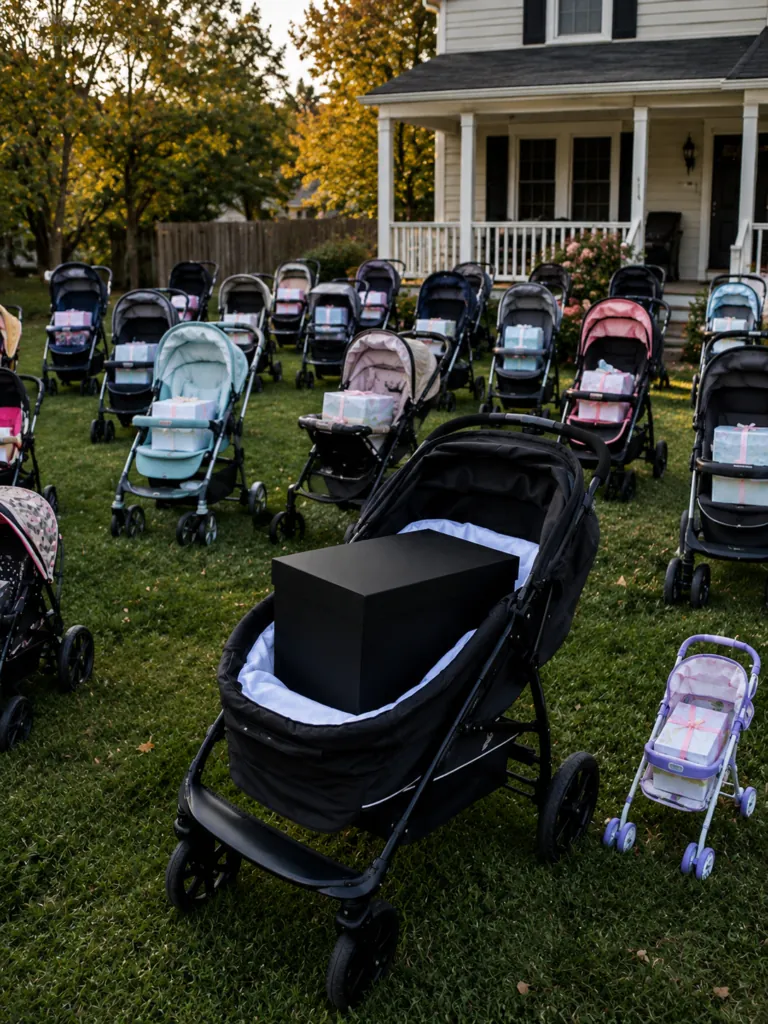
The lawn was covered with baby strollers.
Not one.
Not two.
Dozens.
They stretched across the dew-covered grass in neat rows, their wheels glistening beneath the early morning sun.
Some were brand new.
Others showed years of careful use.
Blue.
Gray.
Green.
Pink.
Black.
Their canopies were raised like tiny shelters standing silently beneath the pale sky.
I looked up and down the street.
No moving trucks.
No volunteers.
No explanation.
Only complete silence.
My heart began pounding exactly the way it had outside the NICU when doctors disappeared behind closed doors.
“That’s impossible…”
The words barely escaped my lips.
I walked down the porch steps on shaky legs.
Every stroller faced my front door.
As though they had all arrived for me.
Halfway across the yard I stopped beside one with a faded navy canopy.
Inside rested a neatly wrapped cardboard box tied with white ribbon.
Nothing else.
I stared.
Then moved to the next stroller.
Another sealed box.
Another ribbon.
Another carefully arranged package.
Every stroller held one.
Every single one.
Near the center of the lawn stood one stroller unlike all the others.
It was matte black.
Larger.
Older.
Its hood was pulled forward, giving it the appearance of a tiny chapel standing among the others.
Inside rested another box.
On top lay a black envelope.
My name was written across it.
Kate.
No address.
No stamp.
Just my name.
Fear crept through me.
For one irrational second I wondered whether someone blamed me for giving Noah’s things away.
Whether this was some cruel joke.
I backed away.
My heel struck another stroller.
It tipped dangerously to one side.
Instinctively I grabbed the handle before it could fall.
As I steadied it, the ribboned box inside shifted slightly.
Curiosity slowly overcame fear.
I picked it up.
The ribbon came loose beneath trembling fingers.
Inside lay a beautifully folded baby blanket.
A tiny pair of knitted socks.
A pacifier still sealed inside its package.
Beneath them rested a handwritten letter.
I unfolded it carefully.
Our daughter Emma lived for nineteen beautiful hours.
Packing away her things nearly destroyed us.
Someone once told us that love doesn’t disappear when a child dies.
It simply has to find somewhere else to go.
Please let these things help another baby.
With love,
Emma’s parents.
I pressed one hand over my mouth.
Fresh tears blurred the words.
My knees weakened.
Another parent.
Another child who never came home.
I reached into the next stroller.
Another carefully packed box.
Inside waited a hand-crocheted elephant.
Three newborn sleepers.
A tiny bottle warmer.
Another letter.
Our son Owen was stillborn at thirty-eight weeks.
For months we couldn’t even open the nursery door.
Yesterday we finally did.
We hope another little boy smiles while wearing these clothes.
I couldn’t breathe.
I hurried to another stroller.
Then another.
Each one contained something different.
A blanket.
Bibs.
Diapers.
Tiny shoes.
Bottles.
Stuffed animals.
Each accompanied by another letter.
We lost twins.
…
Our little girl lived only six weeks.
…
Our son passed away before his first birthday.
…
I never believed I would survive burying my baby.
Every letter carried unimaginable heartbreak.
Yet every one ended with hope.
Please let these things help another family.
Please give this love somewhere to go.
Please tell another baby they are wanted.
I stopped seeing abandoned baby supplies.
I saw parents.
Mothers.
Fathers.
Families whose hearts had shattered exactly as mine had.
The yard no longer felt strange.
It felt sacred.
As though every stroller represented a child whose memory still refused to disappear.
Someone had gathered all that love into one place.
But why?
None of the letters explained how they had found me.
Or why they had chosen my house.
I was opening another box when I heard a car door close behind me.
Then another.
And another.
I turned.
Cars lined both sides of the street.
People stepped quietly onto the sidewalk.
Couples.
Older parents.
Young mothers.
Grandparents.
No one spoke immediately.
They simply looked toward the lawn.
Toward the strollers.
Toward me.
An older woman with silver hair finally stepped forward.
“Kate?”
I nodded cautiously.
She smiled through watery eyes.
“My name is Linda.”
She pointed toward a blue stroller near the mailbox.
“I brought that one.”
I followed her hand.
“My grandson never came home from the NICU.”
My chest tightened.
Before I could answer, another woman raised her hand.
“The pink stroller belonged to my daughter.”
Her voice trembled.
“She lived six weeks.”
A man in his fifties stepped beside a green stroller.
“My son.”
Another couple pointed toward a gray stroller.
“Our twins.”
One after another they introduced themselves.
No speeches.
No rehearsed words.
Only names.
Only children.
Only love.
Every stroller suddenly had a family standing beside it.
Thirty families.
Thirty impossible stories.
I wiped my eyes.
“I don’t understand.”
Linda stepped closer.
“Yesterday Elena came to the community resource center.”
Recognition flashed across me.
“She couldn’t stop talking about you.”
Linda smiled gently.
“She told everyone about the mother who emptied her own son’s nursery so another baby wouldn’t have to go without.”
I looked across the lawn again.
Linda continued.
“We all belong to the same monthly support group.”
Her eyes moved from stroller to stroller.
“When we heard what you did…”
She laughed softly through tears.
“…every one of us went home and opened a closet we’d been avoiding.”
Several parents nodded.
“We packed the things we’d been unable to touch.”
“We cried.”
“We remembered.”
“And then…”
She gestured toward the lawn.
“…we brought them here.”
I looked around in disbelief.
“Why?”
Linda pointed toward the dozens of sealed boxes.
“These aren’t for you.”
“They’re for every family still struggling to care for a baby.”
“We needed somewhere to begin.”
She smiled.
“Your son gave us that beginning.”
The words stole my breath.
Before I could respond, another familiar car pulled slowly against the curb.
A silver sedan.
Thomas.
He climbed out carrying the manila folder he’d mentioned the week before.
The divorce paperwork.
He stopped the instant he saw the lawn.
His eyes swept across the rows of strollers.
The gathering of strangers.
The boxes.
Finally they landed on me.
“What…”
He looked completely bewildered.
“…what happened here?”
Before I could answer, Linda spoke.
“A miracle.”
Thomas frowned.
“I don’t understand.”
“No.”
I looked at him calmly.
“You wouldn’t.”
His shoulders stiffened.
“I came for the papers.”
He lifted the folder slightly.
“You need to sign.”
I stared at it.
Only yesterday those papers had felt like the final proof that my family no longer existed.
Now dozens of grieving parents stood around me.
Children I’d never meet had somehow filled my yard with hope.
I glanced toward Noah’s nursery window.
Then back at Thomas.
“I don’t think this house is empty anymore.”
He followed my gaze.
For the first time since Noah died, he looked toward that window without immediately turning away.
His face softened.
“I…”
But no words came.
I simply walked past him.
One stroller remained unopened.
The black one.
The one that had frightened me earlier.
This time I wasn’t afraid.
I lifted the envelope.
Inside was a single folded letter.
Beneath it rested a polished wooden plaque.
My hands trembled as I read the carved words.
NOAH’S STROLLERS
When one family is finally ready to let go, another family should never have to start with nothing.
My vision blurred instantly.
I unfolded the letter.
Kate,
Yesterday your kindness became something much larger than a single act of generosity.
Every stroller on this lawn will be cleaned, repaired if necessary, and given to a family struggling to care for a newborn.
Whenever another grieving parent finds the strength to pass along their child’s belongings, another stroller will join this collection.
We hope one day there are hundreds.
We wanted this project to carry the name of the little boy whose love brought us together.
Thank you for giving us one.
I lowered the letter.
No one spoke.

The entire street seemed wrapped in silence.
I rested one hand against the wooden plaque.
The smooth wood felt warm beneath my fingertips despite the cool morning air.
Only weeks earlier, Noah’s nursery had been a room I couldn’t bear to enter.
Now his name belonged to something that would help countless babies I would never meet.
His short life had become the beginning of something neither Thomas nor I could ever have imagined.
A breeze stirred gently through the yard.
The colorful stroller canopies shifted together like waves.
For the first time since the hospital, I didn’t picture the room Noah never slept in.
I pictured mothers buckling babies into safe strollers.
Fathers carrying donated diaper bags.
Grandparents wrapping newborns in blankets once chosen with love by another family.
His belongings would not gather dust behind a closed door.
They would become part of hundreds of first walks, first smiles, first trips home.
Thomas quietly lowered the folder to his side.
He never asked me to sign it.
He simply stood among the families, finally seeing what I had discovered before he did.
Grief doesn’t disappear.
It changes shape.
Sometimes it becomes courage.
Sometimes compassion.
Sometimes an entire community.
I pressed my palm against the plaque and smiled through warm tears.
“My little boy…”
My voice was barely more than a whisper.
“You finally came home.”
Around me, the morning sun rose higher over the rows of waiting strollers, and for the first time since Noah’s death, I believed that love really could outlive loss—because every gift waiting on that lawn carried the same quiet promise:
A child may be gone, but the love they leave behind never has to be.
Source: amomama.com
Note: This story is a work of fiction inspired by real events. Names, characters, and details have been altered. Any resemblance is coincidental. The author and publisher disclaim accuracy, liability, and responsibility for interpretations or reliance.