
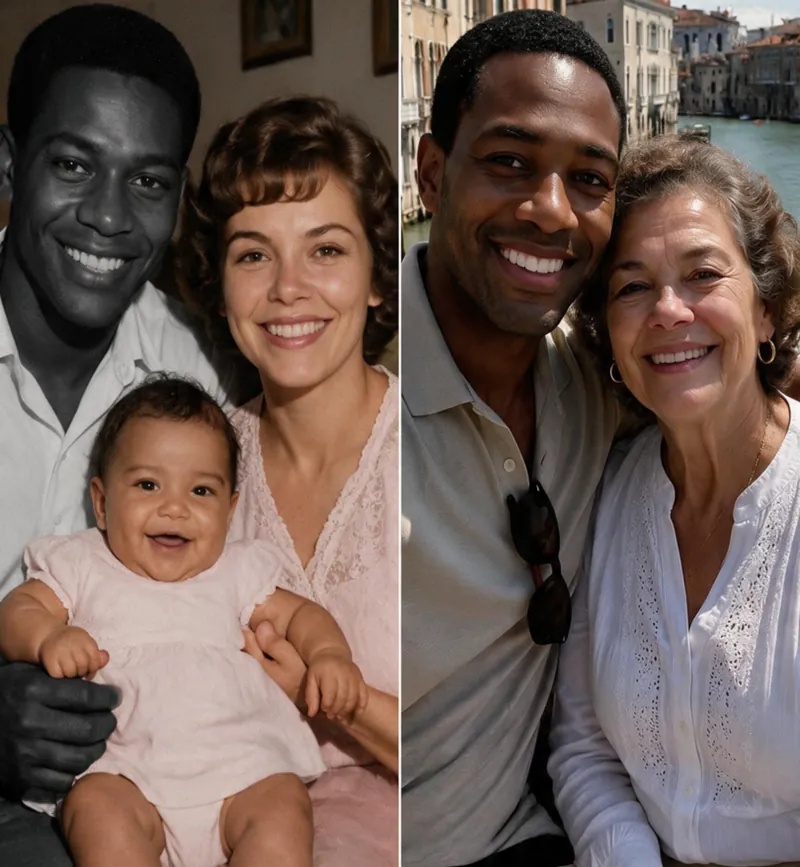
Part One: My Father’s Final Request
My father had been gone for three months, yet every time I said those words, they still sounded as though they belonged to someone else.
My father is gone.
His name was Arthur, and for most of my life, I believed he was the kind of person nothing could truly take away.
He was not loud or dramatic. He never needed to be the center of attention. His strength appeared in smaller ways—in remembering exactly how everyone liked their coffee, in carefully folding used wrapping paper so it could be saved, and in showing up whenever someone needed him without asking for recognition.
Dad rarely raised his voice. When he did, everyone listened because it meant something truly mattered.
He had been the steady center of our family for as long as I could remember.
Then cancer came.
It did not take him all at once. It claimed him slowly, stealing his appetite, his strength, and eventually the familiar spark in his eyes. By the time he entered hospice care, he looked smaller beneath the blankets, but his mind remained clear.
On the final evening of his life, I sat beside his bed pretending the next morning was guaranteed.
The room was dimly lit. A monitor released soft, measured beeps beside him. The air smelled of disinfectant, stale coffee, and flowers that had begun to wilt in their vase.
My mother had left a few hours earlier only because Dad insisted.
“Go home, Violet,” he had told her. “Sleep in a proper bed tonight.”
She had resisted, but he finally convinced her. She kissed his forehead, squeezed his hand, and promised she would return first thing in the morning.
Neither of us said aloud that morning might be too late.
After she left, Dad drifted in and out of sleep. I remained in the chair beside him, watching his chest rise and fall beneath the thin blanket.
Sometime after midnight, he opened his eyes and lifted one hand.
“Jason,” he whispered.
I leaned closer immediately. “I’m here, Dad.”
His fingers moved beneath the blanket. After a moment, he pulled out an old envelope.
The paper had yellowed with age, and my mother’s name was written across the front in his unmistakably careful handwriting.
Violet.
He pressed it into my hand.
“On your mother’s seventieth birthday,” he said, struggling between breaths, “take her to St. Mark’s Square.”
I frowned. “In Venice?”
The faintest smile touched his lips.
“Yes. Venice.”
I turned the envelope over. It had already been sealed.
“What’s inside?”
His eyes sharpened, suddenly intense despite his weakness.
“Do not open it.”
“I won’t.”
“Not before you reach the square,” he continued. “Not afterward. Give it to her there.”
I looked from the envelope to his face.
“Why Venice?”
He did not answer.
Instead, he tightened his fingers around my wrist with what little strength he had left.
“Promise me.”
Something in his expression told me not to argue.
“I promise.”
The tension left his face almost immediately. He sank back into his pillow as if my answer had allowed him to release a burden he had carried for years.
A few moments later, he closed his eyes.
“It’s time,” he murmured.
At first, I believed he meant it was time for him to die.
Only later did I understand that he had been talking about something else.
Dad passed away before sunrise.
My mother, Violet, turned seventy exactly three months later.
She wanted no celebration. No birthday cake. No party. No gathering of relatives trying too hard to behave cheerfully around her grief.
“How am I supposed to celebrate another year,” she asked me quietly, “when your father didn’t get one?”
I had no answer.
Then I remembered the envelope.
When I suggested taking a trip together, she almost refused. But when I mentioned Venice, a strange expression crossed her face—something between longing and alarm.
“Your father always wanted me to see Venice again,” she said.
Again.
The word caught my attention, but only briefly. I assumed she had visited the city with her family when she was young.
I arranged everything—the flights, the hotel, the transportation from the airport. For weeks, the sealed envelope remained hidden at the back of my dresser drawer.
I thought about it constantly.
Dad had always been quietly romantic, so I convinced myself it contained a final love letter. Perhaps he had written about their marriage or included directions to some meaningful place he wanted her to visit.
That explanation made sense.
My parents had never displayed their affection dramatically, but their devotion was visible in ordinary things. Dad warmed her side of the bed during winter. Mom prepared his lunch exactly the way he liked it, even after he retired and no longer needed to take it anywhere.
They argued, of course. My mother could be cutting when she was frightened or upset, and my father sometimes retreated into silence instead of confronting his feelings.
But they always found their way back to each other.
For nearly fifty years, they had chosen one another through illness, financial struggles, disappointments, and countless ordinary mornings.
That was why I believed the envelope could contain only love.
I had no idea it also contained a secret.
Venice seemed almost unreal when we arrived.
The canals reflected the pale buildings like pieces of trembling glass. Boats passed beneath ancient bridges. Church bells echoed through narrow streets that twisted in unexpected directions.
For the first time since Dad’s funeral, my mother appeared interested in something beyond simply surviving the day.
On the morning of her birthday, we walked into St. Mark’s Square.
Sunlight spilled across the stone. Café tables filled the edges of the piazza. Violin music floated above the voices of tourists, while pigeons marched between them with ridiculous confidence.
My mother and I sat at an outdoor table near the square.
She ordered an espresso, added sugar, and stirred it for several minutes without taking a sip.
“This place is still beautiful,” she said.
I noticed the word but did not question it.
She gazed toward the basilica, her eyes glistening.
“Your father would have loved being here.”
“He would have,” I agreed.
For one moment, I considered ignoring his request.
She looked peaceful. Fragile, but peaceful.
I could have left the envelope inside my bag and allowed her birthday to remain untouched.
But I had given Dad my word.
I reached into the bag, removed the envelope, and placed it gently on the table.
“Dad asked me to give you this.”
The change in her was immediate.
All the color vanished from her face.
She did not look surprised.
She looked terrified.
Her chair scraped sharply against the stone as she recoiled. Her hand struck the espresso cup, sending coffee sloshing into the saucer.
“Mom?”
She stared at the envelope as though it were something dangerous.
“Where did you get that?” she whispered.
“Dad gave it to me on his last night.”
Her eyes snapped toward mine.
“Why did he bring you here?”
“He didn’t explain. He only made me promise to give it to you in this square.”
Her breathing became shallow.
“He wasn’t supposed to know.”
The words sent a chill through me.
“Know what?”
Around us, Venice continued as though nothing had happened. A waiter carried a silver tray between tables. A child chased pigeons. The musicians moved into another song.
Yet at our table, my mother’s entire life appeared to be collapsing.
She pressed both hands over her mouth.
“Oh, Arthur,” she whispered.
Then the tears came.

Part Two: The Love She Left Behind
I moved my chair beside hers and placed a hand on her shoulder.
“Mom, talk to me.”
She shook her head.
“I can’t.”
“You’re frightening me.”
“You don’t understand.”
“Then help me understand.”
For several moments, she said nothing.
She stared at the untouched envelope as though opening it would erase the life she had shared with my father.
Finally, she lowered her hands.
“Before Arthur,” she began, “there was someone else.”
I waited.
She gave a quiet, humorless laugh.
“That sounds so ordinary, doesn’t it? Most people have someone before they marry. But this wasn’t a childhood crush or some brief romance I forgot.”
Her eyes moved across the square.
“I was twenty when I first came to Venice.”
She told me that she had traveled to Italy with her parents during the summer. Her father had recently become successful in business and wanted the family to experience Europe.
My mother had been obedient, sheltered, and eager to prove she could make her own decisions.
Then she met a young Italian man named Tom.
Even saying his name seemed to change her. Her voice softened, and for a moment, I could almost see the young woman she had once been.
“He worked with his uncle near the waterfront,” she said. “He repaired boats, carried supplies, and did whatever else was needed. He had almost no money.”
A faint smile appeared through her tears.
“He played the guitar terribly. He knew only a handful of songs, and he forgot half the words. But he played as if he were performing for an entire theater.”
“How long did you know him?” I asked.
“A few weeks.”
I must have looked surprised because she nodded.
“I know. It sounds impossible. But when you are twenty, a few weeks can feel like a lifetime.”
They spent nearly every day together.
Tom showed her quiet courtyards that tourists rarely visited. They shared cheap pastries near the canals and stayed out until the streetlamps reflected across the water.
“He had no grand plan,” she continued. “No important connections. No guarantee of a comfortable future. He lived one day at a time, and I loved that freedom because I had never experienced it.”
Tom eventually asked her to remain in Venice.
He did not offer wealth or security. He simply asked her to stay and build a life with him.
“And you wanted to?” I asked.
“With every part of me.”
Her parents discovered the relationship before she could decide what to do.
“They said love was not enough,” Mom told me. “They said marriage required security, good judgment, and a respectable family. My father told me Tom would ruin my life.”
“What did Tom say?”
“He asked me to trust him.”
Her fingers tightened together.
“But I was afraid.”
The following morning, before sunrise, her parents took her away from Venice.
She did not tell Tom she was leaving.
She did not send a message or leave a note.
She simply disappeared.
“You never said goodbye?” I asked.
She shook her head, shame filling her face.
“I told myself I was protecting everyone. In truth, I was too frightened to face him.”
She returned home, completed her education, and eventually met my father.
Arthur was patient, dependable, and kind. He offered none of the uncertainty her parents had warned her about.
She fell in love with him slowly.
“It was different from what I felt for Tom,” she explained. “With Tom, everything had been fire. Your father was warmth. He made me feel safe. He never demanded that I become someone else.”
“Did you tell Dad about Venice?”
“No.”
She looked at the envelope again.
“At least, I never told him directly.”
Years passed. She and Dad married, bought a house, and had me. Together they built a life that was real and loving.
But somewhere inside her, the memories of Venice remained sealed away.
“I loved your father,” she said urgently, gripping my hand. “Please believe that. I never betrayed him. I never contacted Tom. I never tried to find him.”
“I believe you.”
“But I carried the guilt anyway.”
She described it as a locked room inside her heart. She rarely entered it, but she always knew it was there.
Whenever someone mentioned Venice, she remembered Tom waiting for her.
Whenever Dad told her he trusted her completely, shame tightened around her chest.
“For fifty years, I wondered whether hiding that part of myself made our marriage a lie.”
“It didn’t,” I said.
“How can you know?”
“Because I watched the two of you love each other.”
Her eyes filled again.
“That doesn’t mean your father would have understood.”
I pushed the envelope closer to her.
“Maybe this will tell us whether he did.”
She pulled back.
“What if it destroys everything I remember about him?”
“Whatever is inside, he chose to give it to you.”
She stared at the handwriting on the front.
“I thought he died believing I was the woman he married.”
“You were.”
“No. He married someone he thought had no secrets.”
I thought of my father’s expression when he made me promise.
“He knew something, Mom. But I don’t believe he sent us here to punish you.”
“You didn’t see him when he was hurt,” she whispered. “Your father could remain silent for days.”
“He also forgave people before they knew they needed forgiveness.”
She closed her eyes.
Then she placed her fingertips against the envelope.
“Did you read it?”
“No. I promised him I wouldn’t.”
Her hand shook as she slid one finger beneath the seal.
The paper opened with a quiet tear.
Inside was a single folded letter.
She unfolded it slowly.
At first, her expression remained tense. Then her eyes widened. Fear became confusion, and confusion turned into stunned disbelief.
“Mom?”
She looked at me as tears gathered along her lashes.
Then she began to read aloud.
“Violet, if this letter has reached you in Venice, then Jason honored his promise. I knew I could trust him.”
Her voice trembled so badly that she stopped.
I placed my hand over hers.
She drew a breath and continued.
“I have known about Tom for most of our marriage.”
The words seemed to silence the entire square.
My mother stared at the page.
“He knew,” she whispered.
Then she continued reading.
“You never confessed it to me. You did not need to. People learn the truth about each other gradually when they share enough years.
“I heard a name once while you were sleeping. I found an old photograph you believed you had discarded. I noticed how your face changed whenever someone spoke of Venice.
“I never knew every detail, but I understood enough.”
My mother’s tears began to fall onto the page.
She forced herself to keep reading.
“I was never angry with you.”
At those words, something inside her broke.
A sob escaped her, deep and sudden. She covered her mouth, but there was no stopping it.
Several people nearby glanced in our direction before turning away to give us privacy.
I rubbed her back as her shoulders shook.
After a moment, she lifted the letter again.
“You were twenty years old. You were frightened, and you made the decision you believed would protect your future.
“Whatever part of your heart remained in Venice never diminished what you gave to me.
“You loved me faithfully. You gave me tenderness, companionship, and more happiness than I ever expected to receive.
“You gave me a family.
“You gave me Jason.
“You gave me a life I would choose again without hesitation.”
Mom lowered the letter and pressed it against her chest.
“He knew all this time,” she whispered. “He knew, and he still loved me.”
“He didn’t love you despite knowing,” I said. “He loved all of you.”
She looked at me with the devastated expression of someone finally receiving forgiveness she had stopped believing was possible.
But the letter was not finished.

Part Three: The Man Waiting Across the Square
My mother wiped her cheeks and returned to the page.
“If guilt has lived beside you all these years, I would like to remove it now.
“A dying man should be permitted at least one bold decision. This is mine.
“While you were busy caring for me, I began making inquiries. It was not easy, and it required more time than I expected.
“But I found him.”
Mom stopped breathing.
Her eyes raced over the next line.
“Found who?” I asked, though we both knew.
She continued in a whisper.
“If he still wants to see you, and if you wish to see him, perhaps the two of you can finally have the farewell you were denied.
“Perhaps it will be only a goodbye.
“Perhaps it will become something else.
“That choice does not belong to me.
“Look toward Caffè Florian.”
The letter slipped slightly in her hands.
Slowly, she turned her head.
I followed her gaze across the piazza.
At first, I saw nothing unusual—only crowded café tables, waiters in formal jackets, and sunlight flashing against polished windows.
Then I noticed an elderly man standing alone near the edge of the café.
He wore a dark jacket despite the warmth. His silver hair had been neatly combed, and he held a single red rose between both hands.
His face was lined with age, but his expression carried the nervous hope of someone waiting at the beginning of his life rather than near its end.
Tom.
My mother released a small, broken sound.
She rose so abruptly that her chair tipped backward. I caught it before it struck the ground, but she did not notice.
She was already walking toward him.
She did not run. At seventy, she could not have. Yet there was such urgency in every step that it seemed fifty years were pulling her across the square.
Tom moved toward her.
When only a few feet remained between them, they both stopped.
The square was crowded, but the space around them suddenly felt private.
My mother lifted a trembling hand toward his face without quite touching him.
“Tom?”
He stared at her as though he had imagined this moment too many times to trust that it was real.
Then he exhaled.
“Violetta.”
Not Violet.
Violetta.
The name seemed to return something to her that time had taken away.
She began crying again.
“I’m sorry,” she said. “I left without telling you. I didn’t even say goodbye.”
Tom’s eyes shone.
“I waited for you.”
“I was a coward.”
“I thought something had happened to you.”
She frowned. “What do you mean?”
Tom looked down briefly before meeting her eyes again.
“Your father came to see me.”
“My father?”
“Several years after you left.”
The confusion on her face turned to alarm.
“What did he say?”
“He told me you had become seriously ill after returning home. He said contacting you would make your condition worse.”
My mother shook her head.
“No. I was never ill.”
“He told me to stay away. He gave me money and said I must disappear from your life completely.”
“No,” she whispered.
“I refused the money at first. But he convinced me that leaving you alone was the only way to protect you.”
Mom stared at him, stunned.
“All those years, I thought you hated me.”
“For a long time, I believed you were dead,” Tom said. “Later, I learned you were alive and had married. Then I assumed you had chosen the life you wanted.”
“I never chose to hurt you.”
“I know that now.”
She looked down, struggling to speak.
“I loved you.”
Tom’s face softened.
“I loved you too.”
She accepted the rose he offered and held it as though it were the only steady thing in the world.
“You mattered,” she told him. “You mattered so much that I was terrified of what choosing you might cost.”
A sad, gentle smile appeared on his face.
“And you mattered enough that I spent years trying to understand why you vanished.”
For several moments, neither spoke.
The violinists continued playing. Tourists posed for photographs. Pigeons circled above the stones in search of crumbs.
Yet my mother and Tom stood facing each other as though the city had paused solely for them.
I looked down at my father’s letter, which remained open on the table.
There was one final sentence at the bottom.
I knew I should not read it. I had promised him the letter was meant for Mom.
But my eyes had already found the words.
“Love should never leave this world still wearing chains.”
My vision blurred.
I sat down and wept openly in the middle of St. Mark’s Square.
Only then did I fully understand what my father had done.
He had known about the grief hidden inside his wife for decades.
He could have confronted her. He could have demanded explanations. He could have allowed insecurity to poison their marriage.
Instead, he had recognized that the love she once felt for Tom did not erase the life she had built with him.
Dad did not turn her secret into a weapon.
And as death approached, he used what strength remained to free her from it.
People often speak about love as possession. They talk about being chosen above everyone else, as if another person’s heart is a prize to be won.
My father had loved differently.
He loved my mother enough to care more about her peace than his pride.
He understood that the heart can carry more than one truth without making either of them false.
Eventually, Mom returned to the table with Tom beside her.
Her eyes were swollen, and tear tracks marked her cheeks, but she seemed lighter than she had since Dad’s diagnosis.
She touched my arm.
“Jason, this is Tom.”
He extended his hand awkwardly.
“Your father was an extraordinary man.”
I shook his hand.
“Yes,” I said. “He was.”
Tom sat with us, and Mom carefully placed the rose beside the letter.
“I don’t know what happens now,” she admitted.
Tom smiled gently.
“Perhaps, for now, we have coffee.”
Mom laughed through her tears.
It was the first real laugh I had heard from her since Dad died.
The sound nearly broke my heart all over again.

Part Four: The Last Gift
We remained at the café for several hours.
At first, Mom and Tom spoke cautiously, choosing each word as though the wrong one might cause the moment to disappear.
They talked about the summer they had shared.
Tom reminded her of a small bakery where they had once bought pastries because it was the only place they could afford. Mom remembered the narrow bridge where he had tried to play guitar for her and broken a string halfway through the song.
“I thought it was romantic,” she said.
“It was terrible,” Tom replied.
“It was both.”
Gradually, the tension between them softened.
They talked about the people they had lost, the work they had done, and the families they had built.
Tom had married years after my mother left. His wife had died six years earlier. They had no children, but he had several nieces and nephews who treated him like a second father.
My mother told him about me, though he already knew a little from Dad’s inquiries.
Then she spoke about Arthur.
She described their first date, their modest wedding, the house they had renovated together, and the years they spent raising me.
Tom listened without jealousy.
When she spoke about Dad’s illness, his expression filled with quiet sorrow.
At one point, Mom lifted the letter.
“He arranged all of this,” she said. “Even while he was dying, he was thinking about me.”
Tom looked at the page and nodded.
“Then he loved you very deeply.”
Mom lowered her eyes.
“He did.”
There was no betrayal in the way she said it.
No confusion.
She was not replacing my father with Tom. She was not rewriting her marriage or pretending the past fifty years had not mattered.
She was simply allowing two truths to exist beside one another.
She had loved Tom when she was young.
She had loved Arthur through the life they built together.
One love had remained unfinished.
The other had become her home.
As evening approached, the sunlight softened over the square. Tom asked whether Mom would be willing to meet him again during the remainder of our stay.
She hesitated before agreeing.
“Tomorrow,” she said. “Perhaps you can show us which parts of Venice haven’t changed.”
“Very few,” he said.
She smiled.
“Then show us those.”
Back at the hotel that night, I sat alone in my room, replaying the day.
I kept thinking about Dad in his hospice bed.
How long had he been planning this?
How had he found Tom?
Had he called strangers, searched old records, or written letters while Mom believed he was sleeping?
He must have known there was a chance she would refuse to open the envelope. He must also have known that seeing Tom could bring complicated emotions into her life after his death.
But Dad had trusted her.
More importantly, he had trusted the love they shared.
A soft knock sounded at my door.
When I opened it, Mom stood in the hallway holding the folded letter.
“Can I come in?”
“Of course.”
She stepped inside and sat on the edge of the chair near the window.
For a moment, she simply looked at the paper in her hands.
“I need you to understand something,” she said.
“I’m listening.”
“Your father was the great love of my life.”
“I know.”
Her eyes filled, but she did not look away.
“And Tom was the great unfinished love of my youth.”
I sat beside her.
She waited as though expecting me to judge her.
But there was nothing shameful in what she had said.
Love was not a courtroom where one truth had to defeat another.
“I spent fifty years believing those two things could not exist together,” she continued. “I thought remembering Tom made me dishonest. I thought it meant some part of my marriage was false.”
“Dad didn’t believe that.”
“No.”
Her voice broke.
“He understood me better than I understood myself.”
She unfolded the letter again and traced one finger beneath my father’s handwriting.
“I wish I had told him.”
“Maybe he didn’t need you to.”
“I could have thanked him.”
“You did. Every day you stayed beside him. Every time you cared for him. Every year you chose the life you shared.”
She looked toward the dark window.
“Do you think he knew how much I loved him?”
“Yes.”
My answer came without hesitation.
“I think that was the one thing he never doubted.”
Mom closed her eyes and allowed the tears to fall silently.
After a moment, she reached over and touched my cheek the way she had when I was a child.
“He gave me one final miracle,” she whispered.
When she returned to her room, I remained awake for a long time.
I had brought my mother to Italy because my dying father made me promise.
I believed I was carrying a letter.
In truth, I had been carrying forgiveness.
Dad’s final gift was not a romantic message in the ordinary sense. It was something greater.
He gave my mother permission to stop punishing herself.
He gave her the goodbye she had been denied.
He gave Tom the truth.
And he gave me a new understanding of what love could be.
Love was not always holding someone tightly.
Sometimes it was opening your hand.
Sometimes it was protecting another person’s dignity even when they were not present to witness it.
Sometimes it was seeing every hidden part of someone and deciding, without hesitation, to remain kind.
My father had spent nearly fifty years beside my mother’s silent sorrow.
He never exposed it.
He never used it to make her feel small.
And when he knew he was leaving this world, he refused to let her carry that sorrow alone for the rest of hers.
The following morning, my mother met Tom beside the canal.
They walked slowly through the city, speaking about the years between who they had once been and who they had become.
I followed at a respectful distance.
Mom still wore her wedding ring.
In one hand, she carried Dad’s letter.
In the other, she held the red rose Tom had brought her.
The sight did not seem contradictory.
It seemed complete.
I do not know what will happen between them.
Perhaps they will become friends. Perhaps they will write to one another. Perhaps their reunion will remain only a beautiful goodbye delayed by half a century.
That decision belongs to them.
What matters is that my mother no longer has to wonder whether her secret made her unworthy of the life she shared with my father.
Arthur knew.
He had known for years.
And he loved her completely.
My father is gone now.
There are mornings when I still reach for my phone before remembering I cannot call him. There are moments when grief arrives without warning and leaves me unable to breathe.
But whenever I think of Venice, I do not picture only the loss.
I picture my mother standing in St. Mark’s Square, holding a rose and a letter, finally released from fifty years of guilt.
Even after his death, Dad was still taking care of us.
That was the kind of man he had always been.
And that was his final act of love.
Note: This story is a work of fiction inspired by real events. Names, characters, and details have been altered. Any resemblance is coincidental. The author and publisher disclaim accuracy, liability, and responsibility for interpretations or reliance. All images are for illustration purposes only.