
Part One: The First Silent Saturday
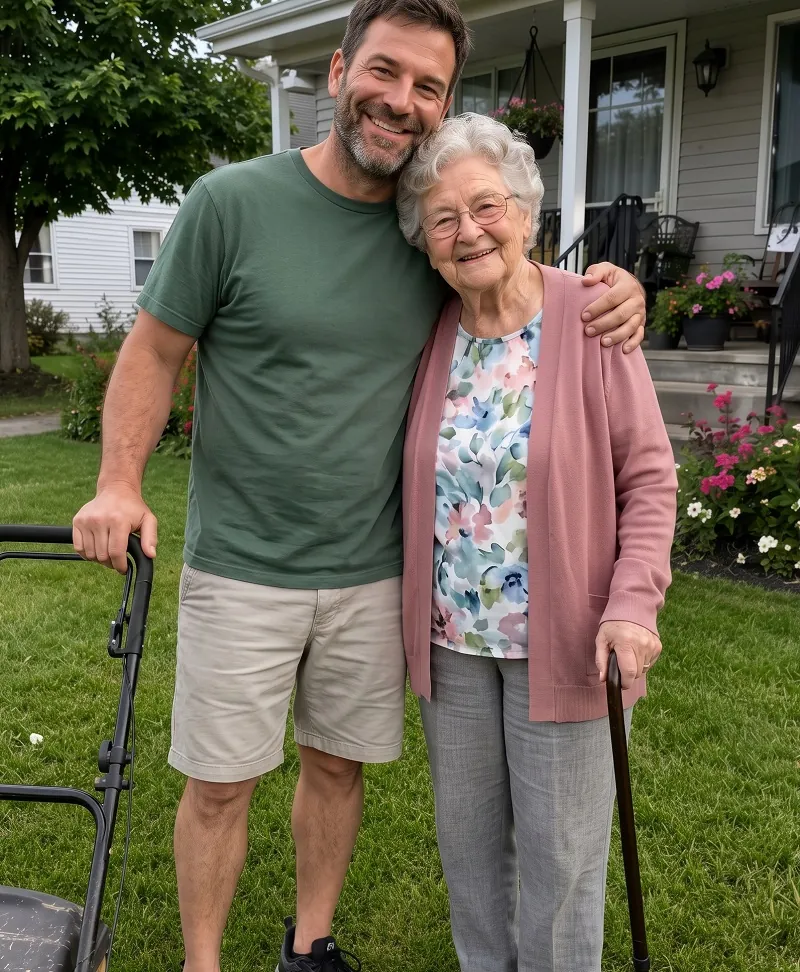
The first Saturday after Theresa died, I wheeled my lawn mower out of the garage as I had done nearly every weekend for eight years.
I wrapped both hands around its faded red handle and started toward the driveway. Then, halfway across the pavement, I stopped.
Theresa’s lawn was no longer mine to mow.
The thought struck me with such force that I could not move.
Across the narrow driveway separating our homes, the grass had grown slightly higher than usual. Several dandelions had appeared near the mailbox, their yellow heads bright beneath the morning sun. Theresa’s flower beds looked carefully tended, as though she might step outside at any moment and apologize for keeping me waiting.
But her porch was empty.
The wooden swing did not creak beneath her weight. Her floral apron was not hanging from the kitchen hook. The chipped blue teapot remained motionless behind the window.
Most painfully of all, there was no voice calling across the yard.
“Justin, don’t you dare begin before breakfast!”
Behind me, our screen door opened quietly.
My eight-year-old daughter, Fanny, stepped onto the porch wearing purple pajamas. She was still young, but she had already learned how to recognize sadness in adults. She came down one step and studied me.
“Dad,” she said gently, “did you forget again?”
I kept looking at Theresa’s house.
“Sometimes I do.”
“Mostly on Saturdays?”
I nodded.
Saturdays had always belonged to Theresa.
For eight years, she had waited for me on that porch with tea, pie, stories, and some playful complaint about the condition of her yard.
Now the grass continued growing without her.
A few days earlier, after the funeral, her attorney had placed a sealed envelope in my hand. My name was written across the front in Theresa’s familiar handwriting.
Something small and metallic rested inside.
Before opening it, however, I needed to remember how everything had begun.
Part Two: The Woman Next Door
Theresa moved into the house beside ours eight years earlier.
She was seventy-four at the time and arrived with three cardboard boxes, a green suitcase, and a framed photograph held tightly against her chest. Her husband, Harold, had passed away that spring after forty-six years of marriage.
At first, Theresa was simply our new elderly neighbor.
I knew she wore gardening gloves decorated with tiny strawberries. I knew she planted sunflowers beside the back fence. I also knew she could turn a simple greeting into a twenty-minute conversation.
“How are the children?”
“Is Olive still making that wonderful soup?”
“Did Fanny enjoy her first week of school?”
There was always another question.
It took me several months to understand why.
Theresa was not merely being talkative. She was trying to delay the moment when she would have to return to a silent house.
One Saturday morning, I heard the strained cough of an old engine coming from her yard.
When I looked outside, Theresa was wrestling with an ancient lawn mower. The grass had grown above her ankles, and the machine lurched forward only a few feet before sputtering to a stop.
She leaned her entire weight against the handle.
I crossed the driveway.
“Let me take care of that.”
Theresa straightened and pushed a loose strand of silver hair away from her face.
“I am perfectly capable, dear.”
The mower immediately died between us.
She stared at it for a moment before sighing.
“I am also perfectly capable of recognizing terrible timing.”
I laughed, took the handle, and finished the yard.
When I was done, Theresa appeared with several folded bills.
I refused them.
“You’ve been working for nearly an hour,” she protested.
“I live ten steps away.”
“That does not make your time worthless.”
“I’m not taking your money.”
She narrowed her eyes, studying me as though I were a difficult customer.
Finally, she tucked the bills back into her apron.
“Very well. But you will allow an old woman to thank you in her own way.”
That was how I found myself sitting on her porch with a glass of sweet tea and a slice of apple pie so enormous it could have fed a small family.
We talked for nearly two hours.
She told me Harold used to whistle whenever he repaired something, especially when he had no idea what he was doing. She said they had spent decades arguing over whether cinnamon belonged in coffee.
“It absolutely does,” she declared.
“Do you actually like it?”
She paused.
“No. But Harold did, and I refuse to let him win the argument merely because he is no longer here.”
Her laughter startled a bird from the railing.
When I finally stood to leave, she wrapped the remaining pie in foil and pressed it into my hands.
“Next Saturday,” she said, “I may need another professional opinion.”
“About the lawn?”
“About cinnamon.”
The following Saturday, her grass did not truly need cutting.
I mowed it anyway.

Part Three: More Than a Chore
Without ever discussing it, Theresa and I created a tradition.
Every Saturday morning, I pushed my mower across the driveway. She opened the kitchen windows, heated water for tea, and pretended she had not already sliced the pie before I arrived.
Her slices were always uneven.
I always chose the smallest.
She always distracted me, exchanged our plates, and then acted astonished when I noticed.
Before long, mowing became the least important part of our Saturdays.
My wife, Olive, began joining us after grocery shopping. Theresa would pull out another chair, insist Olive looked exhausted, and place food in front of her before she could object.
“Young mothers do not eat enough,” Theresa would say.
“I ate breakfast.”
“That was hours ago.”
“It was forty minutes ago.”
“Exactly my point.”
Our children grew up around Theresa’s porch.
Fanny learned how to water flowers without flooding the roots. Theresa taught her which plants needed sunlight and which preferred the shade.
Roger, our five-year-old son, appointed himself Theresa’s official detective. Every Saturday, she claimed to have misplaced her reading glasses.
Roger searched the porch, the kitchen, and the living room before finally reaching into the pocket of her apron.
“Found them!”
Theresa would gasp dramatically.
“Remarkable! Have you considered joining a government agency?”
Roger never seemed to realize that she hid them in the same pocket every week.
Perhaps he knew and simply enjoyed the game.
Theresa attended school performances, birthday parties, family dinners, and one disastrous backyard campout that ended when the sprinklers turned on at midnight.
She baked Fanny a heart-shaped strawberry cake. She taught Roger how to snap green beans. She remembered my wedding anniversary before I did and arrived with flowers for Olive.
“These are from your husband,” Theresa announced, handing them over. “He clearly requires administrative assistance.”
Somewhere during those years, she stopped being the elderly woman next door.
To our children, she became Miss Theresa.
To Olive and me, she became family.
Every spring, Theresa planted a sunflower beside the back fence in Harold’s memory.
When Fanny was six, she knelt beside Theresa and pushed a second seed into the earth.
“This one can keep him company,” she said.
Theresa turned her face away for a moment.
There were signs I noticed but never questioned.
Some Saturdays, half the lawn had already been cut when I arrived.
“The mower stopped working,” Theresa would claim.
Other weekends, the grass barely needed trimming, yet she would wait on the porch with the tea prepared.
“It looks terribly untidy,” she would insist.
Once, after several days of heavy rain, the yard was far too wet to mow.
I knocked on her door anyway.
Theresa opened it before my hand had fully lowered.
“I suppose you came to admire the mud.”
“I heard it was exceptional this year.”
We sat on the porch beneath a blanket while rain drummed against the gutters.
That morning, I finally understood something I should have recognized long before.
I had never truly been coming because of the grass.
But neither of us said it aloud.
Part Four: The Porch Went Quiet
Three weeks before that first silent Saturday, Olive walked next door to ask Theresa for her chicken pot pie recipe.
A few minutes later, my phone rang.
Olive’s voice was trembling.
“Justin, please come over.”
I found Theresa sitting peacefully in her favorite chair near the window.
She had died sometime during the night.
There had been no long illness and no warning. Her heart had simply stopped between turning off the porch light and the arrival of morning.
Her glasses rested beside an unfinished mystery novel. A teacup sat on the table. A grocery list lay beside it.
She had written “apples,” “cinnamon,” and “strawberry candles for Fanny.”
It seemed impossible that someone could make plans for the next day and then quietly disappear before it arrived.
The following Saturday, I stood outside with my mower while Theresa’s house remained dark.
Roger came out carrying a small plastic cup.
“Miss Theresa’s flowers need water, Daddy.”
Together, we crossed the driveway.
Fanny watered the two sunflowers. Roger pulled weeds from the flower bed. Olive stood on the porch holding a pie she had baked out of habit.
None of us knew what to do with it.
At the funeral, Theresa’s distant relatives occupied the first two rows.
They were polite people. They knew the town where she had been born, the year she married Harold, and the names of several family members I had never met.
But when the minister spoke about Theresa’s laughter, they lowered their eyes to the programs in their hands.
I knew that laugh.
I knew Theresa secretly disliked cinnamon in coffee but defended it because Harold had loved it.
I knew she read the last page of every mystery novel before starting the first.
I knew she saved the crust of her pie until the very end.
I knew she whispered to Harold’s sunflower when she believed no one was watching.
Yet legally, I was only the neighbor who lived ten steps away.
After the burial, Olive led the children toward our car. I remained beside Theresa’s grave, looking at the sunflowers arranged across the polished wood.
A man wearing a dark suit approached me.
“Justin?”
“Yes.”
“My name is Mr. Thorne. I handled Theresa’s legal affairs.”
He reached inside his coat and removed a cream-colored envelope.
My name was written across the front in Theresa’s careful handwriting.
When Mr. Thorne placed it in my hand, something small and heavy moved inside.
“What is this?” I asked.
His expression softened.
“Theresa believed it belonged to you.”

Part Five: The Brass Key
I did not open the envelope that afternoon.
It felt wrong to tear into it in a parking lot surrounded by departing cars and wilted flowers.
Theresa had given me eight years of Saturdays.
I decided I could wait for one more.
The next morning, I placed the envelope in the center of our kitchen table.
Olive baked an apple pie. Fanny sat near the window in her robe, watching Theresa’s empty porch. Roger climbed onto a chair and stared at the envelope.
“There’s treasure inside,” he whispered.
“What makes you think that?”
“I heard something metal.”
Olive placed the pie on the counter.
“Open it, Justin.”
My hands trembled as I broke the seal.
A small brass key slid into my palm.
It was old and worn smooth around the edges. Beneath it lay a letter written across two pages.
The first sentence made my chest tighten.
“If you are reading this, my porch has finally become quiet.”
I looked through the window.
For eight years, Theresa’s curtains had been open every Saturday morning.
Now they were closed.
I continued reading.
“Please forgive me for leaving without saying goodbye. At my age, farewells become greedy things. They demand words that are often too painful to speak.”
Olive sat across from me and reached for my hand.
Then came a sentence so perfectly Theresa that I laughed despite the tears already gathering in my eyes.
“Before you assume this key means I left you my house, allow me to save you the trouble. I did not.”
The house would pass to her relatives. Her possessions would be divided according to her will.
The key represented something else.
“This key once opened the back door of the first home Harold and I purchased together,” she had written. “On the day he gave it to me, he said a key did not prove that you owned a place. It proved that someone trusted you enough to enter.”
I rubbed my thumb across the smooth brass.
“I am giving it to you because for eight years, I rested more peacefully knowing that you lived ten steps away.”
The words blurred.
Olive squeezed my hand.
“You probably believed you were rescuing me from an overgrown lawn,” Theresa continued.
Then came the sentence that broke something open inside me.
“Justin, you were rescuing me from Saturdays.”
I stopped reading.
Outside, the wind stirred the sunflowers. Their heavy heads leaned toward each other beside the fence.
Part Six: The Truth About Saturdays
When I could see the page again, I continued.
“Saturdays belonged to Harold. He brewed his coffee far too strong, mowed the grass in crooked rows, criticized my pie crust, and then ate two slices. After he died, Saturday became the longest and loneliest day of my week.”
The kitchen fell completely silent.
“The first morning you crossed the driveway, I truly needed assistance. The second Saturday, I may not have needed quite as much. By the third, I had discovered something I was too proud to confess.”
Before I read the next line, I already understood.
“Every Friday, I deliberately left part of the lawn unfinished so you would have a reason to return.”
I remembered all those mornings when half the yard had already been cut.
I remembered the grass that barely needed trimming, the stalled mower that worked perfectly when I touched it, and the tea waiting before I even arrived.
Theresa had never needed the lawn completed.
She had needed to know that someone was coming.
“I hope you will not consider my little deception unforgivable,” she wrote. “Lonely people sometimes disguise invitations as ordinary problems.”
Fanny covered her mouth.
Roger frowned.
“Was Miss Theresa lonely?”
“Sometimes,” I answered.
“Even when we were there?”
I swallowed.
“Not when she knew we were coming.”
I returned to the letter.
“You gave me more than conversation. You gave me people to bake for, birthdays to remember, performances to attend, and a little detective who found my glasses every Saturday—even when I made his investigation embarrassingly easy.”
Roger’s eyes widened.
“I knew they were in her pocket.”
“Of course you did,” I told him.
Theresa continued.
“Fanny planted a second sunflower so Harold would not be alone. Olive gave me a place at your table. And you gave me the safest gift a widow could receive.”
The next sentence undid me completely.
“You made me feel expected.”
I lowered the letter and pressed both hands against the table.
I had never thought of kindness that way.
I had believed I was doing small things—mowing a lawn, repairing a porch step, drinking tea, eating pie.
But to Theresa, those ordinary acts had created a place where she still belonged.
Fanny slipped her hand into mine.
After several quiet minutes, I read the final paragraph.
“The key no longer belongs to my house. It belongs to the next door you choose to knock on.”
Below that, Theresa had added one last instruction.
“Before returning home today, look two houses beyond mine. His name is Walter. His Saturdays are quieter than mine ever were.”

Part Seven: The Next Door
I stood and walked to the window.
Two houses beyond Theresa’s home, an elderly man sat alone on his porch. His lawn was overgrown, and an empty chair rested beside him.
I had seen him many times.
But until that moment, I had never truly noticed him.
The final lines of Theresa’s letter were brief.
“Kindness is not meant to be stored away. It must be passed forward before it becomes lonely too.
“Thank you for every Saturday.
“Now please go find the next one.”
Olive stood without speaking.
She wrapped the pie in a clean kitchen towel.
Fanny lifted it carefully with both hands.
Roger jumped down from his chair.
“I’ll get the fuel can, Daddy.”
I folded Theresa’s letter and attached the brass key to my keyring. It made a soft metallic sound as it settled beside the key to our own home.
Then I pulled the mower across the driveway.
We passed Theresa’s porch.
Her chipped blue teapot was still visible through the kitchen window. The swing moved once in the breeze, almost as though someone had just risen from it.
Walter watched us approach with uncertainty.
He looked at his lawn and then down at his hands, perhaps embarrassed by how high the grass had grown.
I stopped at the foot of his porch.
“Good morning.”
He nodded cautiously.
“Morning.”
I glanced at the empty chair beside him.
“Your lawn looks like it could use some attention.”
Walter started to apologize, but I raised one hand.
“And your Saturday looks like it could use some company.”
For several seconds, he said nothing.
Then his face slowly changed.
It reminded me of a dark room when someone opens the curtains.
“There’s coffee inside,” he said. “Though I should warn you, it’s probably too strong.”
I smiled.
“I know someone who would have approved.”
Part Eight: What the Key Unlocks
Months passed.
Walter became part of our Saturdays.
Roger searched for his reading glasses, which somehow disappeared into the same shirt pocket every weekend. Olive brought tea. Fanny helped tend the garden. I mowed Walter’s lawn while he offered unnecessary instructions from the porch.
Theresa’s house was eventually sold to a young couple with a baby.
Before they moved in, they allowed us to collect seeds from the two sunflowers beside the back fence.
One afternoon, Fanny noticed the brass key still hanging from my ring.
“Why do you keep carrying it?” she asked.
I removed it and placed it in her palm.
“This key doesn’t open Theresa’s house anymore.”
She traced its smooth edge with her finger.
“Then what does it open?”
I looked toward Walter’s porch.
Roger sat beside him, pretending he had no idea where Walter had hidden his glasses. Olive was pouring tea. A pie cooled on the railing.
“The part of us that notices when someone is waiting,” I said.
Fanny looked down at the key for a long moment.
“When I’m older, can I be the next person who carries it?”
My eyes filled with tears before I could stop them.
“I was hoping you would ask.”
She closed my fingers around the key and smiled.
Theresa taught me that loneliness never disappears completely.
It simply moves.
It settles behind another window, waits on another porch, or hides beneath an ordinary request for help.
Sometimes it looks like an overgrown lawn.
Sometimes it sounds like a question meant to keep a conversation going for another few minutes.
And sometimes, reaching it requires nothing more than noticing an empty chair and taking ten ordinary steps across a driveway.
Note: This story is a work of fiction inspired by real events. Names, characters, and details have been altered. Any resemblance is coincidental. The author and publisher disclaim accuracy, liability, and responsibility for interpretations or reliance. All images are for illustration purposes only.