
Trapped In The Sludge
The seagull shifted its weight in the shallows, its wings pinned down by a thick layer of black sludge.
It opened its beak, vocalizing toward the shoreline as the dark, contaminated water rippled around its legs.
The sticky substance coated every visible feather, turning the bird into a dark, oil-slicked silhouette against the gentle waves.
It lifted one foot, struggling to pull the webbing free from the viscous film covering the water’s surface.
A woman in a blue utility shirt and khaki shorts strode down the sand, her eyes locked on the struggling bird.
She slipped on a pair of thick blue nitrile gloves, her pace steady as she navigated the edge of the tide.
The heavy liquid crested with the small waves, coating the shoreline in a dark film.
The seagull stood at the center of the slick, its body weighed down by the clinging substance.
A Gentle Extraction
Moments later, the woman maneuvered a small white motorboat through the dark water.
She cut the outboard engine, letting the hull drift quietly alongside the bird.
The seagull paddled weakly near the surface, unable to generate enough lift to escape the oily film.
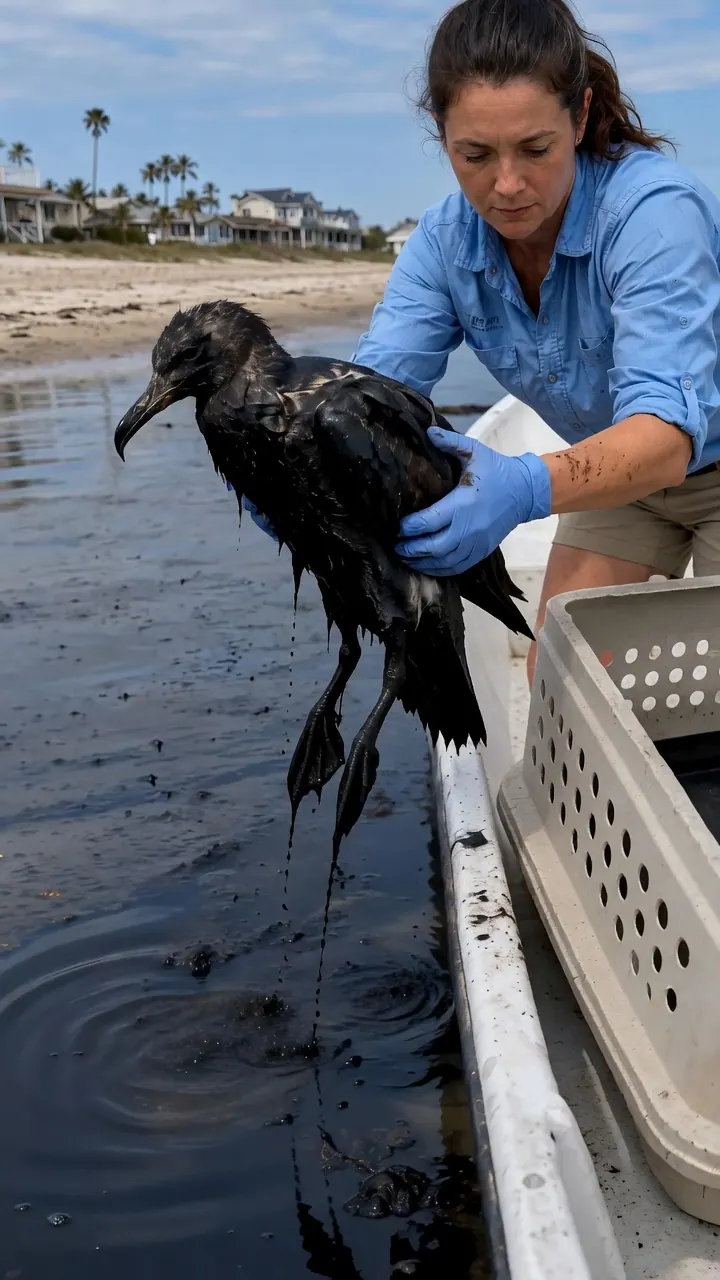
Reaching over the edge of the boat, the woman extended her gloved hands toward the water.
She slid her fingers underneath the bird’s chest, taking care to support its weighted wings.
She lifted it upward in one fluid motion, the sludge dripping continuously from its webbed feet back into the bay.
The gull offered no resistance to the hands lifting it.
Its dark, oil-soaked neck settled against her forearms as she carried it over the gunwale of the boat.
She slowly lowered the heavy bird into a ventilated tan plastic transport crate resting on the deck.
With her hand on the tiller, she restarted the engine and steered the boat back toward the shoreline.
The crate remained secured near her feet, the bird sitting quietly inside the plastic enclosure.
The Cleaning Process
Inside a bright, tiled care facility, the woman placed the seagull into a deep, stainless steel sink.
She applied clear liquid dish soap directly to a thick white sponge.
Pressing the sponge against the bird’s back, she began working the lather deep into the layers of matted feathers.
Her fingers traced the natural curve of the bird’s wings, lifting the stiff, oil-clumped feathers one by one.
The dark sludge slowly yielded, mixing with the white foam and running down the metal drain.
She added more soap to the sponge, carefully working it around the delicate joints of the wings.
The suds turned a deep brown, carrying the toxic film away from the bird’s skin.
She picked up a commercial spray nozzle, directing a steady stream of warm water over the bird’s neck and body.
The gull stood completely still under the running water, shifting its dark beak downward.
The thickest layers of black oil broke apart, washing away to reveal the lighter feathers beneath.
Using the hose, she rinsed the area repeatedly until the water cascading off the bird ran perfectly clear.
Lifting the bird from the sink, the woman placed it onto a soft blue towel on the examination table.
She gently pressed a smaller white cloth over its patterned wings, absorbing the heavy water from the newly exposed plumage.
She repeated the motion across its chest, blotting the feathers until they began to separate and fluff.
The bird was then moved into a brightly lit warming incubator with a glass door.
It tucked its feet underneath its body, resting quietly on a dry towel as the ambient heat dried the rest of its coat.
Building Back Strength
Out in an open-air rehabilitation enclosure, the woman crouched low on the wet concrete floor.
The bird stood a few feet away, its feathers now completely free of oil, showing a striking pattern of brown, black, and white.
She held out a small silver fish, pinching the tail end between her thumb and index finger.
The seagull extended its neck, its beak opening wide as it snatched the fish from her grip.
It tilted its head back, swallowing the meal whole in one quick motion.
The woman extended her hand, lightly brushing her fingers against the top of the bird’s head.
She scratched the nape of its neck, feeling the soft, dry feathers.
The gull leaned into the touch for a moment, closing its eyes as her thumb ran along its jawline.
Stepping away from her hand, the bird planted its feet firmly on the wet concrete.
It extended both wings to their full span, testing its newly regained mobility.
The wings beat against the air, pulling moisture from the damp floor in a strong, steady draft.
The Return Flight
The woman knelt on the wet sand of the beach, carefully holding the clean seagull near the breaking waves.
The ocean breeze caught the bird’s feathers, lifting them slightly as it stared out at the water.
She loosened her grip, pulling her hands away from the bird’s sides to let it stand on its own.
The gull stepped forward onto the sand, its webbed feet sinking slightly into the wet shoreline.
It lifted its broad wings and pushed off the ground, propelling itself over the white foam.
It climbed higher over the blue water, its wings beating in a steady rhythm toward the horizon.
https://www.youtube.com/shorts/CkuhGvY146Y
Share this with someone who appreciates the tireless work of wildlife rescuers. Sometimes the smallest efforts can completely change a life.