

Part 1: The Morning Everything Went Wrong
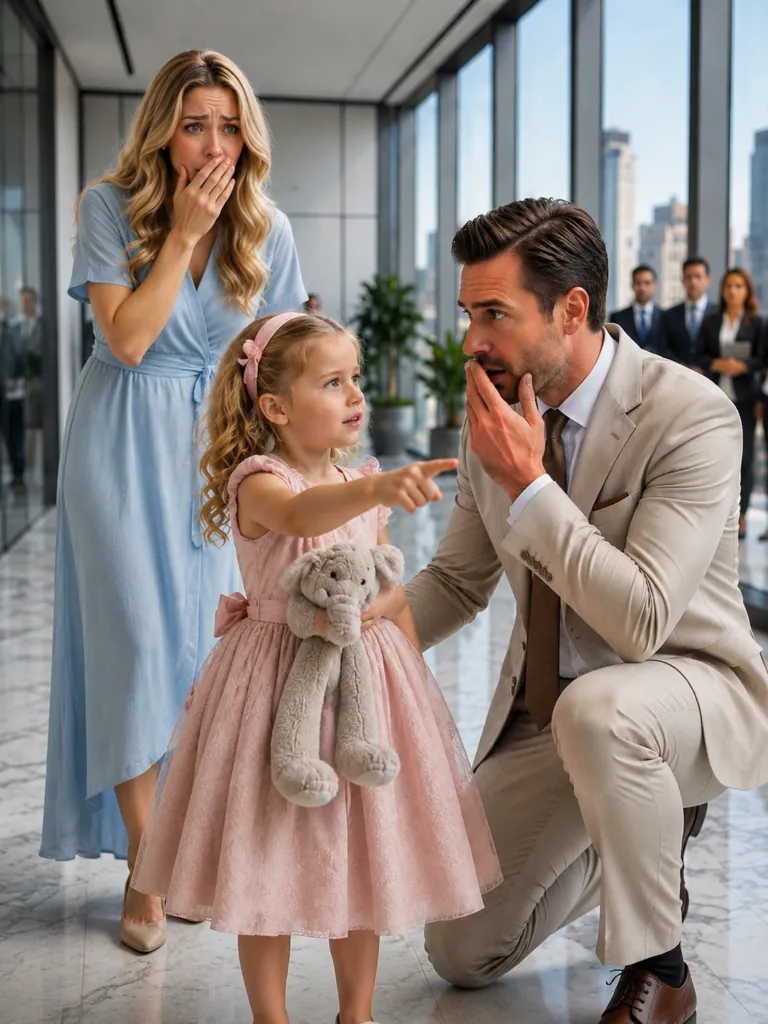
“You’re way too handsome to be alone. You should be my dad.”
My six-year-old daughter said those words in the middle of the executive hallway of one of the most expensive office towers in Scottsdale, Arizona.
For a few seconds, nobody moved.
Nobody laughed.
Nobody even seemed to remember how to breathe.
I stood about twenty feet away, frozen in place with a presentation folder pressed against my chest, watching the most embarrassing moment of my professional life unfold in front of some of the most intimidating people I had ever worked with.
My first thought was not about my boss.
It was not even about my daughter.
It was simple.
I thought, I just lost my job.
The man standing in front of my daughter was Beckett Shaw.
Thirty-eight years old.
Founder and CEO of Shaw & Finch, one of the fastest-growing luxury branding companies in the Southwest.
The kind of man people described in whispers.
Brilliant.
Uncompromising.
Private.
Demanding.
A person who could walk into a conference room and make a dozen executives sit straighter without saying a word.
In three years working under him, I had seen employees leave his office looking like they had just survived an interrogation.
I had seen multimillion-dollar decisions made with a single sentence from him.
I had seen people carefully choose every word around him because nobody wanted to disappoint Beckett Shaw.
Warm was not a word anyone used when describing him.
Friendly was even rarer.
But there he was, standing in the middle of the hallway, looking down at my little girl with the most unusual expression on his face.
Confusion.
Surprise.
And something I had never seen before.
Amusement.
Then, somehow, the impossible happened.
He laughed.
Not the controlled, professional laugh executives used when they wanted to appear polite.
Not the fake smile people gave during uncomfortable conversations.
A real laugh.
Deep.
Unexpected.
Completely genuine.
Everyone nearby noticed because nobody in that building had ever heard it before.
And somehow, my daughter Lila had managed to make the coldest man in the company laugh within five minutes of meeting him.
My name is Mara Ellison.
I was thirty-four years old.
I was a senior creative director.
I was a widow.
And I was the mother of a six-year-old girl who had become my entire world after losing the man I thought I would grow old with.
For the last three years, I had convinced myself that I could handle anything.
The grief.
The bills.
The parenting.
The loneliness.
The pressure of being successful at work while pretending my personal life was perfectly under control.
I had become an expert at smiling when I was exhausted.
At saying “I’m fine” when I wasn’t.
At carrying every problem quietly because I never wanted anyone to look at me and see someone who needed help.
Especially not Beckett Shaw.
But that morning, before my daughter accidentally changed my relationship with my boss forever, everything in my carefully organized life started falling apart.
The day began at 5:12 in the morning.
My phone rang while it was still dark outside.
I knew something was wrong before I even answered.
Nobody calls that early with good news.
“Hi, Mara,” my babysitter said, sounding stressed. “I’m so sorry, but I can’t come today.”
I sat up immediately.
“What happened?”
“There’s a major plumbing issue in my apartment building. The water is shut off, and management says nobody can leave until they inspect everything.”
I closed my eyes.
Of all days.
Not today.
Not when I had the biggest client presentation of the quarter scheduled for ten o’clock.
“Are you sure there’s no way?”
“I tried, Mara. I really did. I’m sorry.”
After we hung up, I sat there in the quiet bedroom, staring at the ceiling.
My mind started racing.
My father was visiting relatives in Oregon.
My closest friend was away on a business trip.
Lila’s school was closed for teacher training.
Every possible backup plan disappeared one by one.
And then I looked toward the doorway.
My daughter was standing there holding Mr. Button, her stuffed rabbit she had slept with since she was two.
Her hair was messy from sleep.
She was wearing pajamas covered in little stars.
And she looked at me with those big, curious eyes that always seemed to know when something was wrong.
“Mommy?”
I forced a smile.
“Good morning, sweetheart.”
“Why do you look like you’re trying to solve a mystery?”
I almost laughed.
Because that was exactly what it felt like.
I was trying to solve an impossible puzzle.
How do I get through the most important workday of the quarter while taking care of my six-year-old daughter?
How do I keep my career stable when my entire support system suddenly disappears?
How do I admit that I need help when I have spent years proving I don’t?
The answer was simple.
I couldn’t.
Not unless I brought Lila with me.
And I hated that.
I hated the idea of my daughter sitting quietly in an office while I worked.
I hated feeling like I was failing at both jobs—the job that paid the bills and the job that mattered most.
Being her mother.
But I had no other choice.
So I packed everything I could think of.
Coloring books.
Crayons.
Snacks.
Headphones.
Her tablet.
A water bottle.
And, of course, Mr. Button.
Before we left our townhouse, I knelt down and looked her in the eyes.
“Okay, today you have a very important mission.”
She immediately became serious.
“A mission?”
“Yes.”
“What kind?”
I lowered my voice.
“The kind only the best agents can handle.”
Her eyes widened.
“Like spies?”
“Exactly.”
She stood a little taller.
“What do I have to do?”
“You have to be the quietest little person in Arizona.”
She thought about that.
Then she nodded.
“Like a ninja?”
I smiled.
“Exactly like a ninja.”
She pointed toward her backpack.
“Can ninjas eat crackers?”
“Yes.”
“Can ninjas watch cartoons?”
“With headphones.”
She considered this.
“Can ninjas talk to your grumpy boss?”
I pointed at her immediately.
“Absolutely not.”
She smiled innocently.
“Okay.”
That should have been my warning.
Because Lila had always been sweet.
She had always been kind.
But she had also inherited her father’s confidence and my inability to back down.
When she decided something mattered, there was no stopping her.
I just didn’t know that before the day ended, my six-year-old daughter would walk into the office of the most powerful man I knew and say the one thing nobody else dared to say.
And somehow…
She would change all of our lives forever.

Part 2: The Hallway Conversation That Changed Everything
For the first hour at Shaw & Finch, Lila was perfect.
Almost suspiciously perfect.
I settled her inside my office with a small table, coloring books, her tablet, headphones, and enough snacks to survive what she called “a very serious ninja mission.”
She sat quietly, drawing pictures of animals and occasionally whispering conversations between her stuffed rabbit and cartoon characters.
Every few minutes, I looked through my glass office wall just to make sure she was still there.
Every time, she was.
I started believing that maybe—just maybe—we could get through the day without anyone noticing.
That was when my assistant appeared at my doorway.
“Mara?”
I looked up from my computer.
“Yes?”
She held a tablet against her chest.
“The client moved the presentation time.”
My stomach tightened.
“What do you mean moved?”
“They want to start earlier. Conference Room One. Ten minutes.”
Ten minutes.
I looked at Lila.
Then at the presentation files open on my screen.
Then back at my assistant.
My entire morning had been built around having extra time.
Now that time was gone.
I quickly gathered my notes and walked over to Lila.
She looked up immediately.
“Is it time for the ninja mission?”
I smiled.
“Part two.”
She sat straighter.
“Do I have a job?”
I knelt beside her.
“Yes. Your job is very important.”
She listened carefully.
“Stay right here. Keep your headphones on. Don’t leave this room unless I come get you.”
She nodded.
“No exploring.”
“Exactly.”
She raised one finger.
“But what if exploring finds me?”
I froze for half a second.
Because that was such a Lila answer.
“What?”
She shrugged.
“Sometimes adventures just happen.”
I laughed softly.
“Not today, sweetheart.”
She promised.
And I believed her.
That was my mistake.
The presentation started on time.
For the first few minutes, everything went smoothly.
The client asked questions.
The marketing strategy was well received.
The creative concepts I had spent weeks developing were finally being shown to the people who would decide whether our team succeeded or failed.
Normally, I loved moments like that.
I loved presenting ideas.
I loved watching people react when they saw something they never expected.
But that morning, my attention kept drifting.
Every few minutes, I glanced toward the door.
Every mother knows that feeling.
That invisible alarm inside you.
The one that starts ringing even when you have no proof anything is wrong.
At minute twelve, I felt it.
Something was wrong.
I tried to ignore it.
I continued speaking.
I answered questions.
I smiled.
But the feeling grew stronger.
I knew.
I just knew.
The second the meeting ended, I thanked everyone quickly and walked out.
I moved faster than I probably should have through the hallway.
My heels clicked against the polished floor.
My heart beat harder with every step.
Then I saw it.
The chair outside my office was empty.
The coloring books were still there.
The tablet was still there.
The snacks were untouched.
But Lila was gone.
“Lila?”
No answer.
My chest tightened.
I turned toward the executive corridor.
And then I heard something that stopped me completely.
Laughter.
Not ordinary laughter.
Not from employees chatting near their desks.
It was coming from the private executive area.
And I knew that voice.
Beckett Shaw.
I followed the sound.
And when I turned the corner, I nearly dropped the presentation folder in my hand.
My daughter was standing outside Beckett’s private office.
Holding Mr. Button under one arm.
Talking to my boss.
The man who rarely allowed anyone into his personal space.
The man whose schedule was planned down to the minute.
The man who had rejected countless casual conversations from employees.
Was now crouching down in front of my six-year-old daughter.
And she was looking at him like she was interviewing him for a position.
“You’re tall,” she announced.
Beckett looked slightly confused.
“I’ve been told.”
She tilted her head.
“Do you always wear suits?”
He glanced down at himself.
“Usually.”
“Why?”
That actually made him pause.
“I suppose because it’s part of my job.”
Lila nodded as if she had just received an important answer.
Then she studied his face.
“And you have nice hair.”
A few employees nearby immediately looked away, trying not to smile.
Beckett blinked.
“That’s new.”
I covered my face with one hand.
I wanted to disappear.
I wanted the floor to open beneath me.
But Lila wasn’t finished.
She hugged Mr. Button tighter.
Then she said the sentence that changed the entire atmosphere of the hallway.
“You’re too handsome to be alone. You should be my dad.”
Silence.
Complete silence.
I don’t know if I have ever experienced a moment where time seemed to actually stop.
Every person nearby heard it.
Every person understood exactly what she had said.
My face burned.
“Lila!”
She turned around.
Her expression immediately brightened.
“Hi, Mom.”
Then she smiled.
“I made a friend.”
I stared at her.
Then at Beckett.
Then at the employees pretending they weren’t listening.
I wanted to apologize.
I wanted to explain.
I wanted to somehow rewind the last thirty seconds.
Instead, all I could say was:
“Mr. Shaw, I am so sorry.”
Beckett slowly stood.
His professional expression returned, but I could still see amusement in his eyes.
“Miss Ellison,” he said calmly, “your daughter has presented a surprisingly direct proposal.”
I closed my eyes.
“I apologize. She doesn’t usually—”
“She usually doesn’t suggest major life changes to strangers?”
I opened my eyes.
“No.”
Lila looked between us.
“Why are you both acting weird?”
Someone behind me quietly coughed.
They were clearly trying not to laugh.
Beckett looked down at her.
Instead of being annoyed, he seemed genuinely curious.
“Lila, may I ask something?”
She nodded.
“Why exactly do you think your mother needs me to become your dad?”
The hallway became quiet again.
But this time, it wasn’t because everyone expected a funny answer.
It was because something about Beckett’s voice had changed.
He wasn’t teasing her.
He was asking seriously.
Lila’s smile faded.
She looked down at Mr. Button.
For the first time all morning, she seemed like a little girl instead of the confident child who had just walked into the CEO’s hallway without fear.
Then she said softly:
My heart stopped.
I felt like someone had pulled the air out of my lungs.
“Lila…”
She hugged her rabbit.
“Not a lot.”
Her little voice became quieter.
“Just sometimes.”
I looked away because I couldn’t let anyone see my expression.
Especially not Beckett.
Especially not my boss.
I had spent three years making sure nobody at work knew how difficult life had become after Caleb died.
I had shown up early.
Stayed late.
Delivered results.
I never complained.
Never asked for special treatment.
Never let anyone see the nights when I sat alone after Lila went to bed, staring at bills spread across the kitchen table.
But my daughter had just revealed the one thing I had worked hardest to hide.
My loneliness.
My exhaustion.
My fear.
Beckett’s expression changed.
The amusement disappeared.
The CEO disappeared.
For a moment, he was simply a man listening to a child who had accidentally told the truth.
“She cries?” he asked quietly.
Lila nodded.
“Mostly when the red letters come.”
My stomach dropped.
The red letters.
The payment reminders.
The overdue notices.
The bills I hid inside the kitchen drawer because I didn’t want Lila to see them.
The things I told myself I could handle.
The things I told everyone else were fine.
I forced a smile.
“Sweetheart, we don’t need to talk about that here.”
But Lila looked back at Beckett.
“Mom says she doesn’t need a husband.”
I closed my eyes.
“Lila.”
“But she does need someone who can make coffee because hers tastes terrible.”
For a second, nobody spoke.
Then someone nearby laughed.
A real laugh.
Even Beckett’s mouth twitched.
“Your daughter appears to have very strong opinions about coffee.”
“She does.”
“Are they accurate?”
I looked at him.
“Unfortunately.”
That was the first time I saw Beckett Shaw almost smile at me.
Almost.
I gently took Lila’s hand.
“Come on, future ninja.”
Before we walked away, she turned back toward Beckett.
“Think about it.”
Beckett raised an eyebrow.
“Think about what?”
“My dad application.”
The hallway erupted with laughter.
Even I couldn’t stop myself.
For the first time in weeks, I laughed.
A real laugh.
But I had no idea that fifteen minutes later, Beckett Shaw would ask me to come into his office.
And the conversation waiting for me would change the direction of my entire life.

Part 3: The Secret Behind the Legal Papers
Fifteen minutes after Lila’s unexpected hallway announcement, my assistant appeared at my office door.
“Mara?”
I looked up immediately.
“Yes?”
She hesitated.
“Mr. Shaw would like to see you.”
Of course he would.
I stared at the message on my screen for a moment.
After everything that had happened, I wasn’t surprised.
I had embarrassed myself in front of the entire executive floor.
My daughter had suggested my CEO become her father.
She had revealed my financial struggles.
And now I had to walk into Beckett Shaw’s office and face him alone.
I took a deep breath.
“Is he angry?”
My assistant smiled slightly.
“No.”
That somehow made me more nervous.
Because Beckett being angry was something I understood.
Beckett being kind was unfamiliar.
I walked toward his office and knocked.
“Come in.”
His voice was calm.
I stepped inside.
Beckett was standing near the floor-to-ceiling windows, looking over downtown Scottsdale.
The afternoon sunlight reflected off the glass buildings below.
For a moment, neither of us spoke.
Then he turned around.
“Close the door, Mara.”
That caught me off guard.
Usually, he called me Ms. Ellison.
Never Mara.
I closed the door slowly.
“Mr. Shaw, I want to apologize again. Lila’s behavior was inappropriate, and I understand if—”
“I didn’t ask you here because of Lila.”
I stopped.
He motioned toward the chair across from his desk.
“Sit.”
I remained standing.
“I’m sorry, but if this is about today, I understand.”
One eyebrow lifted.
“Now I understand where your daughter gets her stubbornness.”
Despite everything, a small smile almost escaped me.
Almost.
“If you’re going to dismiss me, please just do it quickly.”
His expression changed.
Not anger.
Surprise.
“Dismiss you?”
I looked down.
“I brought my child into the office. She interrupted the executive floor. She made inappropriate comments to the CEO.”
Beckett leaned against his desk.
“Mara.”
I looked up.
“Your daughter just attempted the boldest corporate merger I’ve seen all year.”
A laugh escaped me before I could stop it.
A real one.
And for some reason, that seemed to make him relax.
Then he picked up a folder from his desk and placed it in front of me.
I looked at it.
“What is this?”
“Open it.”
I did.
And my breath caught.
Inside was an official promotion letter.
Vice President of Creative Strategy.
A significant salary increase.
A performance bonus.
And a new flexible schedule that included three work-from-home days every week.
I looked up at him.
“I don’t understand.”
“Yes, you do.”
“No.”
I closed the folder.
“I can’t accept a promotion because you feel sorry for me.”
His expression immediately hardened.
Not because he was offended.
Because he was certain.
“I do not pay executive salaries because I feel sorry for people.”
He tapped the folder.
“You earned this.”
I didn’t respond.
He continued.
“You earned it six months ago. The only reason it wasn’t announced was because we were waiting for the restructuring approval.”
I stared at him.
“You’re serious?”
“Very.”
He walked around the desk.
“You delivered twenty-three major campaigns last year. You saved the Harrington account when everyone else thought it was lost. You rebuilt the West Coast creative team after three senior employees resigned.”
His voice softened slightly.
“Do not mistake recognition for charity.”
I looked away quickly.
Because my eyes had started burning.
Nobody had said something like that to me in a long time.
Not since Caleb.
Before I could answer, there was a knock.
My assistant stepped inside.
“Mara?”
I turned.
“There’s a gentleman at reception asking for you.”
I immediately felt uneasy.
“Who?”
She looked at her tablet.
“Douglas Mercer.”
The room changed instantly.
My stomach dropped.
Caleb’s father.
I had not seen Douglas in almost two years.
And the fact that he had come here, to my workplace, on this exact day, made every instinct inside me scream.
Something was wrong.
Douglas Mercer walked into the reception area like he owned the building.
He was sixty-five years old, perfectly dressed, with silver hair, an expensive watch, and the confidence of someone who believed the world would always make room for him.
He didn’t hug me.
He didn’t ask how Lila was.
He didn’t even say hello.
He simply placed a leather folder on the table.
“Mara.”
His voice was cold.
“My attorney filed for temporary guardianship of Lila this morning.”
For several seconds, I thought I had heard him incorrectly.
“What?”
“You heard me.”
I stared at him.
“You filed for guardianship of my daughter?”
“Yes.”
The words felt impossible.
“You haven’t seen her in almost two years.”
His jaw tightened.
“That is going to change.”
“You visited her twice.”
“She needs stability.”
I felt my hands go cold.
“Stability?”
I looked around.
“You disappear for months, then walk into my workplace with legal papers and tell me you’re taking my daughter?”
Douglas’s expression remained unchanged.
“You work constantly. You’re under financial pressure. And now you are bringing her into an office because you have no childcare.”
The cruelty of his words hurt because there was a small part of me that feared they sounded true.
But fear was not reality.
I straightened.
“I am her mother.”
“And Caleb was my son.”
The mention of Caleb cut deeper than I wanted.
Douglas lowered his voice.
“Caleb would have wanted stability for his daughter.”
I looked at him.
That sentence hurt more than anything else.
Because he knew exactly where to aim.
“You don’t get to use Caleb against me.”
Before Douglas could respond, Beckett stepped closer.
His voice remained calm.
“This is a family matter.”
Douglas finally noticed him.
His eyes narrowed.
“And you are?”
“Someone who suggests you have this conversation somewhere else.”
Douglas looked between us.
“This does not concern you.”
Beckett didn’t move.
“You are standing inside my office building threatening one of my employees. That makes it my concern.”
Douglas ignored him.
Instead, he looked directly at me.
“You should have accepted our offer when you had the chance.”
My heart stopped.
“What offer?”
But he didn’t answer.
He simply picked up his folder.
“You’ll understand soon enough.”
Then he walked away.
I stood there, unable to move.
Beckett looked at me.
“What offer?”
I didn’t answer immediately.
My phone buzzed.
A message appeared.
It was from Caleb’s sister, Vanessa.
You should have cooperated.
I stared at those words.
Then everything suddenly connected.
The sudden guardianship request.
The timing.
The pressure.
The accusations.
My voice came out quietly.
“They don’t suddenly want Lila.”
Beckett watched me carefully.
“What do they want?”
I swallowed.
“Her trust.”
And for the first time that day, I realized my daughter was not just being fought over.
She was being used.
Three years after Caleb’s death, I had always believed the hardest part was losing him.
I was wrong.
The hardest part was discovering that some people could look at a grieving mother and see an opportunity.
I didn’t know it yet, but the next few days would uncover a secret worth millions.
A secret that would explain exactly why Douglas Mercer had suddenly decided he wanted custody of my daughter.
And when the truth came out, everyone would learn one thing:
The person they thought was the weakest in the room was the one who had been protecting everything all along.
Note: This story is a work of fiction inspired by real events. Names, characters, and details have been altered. Any resemblance is coincidental. The author and publisher disclaim accuracy, liability, and responsibility for interpretations or reliance.