
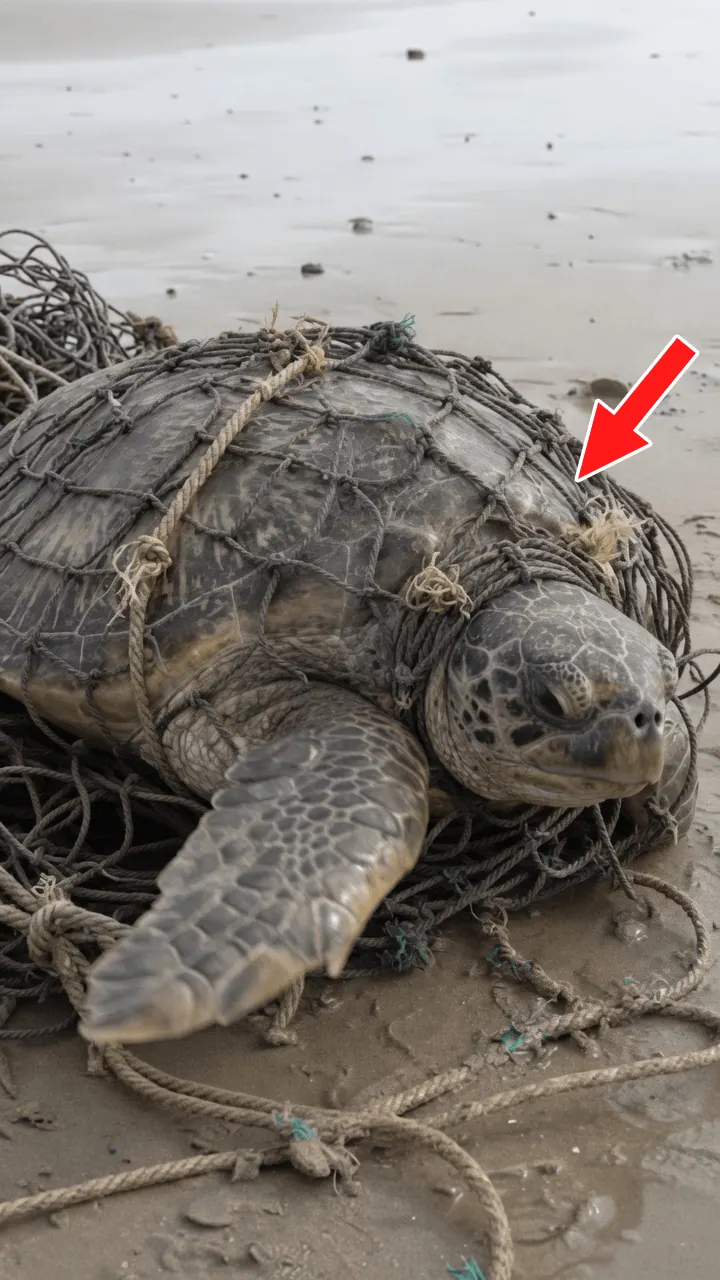
Trapped in a Knot of Ghost Nets
Thick cords of black plastic netting pinned the sea turtle flat against the wet gray sand. Each time the animal attempted to extend its front flippers, the tight loops dug deeper into its leathery skin.
A massive ball of discarded fishing line covered almost the entire shell. Only the turtle’s head and the tips of its paddle-like limbs pushed out through the tangled mesh.
Dark ropes crossed directly over the turtle’s neck and back, anchoring it to the mud near the water’s edge. The animal blinked slowly against the sea spray, keeping its head low while the tide lapped a few yards away.
Uniformed rescue personnel arrived on the beach, carrying scissors and shears across the wet ground. They approached the stranded reptile quietly, dropping to their knees to assess how deeply the cords were bound.
Snipping Away the Entangled Strands
One officer in a yellow and black camouflage uniform pressed the blunt side of a pair of scissors beneath the uppermost cord. He worked slowly, ensuring the metal blades stayed clear of the turtle’s soft neck.
Snip by snip, the heavy strands parted under the pressure of the blades. Two other rescuers knelt on the sand, using their gloved hands to pull the loosened loops away from the carapace.
The turtle remained still as the rescuers worked, its dark eyes watching the hands moving over its shell. Every time a tight section gave way, the thick mesh sprang open, peeling back layer after layer of ocean debris.
A rescuer carefully untangled a knotted section looped around the right flipper. He slid his fingers between the skin and the cord, lifting the plastic just enough to slice it clean through.
Together, the officers gripped the main bundle of the netting and hauled it backward. The heavy cluster dropped into the sand beside them, leaving the turtle’s shell clear and unburdened.
A Careful Lift to the Shoreline
With the nets removed, the turtle stretched both front flippers outward against the mud. The animal pushed forward slightly, testing its weight on the wet sand.
One of the rescuers stepped behind the turtle and bent his knees. He placed both gloved hands firmly under the sides of the broad shell, lifting the heavy reptile into his arms.
He walked across the firm sand toward the breaking surf, holding the turtle level against his chest. The turtle kept its flippers tucked inward as the man carried it toward the white foam of the incoming tide.
Reaching the shallow wash, the officer knelt down into the shallow water. He lowered the turtle gently until its plastron rested directly in the foamy surf.
Returning to the Open Sea
The first small wave washed over the turtle’s shell, wetting the dry scales and clearing away the sand. The animal lifted its head, drawing in a breath as the cool water lifted its weight.
Its front flippers swung forward in wide, rhythmic strokes. The turtle pushed itself off the sandy bottom, sliding smoothly through the shallow water toward deeper territory.
The officer stepped back onto the dry beach, watching the dark silhouette glide outward past the breaking crests. The turtle crested the surface once more, dipped beneath the green water, and swam away toward the horizon.
Share this with someone who cares about keeping our oceans safe for marine life.