
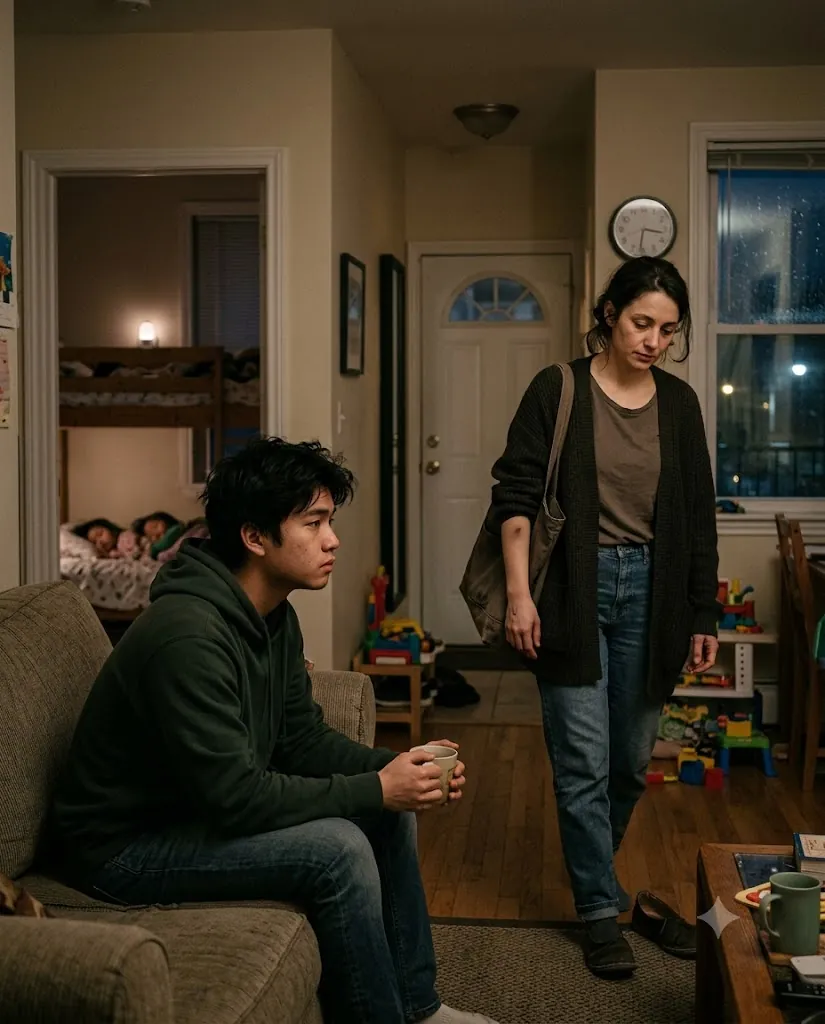
I was nineteen when I first stepped into her apartment. It was small and strangely quiet, the kind of quiet that didn’t feel peaceful, just… incomplete. When she opened the door, one baby rested against her hip while the other cried softly in the background. Her hair was loosely tied, her eyes tired but gentle, and instead of greeting me, she simply said, “I’m sorry, it’s been a long day,” as if she had already been carrying something heavy before I ever arrived.

Her name was Elena, and from the beginning, there was something about her life that didn’t quite fit. There were no photos on the walls, no signs of family, no trace of anyone else ever being there. It was just her and the twins, Luca and Mira, like the rest of the world had been quietly erased.
At first, everything felt normal enough. I worked during the day, helping with the babies while she moved through the apartment calmly, always polite, always grateful. But there was a distance in her that never changed, like she was present physically but holding a part of herself somewhere far away.
Then I started noticing her routine. Every night, at exactly midnight, she would leave. No explanation, no hesitation, just a soft “I’ll be back in the morning,” and the door closing behind her.
I didn’t ask. Not because I wasn’t curious, but because something about her silence felt intentional, like it deserved to be left untouched. Still, small details began to stay with me. Some mornings her clothes were wrinkled, and once I saw a faint bruise on her wrist, quickly hidden but impossible to forget.
One evening, I arrived early and found her sitting on the edge of the bed, holding both babies tightly against her chest. Her face was buried between them, her shoulders trembling slightly, not loudly, but in a way that felt deeper than crying. When she noticed me, she lifted her head and smiled too quickly, thanking me for coming early as if nothing had happened.

Time passed quietly like that, and without realizing it, I became part of their world. The twins grew attached to me, and the apartment, once too quiet, slowly filled with laughter and small moments that made it feel like home.
Then one day, she told me she was leaving. She said she had found a better place for the children, and while her voice sounded certain, her eyes didn’t. On her last day, when she hugged me goodbye, she held on longer than expected, her body trembling as if she was trying not to fall apart.
Three days later, the police came to my door.
They showed me her photo, and before they even explained, my chest tightened. She was alive, they said, but there had been an accident. Then they handed me an envelope and told me she had listed me as her emergency contact.
Inside was a short note: “I have no one else I trust with my babies. Please.”
That was the moment everything shifted. Not suddenly, but deeply.
When I saw her in the hospital, she looked fragile in a way I had never seen before. The moment she saw me, she broke down, whispering, “You came,” like she hadn’t been sure anyone would.
I took Luca and Mira home with me, and for the first time, the weight of her life began to make sense. The truth didn’t come all at once, but slowly, through pieces that finally connected.
Every night, she hadn’t been disappearing.
She had been helping women with nowhere to go, mothers escaping danger, children needing a safe place, even if only until morning. The marks, the exhaustion, the fear I had seen in her—they were never about herself alone.
She had been carrying other people’s lives.
When she was finally discharged, I brought the twins to her. The moment they ran into her arms, something in the room changed, like everything she had been holding finally loosened, even if just a little.
She looked at me then, softer, no longer guarded, and said quietly, “Kindness always finds its way back.”
And in that moment, I understood.
Some people don’t need to be seen to matter. They move quietly through the darkest places, doing what others won’t, asking for nothing in return. And when they finally fall, all they hope for is something simple— that someone, somewhere, will show up for them too.