
An Urgent Discovery On The Asphalt
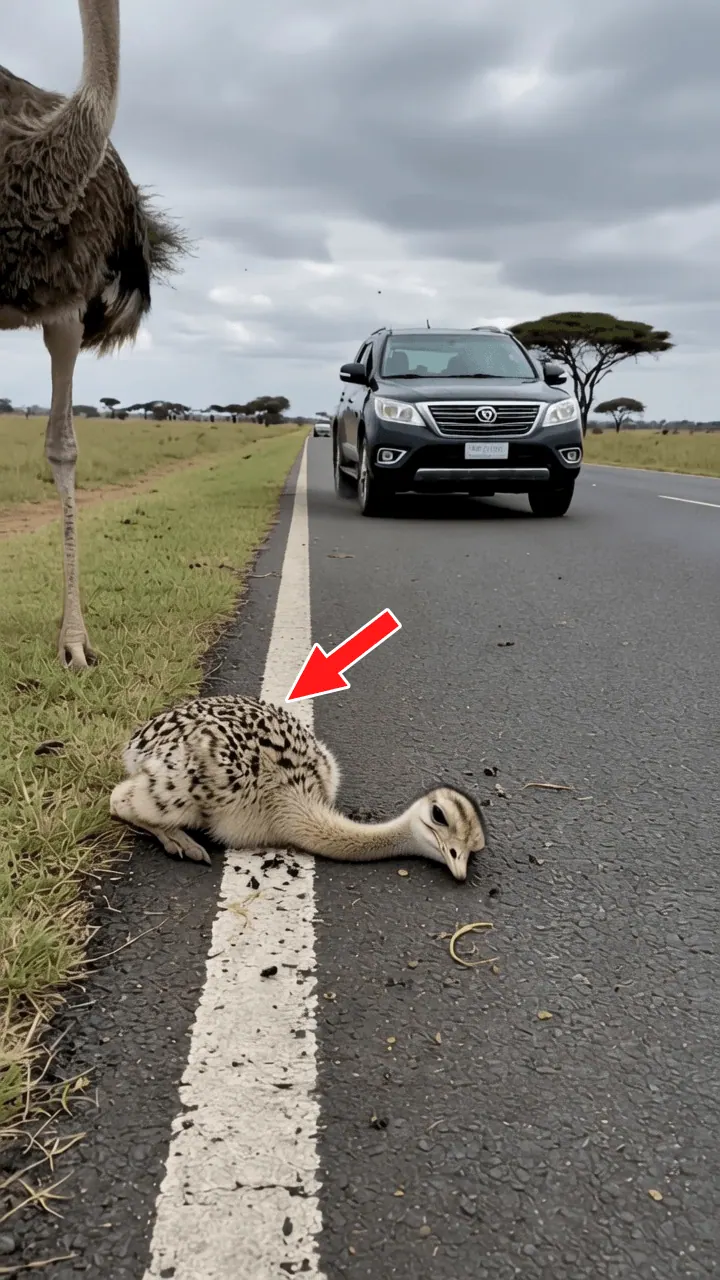
A small rhea chick lay flat against the asphalt of a two-lane road as a blue sedan slowed to a crawl.
Its long neck stretched out completely limp along the white painted line marking the shoulder.
Just inches away, a fully grown adult rhea stood tall on the grass, pacing back and forth with its wings partially flared.
The adult bird opened its beak wide, emitting a sharp, defensive sound toward the passing vehicles.
Cars slowed down and navigated around the bird, their tires kicking up dust at the edge of the road.
A black SUV came to a stop a few yards back, and a man in a gray shirt and blue jeans stepped out of the driver’s side.
He walked directly toward the two birds, holding a small plastic cup in his hand.
The adult rhea stood its ground on the grass, its head turning to track every step of the approaching human.
The man knelt beside the chick, keeping his movements slow and predictable.
He reached out and gently touched the feathers on the young bird’s back to gauge its reaction.
The chick remained still, its head resting heavily on the hot road surface.
A Delicate Treatment Under A Watchful Eye
The man examined a dark patch of matted feathers and blood on the back of the chick’s neck.
He poured a small amount of clear liquid from his cup directly onto the wound to clean away dirt.
The adult rhea watched from less than two feet away, its large eyes fixed on the man’s hands.
The man didn’t pull away when the adult bird leaned its long neck forward to inspect the process.
He reached for a white spray bottle and began applying an antiseptic directly to the injured area.
A fine white mist coated the back of the chick’s neck as the man held its body steady with his left hand.
The young bird flinched slightly but did not attempt to stand up or run away.
The man patted the feathers down, ensuring the antiseptic covered the entire scratch.
He wiped away the excess liquid with a clean cloth, working carefully around the sensitive skin.
The adult rhea remained close, occasionally tilting its head as the spray bottle clicked.
With the wound cleaned and disinfected, the man pulled a large white adhesive bandage from his pocket.
A Bandage And A Handful Of Seeds
He carefully pressed the white bandage over the matted patch of feathers on the chick’s back.
His fingers smoothed down the edges of the adhesive tape to make sure it secured firmly to the plumage.
The chick sat quietly on the asphalt, its breathing steady as the man finished securing the patch.
The adult rhea stepped closer, its beak hovering just inches above the man’s shoulder.
The man slowly sat back on his heels, letting his hands rest on his knees to show he was finished.
He reached into a pouch and pulled out a handful of mixed seeds and grains.
He held his palm open directly in front of the chick’s beak.
The young bird slowly lifted its head from the ground and began peck-feeding from his hand.
The man then offered the remaining seeds to the adult rhea, which reached down to eat.
He scattered a small pile of food onto the pavement between them to encourage them both.
The adult bird dipped its head to pick seeds from the asphalt next to the chick.
Know someone who loves wildlife rescues? Share this amazing recovery with them.