
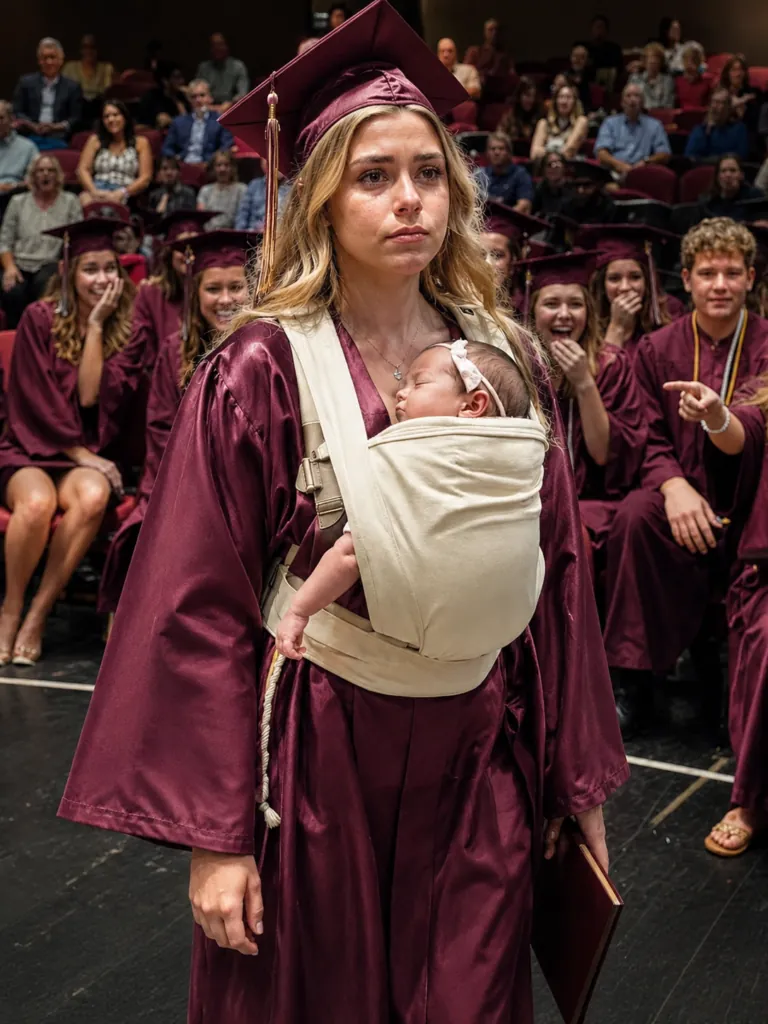

The laughter started before my name was even announced.
A mistake.
A disappointment.
A young woman who had ruined her own future.
I could feel hundreds of eyes following me as I walked across the stage. Some were filled with curiosity. Others carried judgment. A few people whispered behind their programs, not even trying to hide their opinions.
Then I heard a voice from the seats behind me.
“Just like its mother…”
The words were quiet, but they reached me clearly.
My arms tightened around baby Noah.
I refused to look back.
I had spent most of my life learning how to survive people’s assumptions. I knew exactly what they saw when they looked at me.
A twenty-two-year-old orphan.
A former foster child.
A girl who should have been grateful for every opportunity she received instead of asking questions.
They did not know the truth.
They did not know how many nights I had stayed awake studying after working late shifts. They did not know how many times I had been told I was lucky just to have a roof over my head. They did not know how often I had been reminded that someone else had “saved” me, as if kindness could become a lifelong debt.
And they certainly did not know why I was standing on that stage holding a baby who was not mine by birth.
The woman laughing the loudest was my aunt, Marlene.
For sixteen years, she had made sure I never forgot that she had taken me in after my parents died.
She never missed an opportunity to remind me that I was not truly part of the family.
Food, clothes, and a place to sleep were not gifts in her eyes.
They were debts.
Every meal came with a reminder.
Every birthday came with a lecture.
Every achievement came with the question of whether I would have succeeded without her.
Beside her sat her daughter, Vanessa, wearing the white honor stole that should have been mine.
A stole I had earned through years of perfect grades, late-night research, and countless hours of work.
But three weeks earlier, Vanessa had taken it from me with a single complaint.
A complaint built on lies.
And now she sat there smiling while everyone believed I was the one who had done something wrong.
They thought I was walking onto that stage carrying a symbol of failure.
They had no idea I was carrying the reason their entire plan was about to collapse.
Three weeks before graduation, I had found Noah outside St. Catherine’s Clinic.
It was early in the morning when I saw the small cardboard carrier sitting near the clinic entrance.
Inside was a newborn baby wrapped in a hospital blanket.
A note explained that his mother had passed away shortly after giving birth due to complications. His father was unknown. No relatives had come forward to take responsibility.
A social worker stood nearby, her expression filled with sadness.
“He’ll go into the system,” she told me gently.
I looked down at Noah’s tiny hand curling around my finger.
And suddenly, I remembered myself at six years old.
Waiting in a county office.
Listening to strangers discuss where I would go next.
Wondering if anyone would choose me.
I knew what it felt like to be a child everyone considered a problem to solve.
So I made a decision.
“No,” I whispered.
The social worker looked surprised.
“No?”
I held Noah closer.
“He comes home with me.”
People later called it reckless.
They said I was too young.
They said I had no idea what I was doing.
But what they did not know was that I had already spent years preparing.
Through my social work program, I had completed foster-care training. I had studied child welfare systems. I had volunteered at legal-aid clinics helping families understand paperwork, records, and their rights.
Temporary guardianship was approved.
And from that moment, Noah became part of my life.
But Marlene did not see it as compassion.
She called it a performance.
A way for me to get attention.
Vanessa was even crueler.
She laughed when she heard.
“Clara, you’re unbelievable,” she said. “You’re collecting problems now?”
I stared at her.
“He’s a baby, Vanessa.”
She rolled her eyes.
“You barely have your own life together.”
I wanted to believe she was just being insensitive.
I wanted to believe she was simply jealous.
But then they went further.
A complaint suddenly appeared accusing me of academic misconduct.
It claimed I had cheated on my final research project.
It claimed I had behaved irresponsibly by bringing “an unrelated infant” onto campus.
And because Vanessa’s boyfriend, Caleb, worked in the registrar’s office, the complaint moved faster than it ever should have.
My scholarship was suspended.
My graduation status was placed under review.
Everything I had worked for was suddenly hanging by a thread.
When Marlene heard the news, she smiled.
Not with concern.
With satisfaction.
“You should skip the ceremony,” she told me.
I looked at her carefully.
“Why?”
She leaned closer.
“Save yourself the humiliation.”
For a moment, I almost believed her.
Almost.
Then I remembered something.
Two years of volunteering at a legal-aid clinic had taught me a lesson.
People who relied on power often underestimated paperwork.
They believed records disappeared.
They believed signatures could not be questioned.
They believed money could erase the truth.
But I had learned how to follow a trail.
And my final research project was not just an assignment.
It had uncovered something much bigger.
While studying scholarship access and student support systems, I noticed a pattern.
Students from difficult backgrounds were repeatedly losing opportunities to students with lower qualifications but stronger connections.
At first, I thought it was coincidence.
Then I started comparing records.
Dates.
Approval forms.
Financial documents.
Recommendation letters.
Nothing matched.
The more I investigated, the more disturbing the pattern became.
Scholarship rankings had been altered.
Student records had been changed after committee reviews.
Donor funds had been redirected.
And every trail seemed to lead back to the same people.
Caleb.
Vanessa.
And one administrator who had protected them.
When they realized I was getting close, they attacked first.
They thought suspending my scholarship would silence me.
They thought embarrassing me would make me disappear.
They thought the girl they had controlled for years would simply accept another injustice.
They were wrong.
Because this time, I had evidence.
I had copied access logs.
Approval records.
Financial transfers.
Every suspicious document I could find.
And before my own case was reviewed, I had already sent encrypted copies to Principal Everett, the state education inspector, and the financial crimes division.
A former legal-aid attorney had also reviewed everything and helped preserve the evidence properly.
I knew the truth would eventually come out.
I just did not know when.
Until graduation day.
I walked onto that stage holding Noah because I wanted them all to see me.
I wanted Marlene to look at me.
I wanted Vanessa to understand.
I wanted every person who had whispered behind my back to witness the moment their assumptions disappeared.
The principal slowly rose from his chair.
The laughter continued.
For a few seconds, the entire auditorium waited for my embarrassment.
Then Principal Everett stepped toward the microphone.
He raised one hand.
The room slowly quieted.
“Before Miss Clara Hayes receives her diploma,” he said, his voice carrying across the auditorium, “this institution owes her a public apology.”
The laughter stopped.
Everyone froze.
And for the first time that day…
people were no longer looking at me with judgment.
They were waiting to hear the truth.

Principal Everett stepped toward the microphone while I stood beneath the bright stage lights, Noah sleeping peacefully against my graduation gown.
For several seconds, nobody moved.
The entire auditorium had gone from laughter to confusion.
The same people who had been whispering moments earlier were now staring at the principal, waiting for an explanation.
Everett looked directly at the audience.
Then he looked at me.
“Miss Hayes,” he began, “has not been found guilty of academic misconduct.”
A wave of surprise moved through the room.
“She has been found responsible for exposing it.”
The silence that followed was heavier than any insult I had heard that morning.
A few people gasped.
Someone dropped a program.
Vanessa’s confident smile disappeared instantly.
The white honor stole around her shoulders suddenly looked different.
Not like an achievement.
Like evidence.
Principal Everett opened a folder in his hands.
“Her final research project identified a coordinated scheme involving altered scholarship rankings, forged disciplinary reports, and the diversion of more than two hundred thousand dollars in donor funds.”
The auditorium erupted with whispers.
Parents turned toward each other.
Students raised their phones.
Several donors sitting near the front looked completely stunned.
Caleb immediately stood up.
“This is insane!”
His voice echoed through the room.
He looked around desperately, as if everyone else would agree with him.
But nobody did.
Two campus security officers walked into the aisle.
Caleb’s expression changed.
For the first time, he looked uncertain.
Marlene grabbed Vanessa’s wrist.
“Sit down,” she whispered sharply.
But I watched them calmly.
For sixteen years, they had mistaken my silence for weakness.
They thought because I did not fight back loudly, I did not see what was happening.
They were wrong.
The truth had started six months earlier.
I had noticed that students with difficult backgrounds and strong academic records were repeatedly losing scholarships to students with lower scores but wealthier families.
At first, I questioned myself.
Maybe I was seeing patterns that were not really there.
Maybe I was looking too closely.
But then I found inconsistencies.
Files had been edited after committee reviews.
Time stamps did not match.
Recommendation letters disappeared from student records.
Approval documents were changed without proper authorization.
Because I worked nights in the archive office, I knew how to trace document histories.
I knew where records were stored.
I knew how changes were recorded.
I knew which digital footprints people forgot to erase.
So I started collecting everything.
Every access log.
Every approval code.
Every suspicious transfer.
Every connection between people involved.
And when my own scholarship was suddenly suspended, I understood why.
They had discovered I was close.
But what they did not know was that I had already protected myself.
Principal Everett lifted another document.
“The evidence provided by Miss Hayes was reviewed independently.”
He looked toward the audience.
“The investigation confirmed unauthorized changes to student records, improper scholarship decisions, and financial irregularities connected to multiple individuals.”
Vanessa suddenly stood up.
“She’s obsessed with me!”
Her voice cracked through the auditorium.
“She made all of this up because she’s jealous!”
Everyone turned toward her.
I finally faced her.
For years, Vanessa had acted like she was untouchable.
Like her family’s connections would always protect her.
But now she looked frightened.
I took a slow breath.
“Jealous of what?” I asked.
My voice was calm.
“The grades you changed? Or the money Caleb moved?”
Her mouth opened.
But no words came out.
The silence answered for her.
Principal Everett opened another folder.
“We also recovered security footage showing Mr. Caleb Dunn accessing Miss Hayes’s academic records after midnight using Assistant Dean Mercer’s credentials.”
The room exploded with reactions.
Caleb stepped backward.
“That’s not true.”
But his voice no longer sounded confident.
The assistant dean, who had been sitting near the front, suddenly stood and began moving toward a side exit.
Security officers immediately blocked his path.
The entire auditorium watched as the people who had tried to destroy my future finally realized they could not control what happened next.
Then the giant screen behind the stage changed.
A timeline appeared.
Documents.
Dates.
Messages.
Financial records.
Everything they had tried to hide was now visible to hundreds of witnesses.
Altered scholarship rankings.
Transfers to hidden accounts.
Fake complaints.
Messages between Vanessa and Caleb.
Then one message appeared large enough for everyone to read.
“Once Clara is disqualified, the fellowship is yours.”
A wave of shock moved through the room.
Vanessa looked at me as if she could not believe what she was seeing.
“You planned this,” she whispered.
I shook my head.
“No.”
I looked directly at her.
“I documented what you planned.”
For once, she had no answer.
Then Marlene pushed into the aisle.
Her face was filled with anger.
“You ungrateful little parasite!” she shouted.
The room became silent again.
“After everything I did for you!”
The words hurt more than I expected.
Not because they were true.
Because for years, a part of me had feared she believed them.
I looked at the woman who had raised me but never truly accepted me.
The woman who reminded me constantly that I was a burden.
The woman who had convinced me that I owed her my entire existence.
But before I could respond, Principal Everett spoke again.
And what he revealed next changed everything.
“Mrs. Marlene Hayes,” he said, his voice becoming more serious, “there is another matter investigators reviewed.”
Marlene’s expression changed.
“What?”
Everett opened another file.
“The survivor benefits paid after Clara Hayes lost her parents were examined.”
My heart stopped.
I had expected cruelty.
I had expected manipulation.
But I had not expected this.
“Nearly eighty thousand dollars intended for Clara’s care,” Everett continued, “was transferred into accounts connected to you.”
The entire room went silent.
My knees almost weakened.
For years, I had suspected Marlene was cruel.
I had suspected she treated me differently because she never wanted me there.
But I had never known she had taken the money meant to help me.
I looked at her.
She looked away.
For the first time in sixteen years…
Marlene looked afraid of me.

The auditorium remained frozen as investigators approached Marlene, Caleb, Vanessa, and Assistant Dean Mercer.
For the first time, the people who had spent years controlling the story no longer had the power to rewrite it.
Marlene pointed at me with a trembling finger.
“She belongs to me,” she said.
Her voice was filled with anger and desperation.
“I raised her.”
I stepped down from the stage slowly, still holding Noah in my arms.
The baby shifted slightly against my chest, unaware of the chaos happening around us.
I looked at Marlene.
“No,” I said quietly.
The entire room listened.
“You controlled me. There’s a difference.”
Her expression tightened.
For years, I had been afraid of disappointing her.
Afraid of losing the only home I knew.
Afraid that if I spoke the truth, I would have nowhere to go.
But standing there that day, I finally understood something.
A person does not become family simply because they share your address.
Family is not built through guilt.
It is built through love.
Marlene stepped forward, but an officer moved between us.
“She’s lying!” Vanessa suddenly shouted.
Her voice cracked.
“She’s always trying to make us look bad!”
But nobody believed her anymore.
The evidence was no longer a rumor.
It was not a personal argument.
It was not a disagreement between family members.
It was documented.
Recorded.
Verified.
Vanessa’s confidence completely disappeared as she realized there was nothing left to manipulate.
Then, unexpectedly, she looked at me.
Her expression changed.
The anger faded.
Fear replaced it.
“Clara, please,” she whispered.
“Tell them I didn’t understand.”
I stared at her.
For years, Vanessa had watched while Marlene treated me like I was less important.
She had watched while opportunities disappeared from my hands.
She had benefited from every unfair advantage.
And now she wanted me to save her.
“Tell them I didn’t know,” she begged.
Before I could answer, Caleb turned toward her.
“You told me which records to change!”
His voice was filled with panic.
Vanessa looked at him in disbelief.
“You said no one would check!”
The words hung in the air.
Their accusations collided in front of hundreds of witnesses.
The people who had worked together to destroy my future were now revealing each other’s roles.
Principal Everett walked toward me.
He held my diploma in his hand.
Then he turned toward Vanessa.
Slowly, he removed the white honor stole from her shoulders.
The entire auditorium watched.
“This belongs to the student who earned it,” he said.
Then he placed it over my shoulders.
The applause started quietly.
One person stood.
Then another.
Within seconds, the entire hall rose.
The sound filled the room.
Not because I had defeated someone.
Not because I had exposed a scandal.
But because everyone finally understood what I had been fighting for.
A fair chance.
I looked toward the back row where Marlene had been sitting earlier.
The seat was empty.
She was being escorted through a side exit while cameras followed.
Noah stirred in my arms.
His tiny eyes opened for a moment.
I smiled down at him.
“We made it,” I whispered.
And for the first time in my life, I truly believed it.
The evidence led to formal charges involving fraud, financial misconduct, identity misuse, and conspiracy.
Caleb eventually accepted a plea agreement and testified against Assistant Dean Mercer.
Mercer received legal consequences and was ordered to repay the misused funds.
Vanessa lost her fellowship.
Her degree was withheld while the university reviewed her academic records.
She later admitted to falsifying documents and received disciplinary consequences, including probation, community service, and a permanent notation on her academic record.
But Marlene’s case hurt the most.
Because she was the person who was supposed to protect me.
The investigation uncovered bank records showing she had taken the survivor benefits intended for my care.
The money that should have helped me after losing my parents had been used for Vanessa’s private school expenses and a rental property connected to Marlene.
The property was seized.
Marlene received an eighteen-month sentence and was ordered to repay the money with interest.
At the final hearing, she looked smaller than I had ever seen her.
Not powerful.
Not intimidating.
Just a person finally forced to face what she had done.
She looked at me and whispered:
“You ruined this family.”
For a moment, I remembered being six years old.
A little girl sitting in an unfamiliar office, waiting for someone to decide where she belonged.
A little girl who thought she had to accept anything because she had nowhere else to go.
But I was not that child anymore.
I looked at Marlene.
“No,” I replied.
“You ruined it when you decided an orphan had no one who would believe her.”
One year later, I graduated again.
This time, with a master’s degree in child welfare policy.
No whispers followed me.
No one laughed.
No one questioned whether I belonged.

Noah sat in the front row wearing blue suspenders, clapping proudly.
On the certificate, under the word “Parent,” was my name.
Not because I had given birth to him.
Because I had chosen him.
Because I had stayed.
Because I had loved him.
With the recovered money and a university grant, I created the Hayes House Legal Fund.
Its purpose was simple.
To help foster students and vulnerable families challenge unfair systems, protect their records, and fight for opportunities they deserved.
The first person who came to us was a seventeen-year-old girl whose guardian had emptied her trust account.
She sat across from my desk, afraid nobody would believe her.
When she asked why I trusted her story, I placed my graduation photo on the desk.
The picture showed me standing under the lights.
A diploma in one hand.
Noah in the other.
I smiled.
“Because I know what it feels like,” I told her.
“To have people laugh before they know the truth.”
That evening, Noah fell asleep against my shoulder while rain tapped softly against the windows.
For most of my life, I believed family was something I had lost.
I thought family was something other people were lucky enough to have.
But I finally understood.
Family was never the people who claimed ownership over my pain.
Family was the person I chose to protect.
The future I chose to build.
And the love I created after surviving everything that tried to break me.
Note: This story is a work of fiction inspired by real events. Names, characters, and details have been altered. Any resemblance is coincidental. The author and publisher disclaim accuracy, liability, and responsibility for interpretations or reliance.