
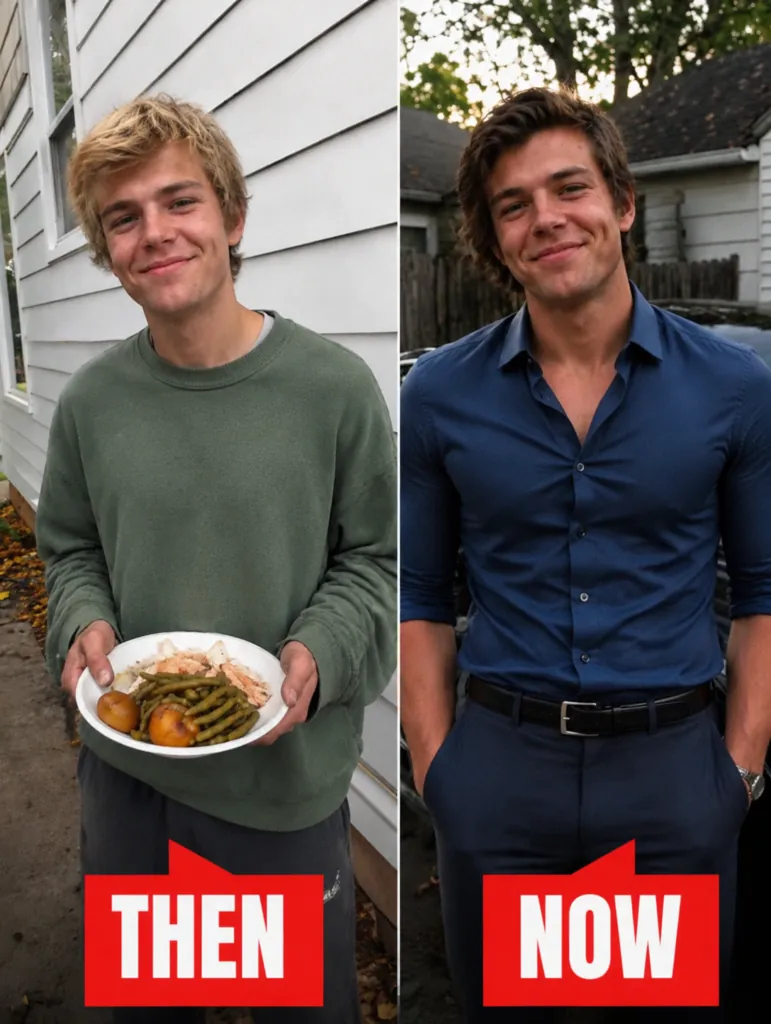

I was eight years old when the homeless boy appeared behind our neighborhood.
At first, nobody knew where he had come from. Some people claimed he’d run away from an abusive home. Others whispered that he had been abandoned after his mother died. A few insisted he was dangerous simply because he had nowhere to sleep.
All I knew was that every evening, when the sun dipped behind the old recycling yard, he crawled beneath a rusted sheet of corrugated roofing beside the dump behind our street and called it home.
His name was Luke.
He looked about eighteen, though later I learned he was only seventeen when he first arrived there. Hunger had aged him. His cheeks were hollow, his clothes hung loosely from his thin frame, and his shoes looked as though they had survived years longer than they should have. Yet despite everything, his eyes remained strangely gentle. They were the cautious eyes of someone who had learned to expect rejection before kindness.
At eight years old, I couldn’t see any of that.
I only saw a stranger stealing something I desperately wanted.
My father had died earlier that spring.
His death shattered our family overnight. One day he had been laughing over breakfast, burning pancakes the way he always did on Sunday mornings. The next, he was simply…gone.
After the funeral, silence settled inside our little house like permanent furniture.
My mother, Evelyn Hart, suddenly became everything at once—a grieving widow, a single parent, and the only person responsible for paying bills that seemed to multiply every month.
Money became something we counted before we spent.
Sometimes before cooking dinner, Mom stood in front of the refrigerator with a notebook, quietly adding numbers under her breath. She would stare at canned soup, potatoes, and half a loaf of bread as though solving a complicated math problem.
Back then, I didn’t understand what she was doing.
Now I know she was calculating which meals we could afford to eat.
Despite that, every afternoon she prepared an extra plate.
She wrapped it carefully in aluminum foil, placed it inside an old cloth bag, and disappeared through the back gate toward the dump.
She never explained where she was going.
She didn’t have to.
I followed her one afternoon.
Hidden behind an overgrown hedge, I watched her kneel beside Luke.
She handed him a plate of roasted chicken, mashed potatoes, and vegetables.
He accepted it with both hands.
“Thank you, ma’am,” he said quietly.
He spoke with such sincerity that it startled me.
Most adults barely thanked my mother when she helped them. Luke thanked her as though she’d handed him the entire world.
Mom smiled.
“Eat while it’s still warm.”
“I don’t know how to repay you.”
“You already have.”
He looked confused.
“You remind me that kindness only matters when it costs us something.”
He lowered his eyes before beginning to eat.
I ran home before she saw me.
That evening, we had canned vegetable soup.
I remember staring into my bowl while imagining Luke eating chicken.
Something bitter settled inside my chest.
The next afternoon, Mom packed sandwiches.
Again she left.
Again we ate leftovers.
Days turned into weeks.
Sometimes Luke received fresh bread while Mom insisted she wasn’t hungry.
Sometimes he got stew while she quietly skipped dinner.
Whenever I asked why she wasn’t eating, she’d simply smile.
“I had a late lunch.”
It wasn’t until years later that I realized she was lying.
Then came the apple pie.
Even now, decades later, I can still remember the smell filling our tiny kitchen.
Warm cinnamon.
Brown sugar.
Butter.
Apple pie had always been my favorite.
Mom only baked it on birthdays or holidays because apples and butter had become expensive after Dad died.
That Saturday morning, I walked into the kitchen and saw the pie cooling on the counter.
My heart nearly burst with excitement.
“Is that for dinner?” I asked.
I was already imagining the first warm slice topped with melting vanilla ice cream—even though we almost never had ice cream anymore.
Mom froze.
For a second, she didn’t answer.
Instead, she picked up the pie and wrapped it carefully.
Then she avoided looking directly at me.
“No.”
Just one word.
No explanation.
No smile.
She tucked the pie against her hip and headed toward the back door.
I stared after her.
A terrible realization hit me.
The pie wasn’t for us.
It was for Luke.
Everything inside me exploded.
“Why?” I shouted.
Mom stopped.
I could hear my own breathing.
“Why does he get dessert when we can’t even eat decent food?”
The words poured out before I could stop them.
“He’s not even part of this family!”
Mom slowly turned around.
I had never seen her expression like that before.
She wasn’t simply angry.
She looked heartbroken.
Her eyes flashed with a kind of disappointment that frightened me more than yelling ever could.
“Emily.”
Her voice was low.
“Never.”
She took one step toward me.
“Never speak about Luke that way again.”
I felt tears filling my eyes.
“But—”
“Never make me hear those words again.”
The kitchen became painfully silent.
For the first time since Dad died, my mother looked at me like she didn’t recognize the child standing in front of her.
Without another word, she carried the pie out the back door.
I stood alone beside the table.
Ashamed.
Angry.
Confused.
Most of all…
Replaced.
Children don’t understand sacrifice.
We understand attention.
Every meal Mom carried outside felt like proof that she loved someone else more than me.
That afternoon changed everything.
I began hating Luke with the fierce certainty only a child can possess.
Whenever I walked home from school, he waved.
I ignored him.
One afternoon he carefully carved a small bird from a piece of scrap wood.
The wings were uneven, but he had sanded every edge smooth.
“I made this for you,” he said shyly.
“It’s supposed to be a bluebird.”
I took it.
For one brief moment, I almost smiled.
Then I deliberately dropped it onto the muddy ground beside his worn-out shoes.
“I don’t want it.”
He looked at the little carving.
Then at me.
He didn’t seem angry.
Only sad.
“You don’t have to like me,” he said quietly.
“But your mother worries because you don’t always look both ways before crossing the street after school.”
I rolled my eyes.
“You don’t know anything about me.”
“No,” he admitted.
“But she talks about you all the time.”
I walked away before he could say anything else.
His kindness somehow made me dislike him even more.
If he’d been rude, I could have blamed him.
Instead, he simply existed.
Years passed.
Luke remained behind the dump.
He picked up odd jobs whenever anyone offered them.
Sometimes he sorted scrap metal at the recycling yard.
Sometimes he unloaded trucks.
Sometimes he disappeared for days before returning thinner than before.
No matter how little we had, Mom never stopped bringing him food.
Neighbors noticed.
Some criticized her.
“You need to think about your own child first,” one woman said outside the grocery store.
Mom simply smiled.
“I am.”
People shook their heads.
They couldn’t understand her.
Neither could I.
As I grew older, my resentment hardened into something colder.
I stopped asking questions because every answer seemed to lead back to Luke.
Whenever I mentioned him, Mom changed the subject.
Whenever I complained, she reminded me that kindness wasn’t something we offered only when life was easy.
I thought those were just comforting words.
Not a real explanation.
Luke tried again and again to bridge the distance between us.
On my twelfth birthday, he left a tiny handmade wooden jewelry box outside our porch.
Inside was a folded note.
Happy Birthday, Emily.
I hope this year is kinder to you.
There was no signature.
There didn’t need to be.
I threw the note away.
The box stayed untouched in the garage for years.
When I was fifteen, I twisted my ankle during basketball practice.
The school called my mother, but she couldn’t leave work immediately.
Luke somehow heard what had happened.
Before Mom even arrived, he was waiting outside the nurse’s office.
“I can walk you home.”
“I’d rather crawl.”
He nodded.
“Fair enough.”

Then he quietly walked twenty feet behind me the entire way home anyway.
Not close enough to embarrass me.
Not far enough to leave me alone.
I hated admitting—even to myself—that the distance he kept felt strangely respectful.
Still, I never thanked him.
I refused to give him that satisfaction.
The summer before my senior year, I noticed he looked different.
Healthier.
He had new boots.
Cleaner clothes.
He was spending less time near the dump.
Sometimes a pickup truck collected him before sunrise.
Other times he disappeared until after dark.
I asked Mom once.
“Did Luke finally get a job?”
She smiled.
“I think things are getting better for him.”
That was all she would say.
No details.
No explanation.
Just quiet relief.
Then, sometime before I graduated from high school…
Luke vanished.
His makeshift shelter disappeared.
The rusted roofing tin was gone.
The blankets were gone.
Even the little wooden stool he’d built from discarded pallets had disappeared.
It was as though he’d never been there.
I asked Mom where he had gone.
She paused for several seconds before answering.
“He’s where he needs to be.”
“What does that even mean?”
“It means he’s safe.”
Safe where?
Doing what?
Living with whom?
She wouldn’t tell me.
Graduation became my escape.
The week after receiving my diploma, I packed everything I owned into a secondhand hatchback and drove three hours away.
I rented the cheapest apartment I could find.
The plumbing rattled.
The windows leaked whenever it rained.
The neighbors argued through paper-thin walls.
I loved every inch of it.
For the first time in my life, I felt free.
Free from grief.
Free from our little house.
Free from the dump behind our backyard.
Free from Luke.
Mom and I still talked.
At first, we called every Sunday.
Then every other week.
Eventually only on birthdays.
Then Christmas.
Then whenever guilt became stronger than silence.
Neither of us mentioned Luke again.
I assumed that chapter of our lives had finally ended.
I had no idea it was only waiting for the day everything I believed about my childhood would be turned upside down.
The years slipped by faster than I ever expected.
Work consumed my weekdays. Bills filled my mailbox. Friends got married, divorced, and remarried before I remembered to return their phone calls. Somewhere along the way, I convinced myself that distance had healed everything that needed healing.
In truth, distance had simply made it easier to avoid asking difficult questions.
Mom and I settled into a polite rhythm that barely resembled the relationship we once had. We exchanged birthday wishes. We talked briefly at Christmas. Sometimes she mailed me newspaper clippings about recipes she thought I might enjoy or photos of flowers blooming in her garden.
Our conversations rarely lasted longer than ten minutes.
Neither of us ever mentioned Dad.
Neither of us ever mentioned Luke.
It was as though both belonged to another lifetime.
Then, eleven years after I left home, my phone rang in the middle of an ordinary Tuesday afternoon.
I almost ignored it.
The number was unfamiliar, and I was buried under paperwork at the office.
Something made me answer anyway.
“Hello?”
“May I speak with Emily Hart?”
“This is Emily.”
The woman’s voice remained calm, but there was urgency beneath every word.
“I’m calling from St. Matthew’s Regional Hospital. Are you the daughter of Evelyn Hart?”
Every muscle in my body tightened.
“Yes.”
“I’m afraid your mother has suffered a severe stroke. Her condition is critical.”
The office around me disappeared.
“I… I’ll leave immediately.”
“You should come as soon as you can.”
The drive home took nearly four hours.
It felt like forty.
Rain hammered against the windshield almost the entire way, forcing traffic to crawl along the highway. Every red light felt personal. Every delay seemed unbearable.
I kept replaying our last conversation.
She had called two weeks earlier to ask whether I’d finally learned to make her beef stew without burning the onions.
We laughed.
She reminded me to change the batteries in my smoke detector.
Then she told me she loved me.
I had answered automatically.
“Love you too, Mom.”
Neither of us knew it would be the last ordinary conversation we’d ever have.
When I reached the hospital, a nurse met me outside the intensive care unit.
“She’s awake,” she said softly. “But she’s very weak.”
The room was filled with machines.
Monitors blinked steadily beside the bed.
Clear tubes disappeared beneath blankets.
My mother looked impossibly small.
The confident woman who had carried our family through years of grief now seemed fragile enough to disappear beneath the white hospital sheets.
I stood frozen beside the doorway.
She turned her head.
The moment our eyes met, she smiled.
It was faint.
Barely visible.
But it was unmistakably hers.
I hurried to her bedside and took her hand.
“I’m here.”
Her fingers curled weakly around mine.
“I’m sorry,” I whispered.
“So… so sorry.”
For the years I stayed away.
For the holidays I skipped.
For pretending distance was easier than forgiveness.
Tears blurred my vision.
“I should’ve visited more.”
She squeezed my hand.
Just once.
Then relaxed again.
“I’ll take care of everything now,” I promised.
“The house.”
“The bills.”
“You don’t have to worry anymore.”
Her lips moved, but no sound came out.
I leaned closer.
“What is it?”
She tried again.
The words came out broken, almost impossible to hear.
“Don’t…”
Another breath.
“…leave…”
I lowered my ear beside her mouth.
“…Luke…”
That was all.
Three syllables.
Not Emily.
Not I love you.
Not goodbye.
Luke.
I stared at her.
Even now?
Even after everything?
The machines continued their steady rhythm.
Mom looked directly into my eyes, silently pleading with me to understand something she no longer had the strength to explain.
“I…”
The bitterness I’d buried for years returned in an instant.
Luke again.
Always Luke.
Even with death standing at the foot of her bed.
She was still worrying about him.
I swallowed hard.
“I promise.”
The words tasted like betrayal.
“I won’t abandon him.”
Relief softened her expression.
She closed her eyes.
Her breathing slowed.
Within minutes, alarms began sounding.
Doctors rushed into the room.
Someone gently guided me backward.
Voices overlapped.
“Pressure’s dropping.”
“Increase oxygen.”
“No pulse.”
I don’t remember crying.
I only remember standing outside the room, staring through the glass while strangers fought a battle that had already been lost.
Just before sunset, a physician stepped into the hallway.
“I’m very sorry.”
Everything after that happened in pieces.
Phone calls.
Paperwork.
Choosing a funeral home.
Signing forms without reading them.
Neighbors bringing casseroles I couldn’t eat.
People hugging me while saying they were sure Mom was in a better place.
None of it felt real.
At the funeral, nearly the entire town showed up.
Former coworkers.
Church members.
People I’d never seen before.
Several elderly couples quietly told me stories I’d never heard.
“Your mother paid my heating bill one winter.”
“She drove my husband to chemotherapy for six months.”
“She left groceries on our porch when I lost my job.”
Again and again, strangers described acts of kindness Mom had never once mentioned.
It surprised me.
Then it didn’t.
Keeping generosity private had always been her way.
Still…
One person never appeared.
Luke.
I searched every face during the service.
Every row.
Every corner of the cemetery.
Nothing.
Mom had fed him for twenty years.
Protected him.
Defended him.
Spent her final breath asking me not to abandon him.
And he couldn’t even come to say goodbye.
That evening I stood alone inside her empty kitchen.
Everything looked exactly the same.
The apple-shaped clock still ticked above the stove.
The faded curtains still smelled faintly of lavender.
Her favorite coffee mug remained beside the sink.
The silence was overwhelming.
Then I remembered my promise.
I almost ignored it.
Part of me wanted to believe that I’d fulfilled my obligation simply by intending to help.
But another part—the part that still heard Mom’s final whisper—wouldn’t let me.
The next morning, I cooked beef stew.
Her recipe.
The same one she’d taught me years earlier.
I packed fresh bread beside it and drove toward the old dump.
As I turned onto our street, memories flooded back.
The cracked sidewalks.
The maple tree where Dad had once pushed me on a tire swing.
The chain-link fence behind which Luke’s little shelter had stood.
Everything looked smaller than I remembered.
When I reached Mom’s house, I slowed to a stop.
Something immediately felt wrong.
There was a black SUV parked in front of the driveway.
It looked expensive enough to cost more than every car on our street combined.
A tall man stood beside it.
Dark wool coat.
Polished shoes.
Silver watch.
His posture was confident, but his face…
His face looked as though he hadn’t slept.
He watched my car pull over.
Then tears filled his eyes.
“I thought…”
His voice caught.
“I thought you might not come.”
I climbed out slowly, still holding the warm pot of stew against my chest.
“I’m sorry…”
He paused.
“…about your mother.”
His voice sounded strangely familiar.
I frowned.
He smiled weakly.
“You brought dinner.”
Something about the smile…
The eyes.
The gentle way he stood with his hands folded in front of him…
Recognition hit me so suddenly that I almost dropped the pot.
“…Luke?”
He nodded.
For several seconds, neither of us spoke.
The dirty-haired teenager from behind the dump had disappeared.
In his place stood a successful businessman who carried himself with quiet confidence.
Only his eyes hadn’t changed.
They were still the careful eyes of someone who expected rejection before kindness.
“What…”
I looked him up and down in disbelief.
“What happened to you?”
“I could ask the same thing.”
I laughed once.
It came out more like a sob.
“No.”
I shook my head.
“Seriously.”
“The last time I saw you, you were sleeping beside a dump.”
He glanced toward the old house.
“So much has happened.”
“I thought…”
I hesitated.
“I thought Mom was still bringing you food.”
He looked at me for a long moment.
“She wanted you to think that.”
A cold feeling crept through me.
“What does that mean?”
Luke walked to the back of the SUV and opened it.
From inside, he carefully lifted an old dented metal box.
It looked worn with age.
Rust covered the corners.
A faded padlock hung from the front.
He placed it gently on the hood of the SUV as though it contained something priceless.
Then he looked directly into my eyes.
“Your mother spent eleven years protecting a secret.”
My heartbeat quickened.
“Before she died…”
He swallowed.

“…she begged me never to tell you unless I absolutely had to.”
I stared at the metal box.
“What secret?”
Luke rested one hand on its lid.
“It starts long before your father died.”
He took a slow breath.
“My mother worked as a cleaner.”
“She cleaned offices at your father’s factory.”
I blinked.
“I never knew that.”
“You weren’t supposed to.”
He smiled sadly.
“Your father never wanted anyone to know the people he helped.”
Luke’s voice grew quieter as he continued.
“When I was sixteen, my mother became seriously ill.”
“She started missing work.”
“The medical bills piled up.”
“Our landlord evicted us.”
I listened without interrupting.
“We had nowhere to go.”
“I thought everything was over.”
He looked toward the cloudy sky.
“Then one evening, your father knocked on our motel room door.”
“He’d already paid for the room.”
“He brought groceries.”
“He helped my mother fill out medical paperwork.”
“He spent weeks trying to find programs that would let me finish school while taking care of her.”
My chest tightened.
Dad…
The father I barely remembered.
The man I’d spent years grieving.
There had been an entire side of him I’d never known.
“He never told anyone,” Luke continued.
“Not even your mother at first.”
“He simply helped because someone needed help.”
I felt tears beginning to sting my eyes again.
“What happened after he died?”
Luke’s expression darkened.
“My mother got worse.”
“I quit school.”
“I cared for her until the end.”
“When she died…”
He looked down at the pavement.
“…I had nowhere left to go.”
“The dump behind your house became the only place I could sleep.”
I remembered the boy beneath the rusted roofing tin.
The hollow cheeks.
The oversized coat.
The careful eyes.
For the first time in my life…
I truly saw him.
For several long moments, neither of us spoke.
The afternoon breeze stirred the trees that lined my mother’s street, but everything else seemed frozen in place.
I looked at Luke differently now.
Not as the homeless boy who had haunted my childhood.
Not as the stranger I had spent years blaming.
But as someone whose life had quietly crossed paths with my family’s long before I was old enough to understand.
Mom had never chosen him over me.
She had simply refused to abandon someone my father had already promised to help.
“That explains the meals,” I said quietly. “It explains why she kept bringing you food.”
I rested one hand on the dented metal box.
“But it doesn’t explain this.”
Luke nodded slowly.
“No.”
“It doesn’t.”
He reached into his wallet and removed a tiny brass key that looked almost as old as the box itself.
“I’ve carried this for more than twenty years.”
The key slipped into the lock with a metallic click.
He lifted the lid.
Inside lay dozens of cassette tapes.
They were stacked neatly in rows, each protected in its own worn plastic case.
Every label was written in my father’s unmistakable handwriting.
Eighteenth Birthday.
Graduation.
Wedding Day.
First Real Heartbreak.
When You Think You Failed.
The Day You Become a Parent.
When You Feel Completely Alone.
If You Ever Doubt Yourself.
For the Day You Lose Someone You Love.
I forgot how to breathe.
My fingers trembled as I reached toward the first tape.
“Dad…”
Luke remained silent.
He didn’t interrupt.
He simply waited.
“What is all this?”
He exhaled slowly.
“Before your father died, he knew his health wasn’t improving.”
“He wanted to leave something behind.”
“He spent weeks recording messages for the milestones he knew he might never see.”
My knees suddenly felt weak.
I leaned against the SUV to steady myself.
“He trusted me with them.”
I looked up sharply.
“You?”
“He worried your mother’s grief would become too heavy.”
“He thought she might hide the tapes because hearing his voice would hurt too much.”
“So he asked you?”
Luke nodded.
“My only responsibility was to deliver this box on your eighteenth birthday.”
A painful silence settled between us.
“What happened?”
“I tried.”
His answer came instantly.
“Three days before your birthday, I brought the box here.”
He looked toward my mother’s front porch.
“She opened it.”
“I told her exactly what your father had asked me to do.”
“What did she say?”
Luke stared at the ground.
“She asked to hear one tape.”
“Just one.”
I swallowed.
He continued.
“When your father’s voice filled the kitchen…”
“She collapsed.”
“She couldn’t stop crying.”
“For hours.”
He paused before speaking again.
“When she finally calmed down…”
“She begged me not to give them to you.”
I frowned.
“Why?”
“She believed grief had already stolen enough of your childhood.”
“She thought hearing your father’s voice again would trap you inside the past.”
“She wanted you to build a future instead of living with ghosts.”
I closed my eyes.
It sounded exactly like my mother.
Always trying to protect someone.
Even when protection came at an impossible cost.
“Every year,” Luke continued, “I came back.”
“Every birthday.”
“Every Christmas.”
“I asked if she’d changed her mind.”
“And every year…”
His voice broke slightly.
“…she told me no.”
I looked at him in disbelief.
“For eleven years?”
He nodded.
“I kept hoping.”
“I kept thinking she’d finally be ready.”
“She never was.”
Anger flared inside me.
“After I turned eighteen, they weren’t hers anymore.”
Luke didn’t argue.
“I know.”
“You should’ve ignored her.”
“I know.”
“You should’ve given them to me.”
“I know.”
Each answer came without hesitation.
Without excuses.
Without defending himself.
“I failed your father.”
His words landed harder than any argument could have.
“I’ve lived with that every day.”
His shoulders sagged beneath the weight of years.
“Your mother gave me food when I was starving.”
“She paid for my night classes.”
“She encouraged me when I had nothing.”
“I stopped obeying because she was right.”
“I obeyed because I couldn’t bear the thought of betraying the only family I had left.”
For the first time, I understood the prison gratitude could become.
Not chains.
Not obligation.
Love.
The kind that made disappointing someone feel impossible.
I looked again at the expensive SUV.
“The business?”
A faint smile appeared.
“The recycling yard.”
“The owner let me sort scrap for cash.”
“I learned how to recognize valuable materials.”
“I learned pricing.”
“Transportation.”
Logistics.”
“When I finished night school, I bought an old truck.”
“Then another.”
“And another.”
“Eventually I started my own recycling company.”
He shrugged almost apologetically.
“We expanded across three states.”
I laughed softly through tears.
“So Mom wasn’t secretly feeding a millionaire.”
He smiled.
“No.”
“She helped create one.”
The sentence lingered between us.
Not because of the money.
Because of what it revealed.
One meal.
One pie.
One act of compassion repeated over hundreds of ordinary afternoons.
That had changed the direction of an entire life.
A question suddenly struck me.
“You weren’t at the hospital.”
His smile disappeared.
“When your mother learned you were driving home…”
“She called me.”
“She thanked me.”
“Then she told me not to come.”
I blinked.
“She sent you away?”
Luke nodded.
“She wanted one last conversation with you.”
“Without the secret standing between you.”
I looked toward the house.
“Then why…”
My voice caught.
“Why did she spend her last breath telling me not to abandon you?”
Luke’s eyes filled.
“Because she knew you.”
He smiled sadly.
“She knew you’d come back after the funeral to settle the house.”
“She was afraid you might refuse to even speak to me.”
“So she made you promise.”
“The promise forced us into the same room.”
I leaned against the SUV again.
The realization was almost overwhelming.
Even dying…
My mother had still been trying to repair what had been broken.
Not only Luke’s future.
Mine.
I carried the metal box inside the house.
Dust floated through shafts of afternoon sunlight.
Everything smelled exactly as it had when I was a little girl.
The apple-shaped kitchen clock still ticked faithfully above the stove.
Luke quietly carried the pot of stew inside and set it on the counter.
“I should go,” he said.
“You’ve waited long enough.”
My eyes fell on the tape marked Eighteenth Birthday.
“No.”
He stopped.
“You waited eleven years.”
“You can wait another few minutes.”
We searched through cabinets until we found Dad’s old cassette player tucked behind dusty cookbooks.
Luke carefully cleaned the tape heads with rubbing alcohol while I stood nearby, unable to stop shaking.
Finally…
I pressed Play.
Static crackled through the tiny speaker.
Then—
“Happy eighteenth birthday, Peanut.”
The room disappeared.
It was him.
My father’s voice.
Older than my memories.
Warmer than my imagination had allowed.
“I hope you’re taller than I ever was.”
“I also hope your mother still insists you wear a coat when it’s cold outside.”
I laughed through tears.
That sounded exactly like her.
He told stories I’d never heard.
How terrified he’d been the first time the nurses placed me in his arms.
How he practiced changing diapers on a teddy bear because he was afraid of dropping me.
How he secretly cried the first day I called him Daddy.
He joked about burning pancakes every Sunday.
Admitted he’d never learned to dance.
Confessed he’d always lost arguments because my mother was smarter than he was.
For a while…
It didn’t feel like listening to a recording.
It felt like sitting across the kitchen table from him.
Then his voice softened.
“If you’re hearing this…”
“I’ve already missed too much.”
“I wish I hadn’t.”
I covered my mouth.
“But if your mother is still carrying everything by herself…”
“Please be patient.”
“Grief makes good people hold on too tightly.”
“Don’t disappear completely.”

My heart broke.
Because I had done exactly that.
I had disappeared.
Not physically.
Emotionally.
For eleven years.
Then came the sentence that froze both Luke and me.
“And please…”
“Don’t ever judge your mother for feeding a boy who has nowhere safe to sleep.”
Families survive difficult years because people choose to share.
Sometimes everyone receives a smaller piece…
…and somehow everyone still has enough.
Silence filled the kitchen after the tape clicked to an end.
I lowered my head onto folded arms.
Everything I had believed since childhood suddenly looked painfully small.
“I hated you,” I whispered.
Luke nodded.
“I know.”
“I thought every plate she carried outside meant she loved you more.”
“I know.”
“I thought you stole her.”
He looked at me gently.
“I never wanted to take anything from you.”
“I only wanted to survive.”
Neither of us spoke again for several minutes.
Over the following weeks, we listened to one recording at a time.
Never rushing.
Never trying to finish them all in one sitting.
Some nights we laughed until tears rolled down our faces.
Dad had terrible jokes.
Absolutely terrible.
He seemed strangely proud of them.
Other nights I couldn’t bear another minute.
I’d ask Luke to leave before the next tape.
He always did.
Without complaint.
Without hurt.
The following evening, if I invited him back…
He came.
Not once did he mention forgiveness.
He simply showed up.
Again.
And again.
Until trust quietly grew where resentment had lived for decades.
Between recordings, he told me stories about my parents I’d never known.
How Dad intentionally burned pancakes every Sunday because he loved making me giggle.
How Mom sang while paying bills because silence made worrying worse.
How they never went to bed angry.
Even after arguments.
They always apologized before sleeping.
“They weren’t perfect,” Luke said one evening.
“They were simply determined.”
Months later, I had every cassette professionally digitized.
Then I backed them up three different ways.
One copy stayed in my home.
Another in a safe-deposit box.
Another with encrypted cloud storage.
Losing Dad once had been enough.
I refused to lose him twice.
Some recordings were deeply personal.
Those remained private.
Others contained reflections on parenting, grief, generosity, community, and helping strangers without expecting recognition.
With Luke’s encouragement, I donated copies of those broader messages to our town’s oral-history project so future generations could hear the quiet wisdom of an ordinary man who believed kindness should never become a performance.
The recordings changed me in ways I never expected.
I started calling my own children more often.
For years, I had unknowingly repeated the emotional distance that had grown between my mother and me after Dad’s death.
I refused to let that become our family’s inheritance.
Instead of waiting for birthdays, I called on random Tuesdays.
Instead of rushing conversations, I stayed on the phone just to hear them laugh.
I also began making recordings of my own.
Not because I was ill.
Not because I expected to leave anytime soon.
Because life offers no guarantees.
I recorded birthday messages.
Favorite family recipes.
Stories from my childhood.
Advice for terrible days.
Encouragement for failures.
Memories I never wanted time to erase.
My children joked that I was becoming sentimental.
Maybe I was.
A year after my mother’s funeral, Luke arrived at my house carrying a bouquet of flowers and wearing the same nervous smile he had worn as a homeless teenager.
“I brought dessert,” he announced.
“You brought flowers.”
“I assumed dessert would be safer if you baked it.”
I laughed.
“So you still don’t trust my cooking?”
“I trust your cooking.”
He glanced toward the kitchen.
“I simply trust your smoke alarm more.”
For the first time in my life…
I heard my father’s sense of humor in someone else’s voice.
Waiting on the table was an apple pie.
Golden.
Warm.
Its cinnamon aroma filled the house.
The very dessert that had once convinced an eight-year-old girl she had been replaced.
Only this time, everything was different.
I placed the final cassette into the player.
Dad’s familiar voice filled the room one last time.
Luke looked toward me.
I looked at the pie.
Then I remembered that Saturday afternoon so many years before…
The anger.
The jealousy.
The certainty that one missing slice meant there wasn’t enough love left for me.
I picked up the knife.
Cut two perfectly equal pieces.
Placed one on Luke’s plate.
Kept the other for myself.
Then I smiled through tears.
“I think…”
My voice trembled.
“…we’ve both waited long enough.”
Luke reached across the table and took my hands in his.
His eyes glistened exactly as they had outside my mother’s house.
For a moment, he couldn’t speak.
Then, with quiet certainty, he whispered the sentence that changed my life forever.
“Your mother never fed me because she loved you less… she fed me because she taught me that love only becomes real when there’s enough to share.”
In that single moment, every memory I had carried since childhood rearranged itself.
The apple pie had never been taken from me.
It had been multiplied.
And for the first time since I was eight years old, I finally understood what both of my parents had been trying to teach me all along.
Source: amomama.com
Note: This story is a work of fiction inspired by real events. Names, characters, and details have been altered. Any resemblance is coincidental. The author and publisher disclaim accuracy, liability, and responsibility for interpretations or reliance.