

I was thirty-two years old when I met Robert, and if someone had told me that loving him would shape the next thirty years of my life, I would have smiled and said they were being dramatic.
Back then, I believed life could still be planned.
I believed heartbreak had reasons.
I believed people who promised forever stayed.
I had no idea that one decision, made by the man I loved without my knowledge, would leave me carrying answers that would not arrive until three decades later.
When I first saw Robert, he looked exhausted.
He was standing in the cereal aisle of our neighborhood grocery store, trying to control a shopping cart piled so high with boxes, canned food, diapers, and milk that it looked ready to collapse. A little blonde toddler leaned over the front of the cart with both arms stretched toward anyone who smiled at her.
That happened to be me.
She laughed, reached for me with complete confidence, and nearly climbed out of the cart.
Robert quickly scooped her into his arms.
“I’m sorry,” he said, looking embarrassed. “She does that with anyone who smiles at her.”
I couldn’t help laughing.
“Then I suppose I’ll keep smiling.”
For the first time since I’d noticed him, his tired face softened.
He laughed too.
It wasn’t a loud laugh. It was the quiet laugh of someone who hadn’t had many reasons to laugh lately.
That tiny moment changed everything.
Over the next few weeks, we crossed paths several more times. Sometimes at the grocery store. Sometimes outside the elementary school. Once at the hardware store, where he was trying to buy plumbing supplies while two boys argued over which wrench looked cooler.
Eventually, we started talking.
Only then did I learn the truth about the man behind those exhausted eyes.
Robert was thirty-seven.
His wife had died two years earlier after a long illness.
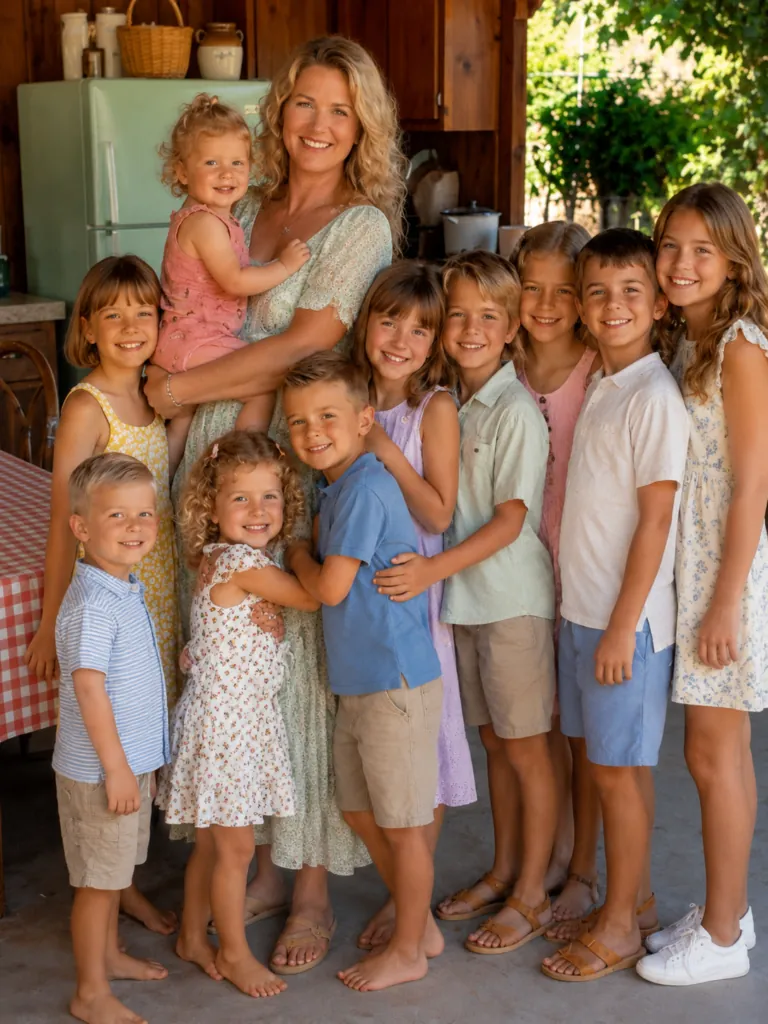
She had left behind ten children.
Ten.
When he first told me, I thought I’d misunderstood.
“You mean… ten?”
He smiled weakly.
“Yes. People usually ask twice.”
I remember staring at him for several seconds before asking the question everyone probably expected.
“How are you managing?”
He looked toward the parking lot where several children were climbing into an old pickup truck.
“I’m not sure I am.”
There wasn’t any self-pity in his voice.
Only honesty.
That honesty made it impossible not to care.
Soon I met the children.
The oldest, Amanda, was fifteen.
She already carried herself like another parent instead of a teenager.
She packed lunches before school.
She braided Sophie’s hair.
She reminded everyone about homework and doctor’s appointments.
Sometimes I caught her watching Robert with worried eyes, as though she feared losing him too.
Derrick rarely talked unless something needed fixing.
If a cabinet door squeaked, Derrick repaired it.
If a bicycle chain slipped, Derrick fixed it.
If one of the younger children cried because a toy had broken, Derrick somehow made it new again.
Sue couldn’t tell a story without using both hands.
Even when she whispered, her fingers danced through the air.
The twins, Jacob and David, turned absolutely everything into a competition.
Who could carry more groceries.
Who finished homework first.
Who washed dishes faster.
Who could make the other laugh during church.
The quadruplets were pure chaos.
If one disappeared, the other three usually knew exactly where.
If someone started laughing, within seconds all four were rolling across the living room floor.
And then there was little Sophie.
The tiny girl who had first reached for me inside the grocery store.
She attached herself to me almost immediately.
Whenever I visited, she’d run straight into my arms.
Before long she refused to let anyone else read bedtime stories.
Robert apologized constantly.
“You don’t have to do all this.”
“I know.”
“You deserve a normal relationship.”
I smiled.
“I don’t think normal is very interesting.”
The truth was, I hadn’t simply fallen in love with Robert.
I’d fallen in love with the entire noisy, impossible family.
Within only a few months, I spent more evenings at their house than at my own apartment.
Without anyone asking, I naturally slipped into their routine.
I helped Amanda cook dinner.
I checked spelling homework.
I stitched ripped backpacks.
I hunted for missing socks.
I kissed scraped knees.
I learned exactly which child responded to gentle encouragement and which one needed firm honesty.
The house was always loud.
Somebody was always laughing.
Someone else was usually crying.
There were dirty dishes stacked in the sink almost every evening.
Laundry never seemed to end.
Yet somehow, I’d never felt more at home anywhere in my life.
One afternoon I realized something surprising.
The children no longer asked whether I was coming over.
Instead, they asked what time.
As though my place in the family had already been decided.
Even Sophie stopped calling me Miss Margaret.
One evening she climbed onto my lap while I was reading her favorite picture book.
Without thinking, she looked up and whispered one simple word.
“Mama.”
The room fell completely silent.
Robert froze halfway across the living room.
Amanda looked down at the floor.
I wasn’t sure whether to correct Sophie.
Before I could say anything, Robert smiled sadly.
“If she’s comfortable calling you that… I don’t mind.”
Neither did I.
Six months after we started dating, Robert proposed.
There were no expensive restaurants.
No violin music.
No diamond hidden inside dessert.
Instead, we were gathered around the kitchen table eating meatloaf and mashed potatoes while all ten children pretended they weren’t listening from the hallway.
Robert stood.
His hands shook slightly.
“So…” he began.
Amanda immediately shushed the younger kids.
Jacob accidentally elbowed David.
Someone giggled.
Robert looked at me.
“I know I don’t have much to offer.”
I shook my head.
“You have everything.”
He swallowed hard.
“Margaret…”
He reached into his pocket and pulled out a small velvet ring box.
The children collectively stopped breathing.
“Will you marry us?”
Not “Will you marry me?”
“Will you marry us?”
My eyes filled with tears before I could answer.
I looked toward the hallway.
Ten hopeful little faces stared back at me.
Some smiled.
Some looked nervous.
Little Sophie hugged Amanda’s leg as if she already knew my answer.
I laughed through my tears.
“Yes.”
The hallway exploded.
Children came running from every direction.
Someone tackled Robert.
The twins nearly knocked over the table.
The quadruplets screamed loud enough for the neighbors to hear.
Sophie wrapped both arms around my waist.
“Mama’s staying!”
Robert slipped the ring onto my finger while trying not to cry.
I don’t think there was a happier house anywhere that night.
Not everyone celebrated with us.
Every Sunday after church, my mother reminded me exactly what she thought of my decision.
“Ten children, Margaret.”
“I know.”
“You haven’t even lived your own life yet.”
“They are my life, Mama.”
She sighed with obvious frustration.
“You’re throwing everything away.”
“I don’t feel that way.”
“You’re being foolish.”
Maybe, in her mind, I was.
But she didn’t see what I saw.
She didn’t see Amanda secretly saving allowance money to buy birthday presents for her younger siblings.
She didn’t see Derrick repairing bicycles for neighborhood children without asking for payment.
She didn’t hear bedtime prayers where every child thanked God that I had come into their lives.
She only saw responsibility.
I saw family.

The wedding preparations filled every spare moment.
The children insisted on helping.
Amanda organized decorations.
Sue wanted flowers everywhere.
Jacob and David argued over who would walk Grandma Helen to her seat.
The quadruplets practiced scattering flower petals so many times that half the yard turned pink.
Even Derrick smiled more than usual.
Two weeks before the ceremony, Amanda helped zip my wedding dress while I stood in front of the bedroom mirror.
Sophie clapped excitedly from the bed.
The boys stood outside the doorway pretending to gag dramatically.
“Eww.”
“She’s getting married.”
“So gross.”
Their performance made everyone laugh.
Then I noticed movement behind me.
Robert stood quietly in the doorway.
He wasn’t smiling the way I’d expected.
Instead, he simply watched me.
There was something in his expression I couldn’t explain.
Not sadness.
Not happiness.
Almost as if he were trying to memorize every detail.
“You look beautiful,” he said softly.
I smiled.
“You’re not supposed to see the dress.”
“I know.”
He didn’t move.
“I just wanted to remember.”
At the time, I laughed and teased him for being impatient.
Looking back now, I realize those words meant far more than I understood.
For months, Robert had looked increasingly exhausted.
He blamed work.
He blamed stress.
He joked about getting older.
Sometimes he’d rub his temples when he thought no one was watching.
Sometimes headaches forced him to sit quietly in the evenings.
He had also lost weight.
Too much weight.
Whenever I asked if he was feeling all right, he’d smile that same reassuring smile.
“I’m fine.”
I believed him because I wanted to.
Love has a strange way of convincing us that the people we depend on are stronger than they really are.
I wish I’d questioned him more.
I wish I’d insisted he see another doctor.
I wish I’d understood why he looked at me that afternoon as though he were saying goodbye.
At the time, I simply believed we were one week away from beginning the happiest chapter of our lives.
I couldn’t have imagined that seven days later, I would wake up to an empty bed… and a silence that would change everything.
The morning Robert disappeared began with a silence that felt wrong before I even opened my eyes.
For months, our mornings had followed the same comforting rhythm. Robert always woke first. I would hear the floorboards creak beneath his footsteps as he started the coffee, packed lunches, or checked the weather before the children came tumbling downstairs.
That morning, there was nothing.
No footsteps.
No clatter in the kitchen.
No low humming while he searched for matching socks.
I reached across the bed.
His side was cold.
Not warm from someone who had just stepped away.
Cold.
A knot tightened in my stomach.
“Robert?” I called.
Only silence answered.
I pulled on my robe and walked into the hallway.
Amanda stood barefoot at the top of the stairs, hugging herself tightly.
She looked pale.
“Mama Margaret,” she whispered, “Daddy’s truck is gone.”
My heart skipped.
“I’m sure he just ran out for something.”
Even as the words left my mouth, I knew they sounded hollow.
Amanda looked at me with eyes far older than fifteen.
She didn’t argue.
She simply nodded in the way children do when they realize the adult is trying to comfort herself instead of them.
The younger children slowly drifted downstairs one by one, rubbing sleepy eyes and asking ordinary questions.
“Where’s Dad?”
“Is breakfast ready?”
“Can we have pancakes?”
I smiled because someone had to.
“He’ll be back soon.”
Inside, panic was beginning to spread through me.
I called Robert’s phone.
Straight to voicemail.
I waited ten minutes.
Called again.
Nothing.
Another twenty minutes passed.
Still nothing.
Maybe his truck had broken down.
Maybe he’d gone to help a neighbor.
Maybe…
Every explanation sounded weaker than the last.
I called his brother.
“No, I haven’t heard from him.”
His foreman.
“He never showed up.”
His oldest friend.
“I thought he was with you.”
Finally I called my mother.
She answered on the second ring.
“Margaret?”
“I can’t find Robert.”
“What do you mean?”
“He’s gone.”
Her voice became cautious.
“Have you checked everywhere?”
“His truck’s gone. His phone is off. Nobody has seen him.”
I hung up before she could answer because I noticed something I had somehow overlooked.
A folded piece of paper sat on the kitchen table.
The sugar bowl rested on top of it as if someone had carefully made sure it wouldn’t blow away.
I stared at it for several seconds before reaching for it.
Something deep inside me already knew.
My fingers trembled so violently I nearly tore the paper opening it.
There were only eight words.
“I’m sorry. I can’t do this anymore.”
Nothing else.
No explanation.
No goodbye.
No signature.
No mention of the wedding.
No mention of me.
No mention of the children.
I read the note once.
Then again.
Then a third time.
The words refused to become anything different.
My knees gave out beneath me.
I sank into a kitchen chair and stared at the page until the ink blurred through tears.
The man who had promised to marry me in seven days had simply vanished.
The father of ten children had walked away without another word.
I didn’t even hear little footsteps approaching.
Sophie appeared beside me wearing pink pajamas decorated with tiny rabbits.
She wrapped both arms around my leg and rested her cheek against me.
“Mama,” she said softly, “juice?”
That single word shattered what remained of my heart.
In that instant, my life divided into two parts.
Everything before.
Everything after.
My phone rang again.
It was my mother.
I answered because I no longer had the strength not to.
“Margaret,” she said carefully after listening to me cry, “listen to me.”
“I am listening.”
“This is a sign.”
I closed my eyes.
“What do you mean?”
“You are still young. You can still have your own life.”
I looked toward the staircase where ten children were beginning to wonder why breakfast was late.
“They’re upstairs, Mama.”
“I know.”
“They’re waiting for me.”
“They are not your responsibility.”
“They’re children.”
“They have a father.”
“No,” I whispered. “They don’t.”
“You need to let the authorities take them.”
The words hit harder than I expected.
“They’ve already lost their mother.”
“They will survive.”
“They just lost their father.”
“You didn’t give birth to them.”
“I love them.”
Silence.
Then my mother’s voice hardened.
“Don’t throw your future away over someone else’s family.”
I felt something inside me become perfectly still.
“I can’t send them away.”
“You have to.”
“I won’t.”
“Margaret—”
“I said I won’t.”
I ended the call.
For a long moment I simply stood there, looking at the children gathered around the breakfast table.
Amanda silently poured cereal for the younger ones.
Derrick helped one of the quadruplets tie his shoes.
Sue wiped spilled milk before anyone asked.
Jacob and David argued over whose turn it was to feed the dog.
Life continued because children don’t stop needing breakfast simply because adults are falling apart.
Word spread quickly.
My aunt insisted I was making the biggest mistake of my life.
Two cousins suggested the children would adjust quickly in foster care.
A family friend reminded me that I wasn’t legally related to any of them.
Even some of Robert’s relatives encouraged me to let the county handle everything.
They all said different versions of the same thing.
You’re too young.
Ten children are too many.
Someone else will raise them.
Don’t sacrifice your future.
I listened politely.
Then I walked back into the kitchen where ten frightened children sat wondering whether they were about to lose another parent.
Looking at their faces, I already knew my answer.
A few days later I sat across from a county caseworker with gentle eyes and an enormous stack of paperwork.
She studied me quietly.
“Miss Margaret…”
“Yes?”
“Emergency guardianship is only the beginning.”
“I understand.”
“It could take years before adoption becomes possible.”
“I know.”
“You’ll be responsible for ten children.”
“I know.”
“There is absolutely no shame in changing your mind.”
I looked down at the forms.
The pen felt strangely heavy.
Then I remembered Sophie asleep against my shoulder.
Amanda trying to act brave.
The twins pretending not to cry.
I looked back up.
“They already call me Mama.”
The woman remained silent.
“I can’t walk away from that.”
My signature came out crooked because my hands wouldn’t stop shaking.
Legally, the process lasted years.
Emotionally…
They became my children the moment that ink dried.
The first year nearly destroyed me.
I worked full-time days in a fabric warehouse loading shipments and checking inventory.
When my shift ended, I hurried across town to sew school uniforms for the local district late into the evening.
Some nights I barely slept four hours.
Bills never stopped arriving.
Shoes were always too small.
Someone always needed medicine.
Some appliance always seemed to break.
We survived because everyone helped.
Amanda learned to cook simple dinners before she earned her driver’s license.
Derrick quietly took responsibility for the yard and every broken appliance.
Sue organized the laundry so efficiently that even I couldn’t keep up with her system.
Jacob and David argued over washing dishes—not because they enjoyed chores, but because splashing each other usually ended with everyone laughing.
The quadruplets somehow filled every room with noise.
And Sophie…
Sophie never went to bed without hugging me first.
After everyone finally fell asleep each night, I sat alone at the kitchen table.
Sometimes there were unpaid bills spread around me.
Sometimes unfinished sewing.
Sometimes only silence.
Those were the moments when questions came.
Why had Robert left?
Had he met someone else?
Had he secretly fallen out of love?
Was there debt he couldn’t escape?
Had raising ten children simply become too much?
Or had I somehow failed him?
No matter how many times I searched for answers, I found none.
Eventually, a few men tried to get to know me.
A kind neighbor invited me to dinner.
A coworker asked whether I’d like coffee after work.
One of Derrick’s baseball coach’s friends flirted awkwardly during a picnic.
The conversations usually ended the same way.
“How many children did you say?”
“Ten.”
The smile disappeared almost instantly.
“All yours?”
“Yes.”
After that, excuses followed.
Busy schedules.
Unexpected commitments.
Promises to call that never came.
Eventually I stopped hoping.
There simply wasn’t room in my life for dating anymore.
My evenings belonged to homework.
To scraped knees.
To birthday parties.
To fevers.
To grocery budgets.
To bedtime prayers whispered through cracked bedroom doors.
Oddly enough, I wasn’t lonely.

I already had everything that mattered.
Years passed.
Then decades.
Slowly, one by one, my children grew into remarkable adults.
Amanda became a pediatric nurse because she wanted frightened children to feel safe.
Derrick opened his own auto repair shop, where everyone in town knew he never overcharged anyone.
Sue became a third-grade teacher whose classroom was always full of laughter.
Jacob and David both became engineers and somehow continued arguing about absolutely everything.
Sophie chose to become a social worker.
The day she told me why, we were washing dishes together.
“I wanted to become the person you were for me,” she said quietly.
“For children who think no one will stay.”
I cried alone in the kitchen for nearly an hour after she left.
Thirty years passed faster than I ever imagined.
Not once did I regret choosing them.
Not once.
Every Saturday the house filled again.
Grandchildren raced across the yard.
Amanda baked her famous lemon cake.
The smell of roast chicken drifted through every room.
Jacob and David argued over football scores exactly as they had argued over dishes decades earlier.
The noise that once exhausted me had become the sweetest sound in the world.
I often looked around the table and thought to myself that despite everything we had endured…
We had made it.
I believed the hardest chapters of my life were finally behind me.
I couldn’t have known that before the afternoon ended…
Someone would knock on my front door carrying an envelope that had waited thirty years to change everything.
That Saturday felt like dozens of others before it.
The house I had somehow managed to keep through three decades of sacrifice was overflowing with life. The grandchildren chased one another across the backyard, their laughter drifting through the open kitchen windows. Amanda carried her famous lemon cake to the counter while reminding everyone not to touch it until after dinner. Derrick, as always, had found something to repair without being asked and was tightening the loose hinge on one of my cabinet doors.
Jacob and David were debating football so passionately that neither noticed everyone else rolling their eyes.
Sue was helping the younger grandchildren color at the dining room table.
Sophie moved quietly between the stove and the table, setting out plates and silverware with the same calm kindness she’d carried since childhood.
Watching them together always filled me with the same overwhelming gratitude.
Thirty years earlier, ten frightened children had wondered if they would be separated forever.
Now they had become doctors, teachers, engineers, business owners, parents, and compassionate adults who still returned home every Saturday simply because they wanted to.
It was the greatest gift life had ever given me.
Then someone knocked on the front door.
I wiped my hands on a kitchen towel and walked across the hallway, expecting to see a neighbor or perhaps another grandchild arriving late.
Instead, a gray-haired man in a tailored charcoal suit stood on my porch.
He held a worn leather folder beneath one arm.
“Mrs. Margaret?”
“Yes.”
“My name is Daniel Johnson.”
His expression was respectful but unusually solemn.
“I was Robert’s attorney.”
For a moment, I thought I had misheard him.
The name hit me with such force that the world around me seemed to blur.
“…Robert?”
He nodded.
Without another word, he reached into his folder and removed a thick cream-colored envelope.
Across the front, written in careful blue ink, was my name.
Margaret.
I recognized the handwriting instantly.
Thirty years had passed.
It didn’t matter.
I would have known those letters anywhere.
My fingers refused to move.
Mr. Johnson gently placed the envelope into my hands.
“Mr. Robert instructed me to deliver this personally on this exact date.”
“This date?”
“Yes, ma’am.”
“Why today?”
“I’m afraid the letter answers that better than I can.”
He hesitated before adding quietly,
“He passed away several weeks ago.”
The words settled over me like winter snow.
Robert was gone.
The man I’d loved.
The man I’d hated.
The man I’d spent thirty years trying not to think about.
Gone.
Mr. Johnson lowered his head respectfully.
“I’m very sorry for your loss.”
Before I found enough breath to ask another question, he returned to his car and drove away.
I stood frozen on the porch.
The envelope suddenly felt impossibly heavy.
“Mama?”
Amanda’s voice came from behind me.
“Who was that?”
I turned slowly.
“I…”
Nothing came out.
The entire family had noticed something was wrong.
Everyone gathered around the dining table without speaking.
Even the youngest grandchildren sensed the unusual silence.
I sat down carefully.
My hands shook so badly that Sophie reached over and steadied the envelope.
“You don’t have to read it if you’re not ready,” she whispered.
I looked around the table.
Ten faces.
Faces I’d watched grow from frightened children into remarkable adults.
Every one of them deserved the truth.
I carefully broke the seal.
Inside was a handwritten letter spanning several pages.
I unfolded the first sheet.
“My dearest Margaret…”
The room became completely silent.
I began reading aloud.
Robert wrote that he had been hiding severe health problems for months before our wedding.
The headaches.
The exhaustion.
The unexplained weight loss.
The constant pain he blamed on work.
They hadn’t been stress.
They had been symptoms.
One week before our wedding, specialists finally gave him an answer.
The diagnosis was devastating.
The doctors believed he had only months to live.
Perhaps a year if he was fortunate.
There was one experimental treatment available.
No guarantees.
No certainty.
Almost no hope.
The words blurred as tears filled my eyes.
“I couldn’t ask you to marry a dying man,” Robert wrote.
“I couldn’t ask you to become a widow before our first anniversary.”
“I couldn’t leave you buried beneath impossible hospital bills while trying to raise ten grieving children.”
“So I made the worst decision of my life.”
“I convinced myself that if you believed I had abandoned you, eventually you would hate me enough to move forward.”
“I believed hatred would heal you faster than pity.”
I stopped reading.
My chest hurt.
For thirty years…
I had believed he left because we weren’t enough.
Beside me, Sophie quietly slipped her hand into mine.
“Keep going, Mama.”
I nodded.
My voice trembled as I continued.
“The note I left was cruel because cruelty seemed kinder than watching you watch me die.”
“I hated every word I wrote.”
“I hated myself even more.”
The room was silent except for quiet sobbing.
Then came the part none of us expected.
“The treatment worked.”
Doctors who had prepared him for death slowly began seeing signs of recovery.
Months passed.
Then a year.
Then nearly two.
Eventually, they believed he would survive.
“I drove back.”
“I parked down the street from our house.”
“I watched from my truck.”
My breathing stopped.
“I saw Amanda carrying groceries through the front door.”
“I saw Derrick teaching the twins how to repair a bicycle chain.”
“I saw Sue helping the quadruplets plant flowers.”
“And then I saw little Sophie running across the yard.”
She threw herself into your arms.
I heard her call you ‘Mama.’
I sat behind the steering wheel for nearly an hour.
I realized something then.
You had done what I prayed someone would do.
You stayed.
You became everything those children needed.
If I returned, I feared I would destroy the only stability they had left.
There would be confusion.
Custody battles.
Questions with no good answers.
Children forced to choose between the father who abandoned them and the mother who never did.
I couldn’t bear to put them through that.
So…
I drove away again.
A tear landed on the paper.
Then another.
Then another.
I could barely continue reading.
“I’m not claiming my decision was right.”
“I’m only admitting that I believed it would hurt them less.”
“I may have been wrong.”
“I have lived with that possibility every day.”
Around the table, no one moved.
No one even breathed loudly.
The next pages explained what Robert had done with the life he rebuilt.
He had started a modest bookkeeping and financial consulting business.
He never remarried.
He never had more children.
He lived alone.
Every extra dollar he earned went into a trust created for the family he had left behind.
“It’s not enough to repay what I owe.”
“Nothing ever could.”
“But perhaps it can help provide opportunities for your children and their children after them.”
Then came the revelation that made every person at the table stare at me in disbelief.
Robert had hired a retired private investigator.
Not to interfere.
Not to contact us.
Only to quietly confirm that the children were safe.
He wanted updates only once or twice each year.
Nothing more.
He knew Amanda had become a pediatric nurse.
He celebrated quietly when Derrick opened his repair shop.
He smiled when Sue accepted her first teaching position.
He learned that Jacob and David both graduated as engineers.
He cried when Sophie chose social work.
He even knew about weddings.
Births.
Grandchildren.
Every milestone.
Every achievement.

He had watched from afar because he believed that was the greatest kindness he still had left to offer.
“I wanted to knock on your door countless times.”
“I wanted to hug every one of them.”
“I wanted to ask your forgiveness.”
“But every year that passed made returning feel more selfish.”
“So I stayed away.”
“When my health began failing again, I instructed Mr. Johnson to wait thirty years before delivering this letter.”
“By then every child would be grown.”
“There would be no custody disputes.”
“No impossible choices.”
“Only the truth.”
Even Jacob and David, who usually joked through emotional moments, sat completely speechless.
The final page was stained with shaky handwriting.
The illness had returned.
This time there would be no miracle.
“My greatest regret is not dying.”
“My greatest regret is leaving you to carry what should have been my burden.”
“Margaret…”
“You gave our children a life I never could.”
“You became the mother they deserved.”
“I don’t ask you to excuse me.”
“I only ask that you know I never stopped loving you.”
“I never stopped loving them.”
“If your heart can ever forgive me…”
“I will be grateful beyond words.”
“Forever yours,
Robert.”
The room remained silent long after I lowered the final page.
No one seemed able to move.
No one knew what to say.
For thirty years, I had carried one question like a stone inside my heart.
Why wasn’t I enough?
Now I finally had my answer.
It had never been about not being enough.
Robert believed he was sparing us unimaginable pain.
Whether he had been right or terribly wrong no longer mattered as much as I once believed.
For the first time in three decades…
I understood.
Derrick quietly wiped his eyes with the back of his hand.
“He watched us grow up?”
I nodded.
“From a distance.”
Sue whispered through tears,
“He knew everything.”
“Almost everything.”
Jacob looked toward David.
Neither brother had one clever remark to offer.
Amanda walked behind my chair and wrapped both arms around my shoulders exactly the way she used to comfort her younger brothers and sisters.
“I wish he’d trusted us enough to stay,” she said softly.
“So do I.”
Tom, one of the younger boys who had long since become a father himself, looked around the table.
“He trusted you with us.”
Those words settled deep inside me.
He had.
Whether by choice or by desperation…
He had trusted me.
And somehow, despite every fear, every sleepless night, every unpaid bill, every sacrifice…
We had made it.
I looked around the room once more.
Ten children.
Their husbands and wives.
Grandchildren laughing outside.
A family that had survived something impossible.
I folded Robert’s letter carefully and placed it back inside the envelope.
“I forgive him,” I said quietly.
Everyone looked at me.
“I don’t forgive the pain.”
“I don’t forgive the years we lost.”
“But I forgive the man.”
Another tear rolled down my cheek.
“I’m sixty-two years old.”
“I don’t want to spend whatever years I have left carrying anger.”
Amanda kissed the top of my head.
Sophie squeezed my hand.
One by one, every member of the family reached across the table until our hands formed a chain stretching from one end to the other.
I lifted my teacup.
“To Robert.”
Amanda smiled through tears.
“And to Mama.”
I laughed softly and shook my head.
“You don’t have to—”
Before I could finish, every voice around the table spoke together.
“To Mama!”
The grandchildren repeated it, even though many of them were too young to understand why.
The room filled with laughter through tears.
For years, one chair at that table had always felt painfully empty.
It reminded me of the life we were supposed to have.
The future that disappeared one silent morning before our wedding.
But as I looked around at the family surrounding me, I realized something beautiful.
That empty chair was no longer a symbol of abandonment.
It was proof of survival.
Proof that love is not measured only by the people who stay, but also by the people who choose to keep loving after they have every reason to stop.
Robert’s story had ended alone.
Mine had not.
Mine was surrounded by ten children who had become my own, grandchildren whose laughter echoed through every room, and a family built not by blood, but by the simple, extraordinary choice to stay.
In the end, Robert left us with far more than a letter.
He left me the truth.
And the truth finally freed me from a burden I had carried for thirty long years.
Source: amomama.com
Note: This story is a work of fiction inspired by real events. Names, characters, and details have been altered. Any resemblance is coincidental. The author and publisher disclaim accuracy, liability, and responsibility for interpretations or reliance.