

Part 1: The Door at the End of the Hall
The first thing I heard when I came home from deployment was my wife telling our neighbor that my mother had lost her mind.
The second was my mother calling my name from behind a locked bedroom door.
I had barely set my duffel bag on the porch.
Vanessa stepped into my arms with the kind of dramatic relief people expected from a military homecoming. She held me tightly, smiling over my shoulder at the neighbors who had gathered nearby.
“Ethan,” she breathed. “I didn’t want to worry you while you were overseas.”
Mrs. Carter from next door touched my arm sympathetically.
“Your poor wife has been handling everything alone. Your mother’s dementia has gotten so bad.”
I looked at Vanessa.
Her expression shifted instantly into exhausted concern.
“She hurts herself,” she said quietly, though not quietly enough to stop everyone from hearing. “Falls. Screams. Accuses me of terrible things.”
There were dark marks around Vanessa’s wrist.
They looked disturbingly like fingerprints.
“Mom did that?” I asked.
Vanessa lowered her eyes.
“She attacked me yesterday.”
The neighbors murmured.
Then, from somewhere inside the house, I heard it.
A faint voice.
“Ethan?”
Everything inside me went still.
It was my mother.
Weak.
Frightened.
But clear.
Vanessa’s smile tightened.
“She gets confused whenever she hears a man’s voice.”
I picked up my bag.
“Let me see her.”
For perhaps half a second, fear flashed across Vanessa’s face.
Then she recovered.
“The psychiatrist warned me isolation helps prevent her agitation.”
I stopped.
“What psychiatrist?”
“Dr. Keller. He’s evaluating her tomorrow. We may need to consider permanent placement.”
Vanessa said it smoothly, like the decision had practically been made.
I walked down the hallway.
She followed me, talking faster.
“She wanders. She leaves the stove on. Last week she smashed a mirror. Ethan, you have no idea how bad things have become.”
Then I saw the bedroom door.
There was a new deadbolt on the outside.
My heartbeat slowed instead of speeding up.
Twelve years in military intelligence had taught me something important: panic made people careless. Observation kept you alive.
“Open it,” I said.
Vanessa hesitated before handing me the key.
The room beyond was dark.
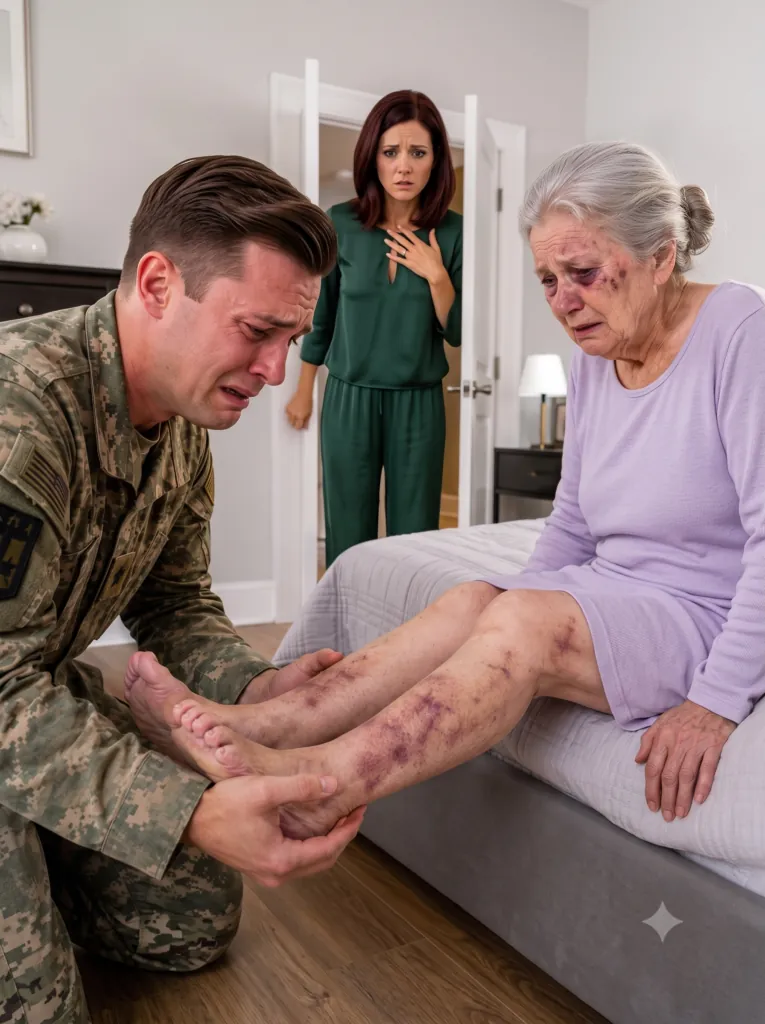
The curtains had been fixed shut so almost no daylight entered. My mother sat beside the bed, noticeably thinner than when I had left. She wore an old nightgown. Bruises marked her arms, and there was a small cut above one eyebrow.
But the moment she looked at me, I knew.
Her eyes were focused.
She knew exactly who I was.
“Ethan,” she whispered. “Don’t believe her.”
Vanessa stepped behind me.
“See? Paranoia.”
Mom flinched at Vanessa’s voice.
That was enough.
Every instinct I had screamed the same warning.
Do not show Vanessa what you know.
So I smiled.
I crossed the room, knelt beside my mother, and kissed her forehead.
“It’s okay,” I said softly. “Vanessa told me everything.”
Mom stared at me in horror.
I squeezed her hand twice.
It was something we had done since I was a child.
Two squeezes meant one thing.
Trust me.
Her fingers tightened around mine.
Then I stood and faced my wife.
“You must be exhausted.”
Vanessa’s whole body seemed to relax.
“You have no idea.”
I hugged her carefully.
And over her shoulder, I saw something mounted near the doorway.
A tiny camera.
It wasn’t aimed toward the hall.
It was pointed toward my mother’s bed.
Vanessa apparently believed I had returned as a tired husband desperate to trust his wife.
She had forgotten what I did for a living.
I kept smiling.
“Tomorrow,” I told her, “we’ll make sure Mom gets exactly the help she needs.”
That evening, Vanessa prepared my favorite dinner.
Steak. Potatoes. Wine.
She opened an expensive bottle and poured herself a generous glass.
Then she began talking.
I listened.
That was her first mistake.
“The doctor agrees she’s dangerous,” Vanessa said, cutting into her steak. “Once she’s committed, we can sell her house. The repairs alone would cost a fortune.”
“My mother’s house is paid off.”
Vanessa shrugged.
“Exactly. Dead money.”
I kept my expression neutral.
“And her pension?”
“I’ve been managing it. Bills, medication, caregivers.”
There were no caregivers.
I knew that because earlier, when Vanessa had stepped outside to answer a phone call, Mom had whispered everything she could in three frantic minutes.
Vanessa had taken her phone.
Hidden her glasses.
Controlled when she ate.
Refused to allow her to sign documents unless they benefited Vanessa.
Whenever Mom protested loudly enough for the neighbors to hear, Vanessa told them it was another symptom of dementia.
And the bruises?
Mom insisted they had not come from falls.
Before entering the house, I had activated the encrypted recorder built into my watch.
Now it captured every word.
Vanessa poured another glass.
“You handled everything,” I said admiringly.
Her eyes brightened.
Vanessa had always mistaken silence for weakness.
“It wasn’t easy,” she said. “Your mother kept threatening to expose me.”
I looked up.
“What did you tell her?”
Vanessa laughed.
“I told her no one would trust an old woman with dementia.”
My fingers tightened around my fork beneath the table.
I forced myself to breathe evenly.
Vanessa leaned closer.
“Once Dr. Keller signs the recommendation, she’ll be in a secure facility by lunch. Then getting power of attorney becomes much easier.”
I pretended to be impressed.
“You already prepared one?”
“Of course.”
She left the room and returned carrying a folder.
I flipped through it slowly while secretly photographing every page.
The signature at the bottom looked like my mother’s.
Almost.
But it wasn’t.
My mother had taught me how to copy her signature when I was ten so I could sign school permission slips after my father died.
I knew every curve.
Every hesitation.
Every stroke.
Vanessa had copied it badly.
“You’ve thought of everything,” I said.
She smiled.
“I had months.”
That was her second mistake.
Much later, after Vanessa fell asleep, I went into the office.
Years earlier, before deployment, I had installed an emergency bypass code on the lock.
Vanessa didn’t know about it.
Inside the desk were bank statements.
Emails.
Medical correspondence.
Financial records.
Nearly eighty thousand dollars had been transferred from Mom’s accounts into an account controlled by Vanessa.
There were messages to Dr. Keller describing supposed hallucinations and violent episodes Mom had never experienced.
There were photographs apparently arranged to support Vanessa’s story.
There were emails to a private nursing facility discussing placement.
And there were messages about selling Mom’s house after she was declared incapable of managing her own affairs.
Then I found the file that changed everything.
A video from the bedroom camera.
I watched only long enough to confirm what I feared.
Vanessa stood over Mom with documents in her hand.
“Sign the paper.”
“No.”
Vanessa struck her.
Mom fell back against the bedframe.
Vanessa’s voice came through the recording, cold and calm.
“That bruise will help tomorrow. Try screaming. The neighbors already think you’re crazy.”
I closed the laptop.
For several seconds, I couldn’t move.
I had been trained to analyze threats without emotion.
But this was my mother.
The woman who had raised me after my father died.
The woman who saved every letter I had ever sent home.
And while I had been thousands of miles away trusting my wife, Vanessa had turned my mother’s own home into a trap.
I copied everything onto three encrypted drives and uploaded the files to my attorney’s secure server.
At 2:14 a.m., I called my former commanding officer, Colonel Reeves, who now worked with the state’s elder-abuse task force.
He listened without interrupting.
“Can you keep playing along until morning?” he finally asked.
“Yes.”
“Then don’t confront her.”
“I wasn’t planning to.”
At breakfast, Vanessa wore a white dress and pearls.
She looked less like someone accompanying an elderly woman to a medical appointment and more like someone attending a celebration.
Mom came into the kitchen trembling slightly, her wrists hidden beneath long sleeves.
Vanessa kissed my cheek.
“Ready?”
I picked up the medical folder she had prepared.
Inside my jacket was another folder.
The one she didn’t know existed.
The one that would destroy every lie she had spent months building.

Part 2: The Appointment
Dr. Keller’s clinic smelled of polished wood and disinfectant.
Vanessa guided Mom toward the consultation room with one hand wrapped firmly around her elbow.
“Careful,” she whispered in a sweet voice. “You know how easily you fall.”
Mom looked at me.
I nodded once.
She understood.
Dr. Keller adjusted his glasses after we sat down.
“Mrs. Hale,” he began, “your daughter-in-law has documented several disturbing episodes.”
Vanessa sighed dramatically.
“I’ve done everything I can.”
“You’ve done enough,” I said.
She smiled.
She thought it was praise.
Dr. Keller extended his hand.
“The file?”
I reached inside my jacket.
Vanessa expected me to hand him her folder.
Instead, I gave him mine.
Her smile disappeared.
The doctor opened it.
The first page wasn’t a symptom report.
It was a summary of Mom’s financial records.
The second was a copy of the questionable power-of-attorney paperwork.
Then came photographs documenting the external bedroom lock, the closed curtains, missing food, and Mom’s injuries over different stages of healing.
Vanessa leaned forward.
“What is this?”
“Evidence.”
Dr. Keller looked up sharply.
I placed my phone on his desk.
Then I played the recording from dinner.
Vanessa’s voice filled the room.
“I told her no one would trust an old woman with dementia.”
Every trace of color left her face.
I played another section.
“Once Dr. Keller signs the recommendation, she’ll be in a secure facility by lunch. Then the power of attorney becomes much easier.”
Dr. Keller slowly turned toward Vanessa.
She opened her mouth.
Nothing came out.
Then I played the bedroom footage.
When the confrontation appeared on screen, Dr. Keller pushed back from the desk so suddenly his chair rolled several inches.
“You told me these injuries were self-inflicted.”
Vanessa pointed at me.
“He manipulated that video! He’s military. He knows how!”
The door opened.
Colonel Reeves walked in with two detectives, a social worker, and a representative from the district attorney’s office.
Vanessa stumbled backward.
“What is this?”
Reeves held up a warrant.
“An elder-abuse investigation.”
“You can’t just believe him!”
“We don’t,” Reeves replied. “We believe the surveillance footage, bank records, forged documents, medical inconsistencies, and your own recorded statements.”
Vanessa looked around the room.
For the first time since I had returned home, she seemed to understand there was nowhere left to hide.
Then she ran.
She made it only a few steps.
One of the detectives stopped her before she reached the hallway.
“You’re making a mistake!” Vanessa shouted as they secured the handcuffs. “Ethan, tell them! Tell them I cared for her!”
I walked toward her.
“You locked my mother in darkness.”
“She was ruining our life!”
“No,” I said. “She was standing between you and her money.”
Vanessa’s face twisted.
“She would’ve given it to us eventually!”
Behind me, Mom spoke.
“My son never wanted my money.”
Her voice was quiet.
But every person in the room heard her.
Vanessa turned.
Mom reached into her pocket and put on the glasses Vanessa had kept from her.
Then she straightened her shoulders.
“I kept every letter Ethan sent me,” she said. “I remembered every day you denied me food. Every pill you withheld. Every transfer I noticed before you changed my passwords.”
Vanessa stared at her.
Mom had never been as confused as Vanessa claimed.
She had been frightened.
Isolated.
Denied the tools she needed to prove what was happening.
But whenever she could, she had memorized details.
Dates.
Amounts.
Names.
Anything that might someday matter.
The detectives led Vanessa through the clinic.
Outside, several neighbors had gathered after seeing the police vehicles.
Mrs. Carter stood near the parking lot.
She watched silently as Vanessa crossed in handcuffs.
The same people who had spent months accepting Vanessa’s whispers now saw the truth with their own eyes.
Mom stood beside me.
Her hand found mine.
I squeezed twice.
This time, she squeezed back immediately.

Part 3: What Happened After
The investigation moved quickly after Vanessa’s arrest.
Once authorities began examining her financial activity, the story she had constructed collapsed.
The money transfers were documented.
The forged paperwork was examined.
The surveillance footage contradicted the claims she had made about Mom’s injuries.
Records from the supposed caregivers exposed another lie.
There hadn’t been a team of people helping her.
There had been Vanessa.
Controlling everything.
Three months later, Vanessa pleaded guilty to charges connected to elder abuse, unlawful confinement, financial exploitation, forgery, and fraud.
She received a prison sentence, was ordered to repay stolen funds, and was permanently prohibited from having authority over my mother’s affairs.
Dr. Keller also faced a professional review.
Investigators concluded that he had relied too heavily on Vanessa’s descriptions without independently verifying enough of what she claimed.
But once the truth emerged, he cooperated fully.
His medical records and testimony became important evidence in Mom’s case.
As for me, I filed for divorce before sunset on the day Vanessa was arrested.
There was no dramatic confrontation afterward.
No final argument.
No attempt to save the marriage.
The marriage I thought I had no longer existed.
Perhaps it never had.
For weeks after Vanessa’s arrest, Mom still startled whenever a door clicked shut.
She disliked dark rooms.
She asked more than once whether she really had permission to open the curtains.
That question hurt more than almost anything else.
“You never have to ask me that,” I told her.
Six months later, we moved into a bright house near a lake.
The windows were large.
Morning sunlight filled the kitchen.
There were no locks on Mom’s bedroom door.
No curtains fixed shut.
No hidden cameras.
No one monitoring how much she ate or when she spoke.
She planted herbs near the kitchen window and became fiercely protective of them.
Every morning she watered basil, rosemary, and mint while complaining that I made coffee strong enough to “wake the dead.”
I told her twelve years in the military had ruined weak coffee for me.
She told me that was no excuse.
Little pieces of normal life returned slowly.
One morning she burned toast and laughed instead of panicking.
Another afternoon she misplaced her glasses, then froze.
I could see the fear on her face.
For months Vanessa had used ordinary mistakes against her.
Every forgotten object had become “proof.”
Every moment of exhaustion had become “dementia.”
I found the glasses beside a book.
“There they are.”
Mom looked embarrassed.
“I suppose now you’ll put me in a facility.”
I stared at her.
Then she smiled.
It was a joke.
A dark one.

But it was the first time she had joked about any of it.
I laughed.
So did she.
That was the day I realized she was beginning to feel safe again.
One evening, months after the trial ended, we sat on the porch watching the lake turn gold beneath the setting sun.
Mom touched the faint scar above her eyebrow.
“You smiled when you found me,” she said.
I looked over.
“I did.”
“I thought you believed her.”
“I needed Vanessa to believe I did.”
Mom was quiet for a while.
“I was terrified you’d leave that room and never come back.”
“I almost broke character.”
“What stopped you?”
I thought about that first moment.
The locked door.
The camera.
The fear on her face.
“My training.”
She raised an eyebrow.
“Military intelligence?”
“Partly.”
“And the other part?”
“You.”
She looked surprised.
“You taught me not to panic when I was ten. Remember when Dad died and everything went wrong at once? You used to tell me, ‘First figure out what’s true. Then decide what to do about it.’”
Mom smiled faintly.
“I said that?”
“Constantly.”
“I was probably trying to sound wise.”
“It worked.”
The lake was completely still now.
For a while, neither of us spoke.
Then Mom laughed softly.
“She really thought you were stupid.”
I smiled.
“She thought I was emotional.”
“No. She thought you were stupid.”
I laughed.
“Fine.”
Mom leaned back in her chair.
“She targeted the wrong family.”
I looked at her.
There was no fear in her expression anymore.
No need to whisper.
No door separating us.
No one standing nearby waiting to call her confused if she said the wrong thing.
Just my mother, sitting in the evening sunlight, finally free to tell the truth without wondering whether anyone would believe her.
I reached over and squeezed her hand twice.
She squeezed mine back.
Outside, the lake remained still beneath the fading gold sky.
And for the first time since I had come home from deployment, so were we.
Note: This story is a work of fiction inspired by real events. Names, characters, and details have been altered. Any resemblance is coincidental. The author and publisher disclaim accuracy, liability, and responsibility for interpretations or reliance.