

Part 1 – The Morning They Appeared on My Porch
I was kneeling on my front porch, tightening a loose hinge, when I heard a scraping sound coming from the sidewalk.
At first, I thought a branch had fallen against the steps.
Then I turned around.
The screwdriver slipped from my hand.
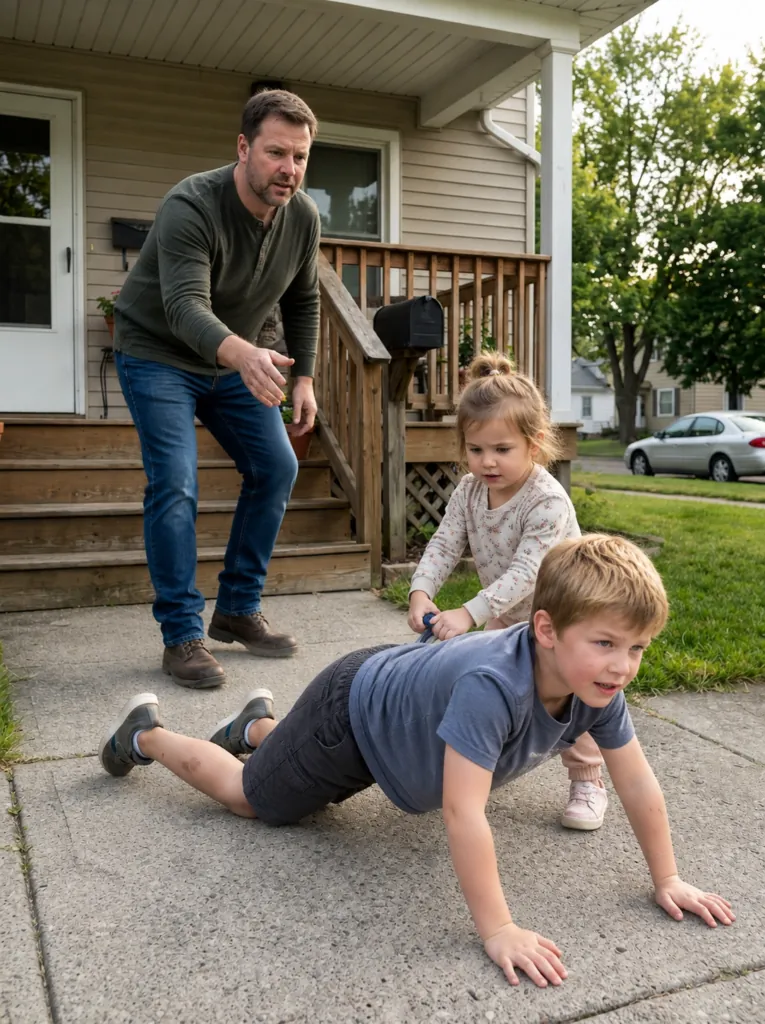
A little boy was dragging himself toward my house with both hands.
Behind him, a much smaller girl stumbled forward, gripping the back of his shirt as though letting go would mean being left behind.
For one stunned second, I didn’t recognize them.
Then my heart stopped.
“Drew?”
My six-year-old nephew lifted his head.
His dark hair was soaked with sweat and stuck to his forehead. Dirt covered his cheeks. His arms shook violently each time he pulled himself forward, while one leg remained stiff behind him.
The little girl was his three-year-old sister, Lily.
Their house was seven blocks away.
They should never have been outside alone.
I ran down the steps just as Drew’s strength failed.
“Drew, buddy. What happened?”
His face was gray beneath the dirt.
“She locked us downstairs again.”
Again.
That single word hit harder than anything else.
Not accidentally.
Not once.
Again.
“I had to get Lily out,” he whispered. “She was really hungry.”
I lifted Lily first because she could barely stand.
The moment I picked her up, panic shot through me.
She was frighteningly light.
I carried her inside, set her down, then rushed back for Drew. I slid one arm behind his shoulders and the other beneath his good leg, careful not to touch the injured one.
When I lifted him, his mouth tightened.
He didn’t scream.
He barely made a sound.
That scared me more than screaming would have.
I placed him on the couch and wrapped blankets around both children despite the heat outside.
Lily immediately spotted a sleeve of crackers on my kitchen table.
She tore it open and began eating so quickly I moved closer, afraid she would choke.
Drew, half-conscious with pain, reached toward her.
“Slow, Lily. Slow.”
He rubbed his little sister’s back.
I stared at him.
He was six years old.
He should have been begging me to make his leg stop hurting.
Instead, he was worried that Lily was eating too fast because she had apparently been hungry long enough to forget how to slow down.
I pulled out my phone.
“I’m calling for help.”
Drew’s expression changed immediately.
Not relief.
Fear.
“She’ll be mad.”
I crouched in front of him.
“She is not touching you again.”
Then I called 911.
The paramedics and police arrived within minutes. They stabilized Drew’s leg, checked Lily, and started asking basic questions without overwhelming either child.
I gave the officers the address.
The same house where I had tried to visit for three years.
The same doorway where birthday gifts had been accepted while I was told the children were sleeping.
The same house where Reena, their stepmother and legal guardian, had repeatedly assured me everything was fine.
Three years earlier, my younger brother Aaron had died from a sudden heart attack at thirty-five.
Drew had been three.
Lily was still a baby.
At Aaron’s funeral, Reena stood beside his casket and told everyone that her only goal was giving the children “stability.”
I believed her.
After Aaron died, I tried to stay involved without interfering.
I called.
I offered groceries.
I bought birthday presents.
I volunteered to fix things around the house.
At first, Reena said the kids were asleep.
Then they were sick.
Then tired.
Then emotionally overwhelmed.
Eventually, she told me, “You remind them too much of their father.”
That stopped me.
I understood grief. I knew seeing Aaron’s brother might stir emotions they weren’t ready to face. Reena was their surviving caregiver, so I convinced myself respecting her boundaries was the responsible thing to do.
I never stopped calling completely.
I kept sending gifts.
But whenever she said no, I stopped pushing.
Now Drew was on my couch with an injured leg, and Lily was eating crackers like she hadn’t seen food in days.
Every decision I had made came back to me differently.
I followed the ambulance to the hospital.
Drew was taken for X-rays while Lily received fluids and bloodwork.
I paced the waiting room, replaying three years of excuses.
The Christmas when Reena took their gifts at the door.
The birthday when she told me Drew was too tired to talk.
The weekends when she insisted the children needed rest.
Every explanation had sounded reasonable on its own.
That was what made them so easy to accept.
But one sentence kept repeating in my head.
“She locked us downstairs again.”
Again meant this had happened before.
And Drew hadn’t said, “We escaped.”
He had said, “I had to get Lily out.”
Somehow, my six-year-old nephew had become responsible for protecting his three-year-old sister.
Eventually, a nurse let me sit with Lily.
She looked impossibly small in the hospital bed.
I didn’t question her.
I wanted facts, but I refused to make a frightened toddler feel responsible for explaining something adults had failed to notice.
Then the doctor came into the waiting room carrying Drew’s chart.
His face told me immediately that something was wrong.
“Mr. Calder?”
“Yes.”
“The X-ray tells us this did not happen today.”
I stared at him.
“What?”
“The fracture shows early healing.”
My stomach dropped.
“How old is it?”
“Several days.”
For a moment, I couldn’t speak.
I had assumed Drew injured himself escaping the basement.
Instead, he had crawled seven blocks after already living with a broken leg for days.
The question was no longer what had happened that morning.
It was how long my nephew had been injured behind that closed door while I kept accepting explanations about why I wasn’t allowed to see him.

Part 2 – What Police Found Behind the Closed Door
The doctor explained that Drew’s fracture had never been properly immobilized.
Lily’s examination raised more concerns. She was dehydrated and showed signs that she had not been receiving adequate nutrition consistently.
Child-protection authorities were contacted immediately.
A hospital social worker soon joined us with one of the responding officers.
“They won’t be returned to Reena while this is being investigated,” she assured me.
I asked whether police had spoken to Reena.
They had.
At first, she claimed she had gone to a nearby pharmacy while the children slept.
When told Drew and Lily were in the hospital, her story changed.
She said Drew had been sent downstairs for misbehaving and must have unlocked the door himself.
“Was it locked?” I asked.
The officer looked directly at me.
“From the outside.”
Police found a sliding bolt mounted high on the hallway side of the basement door.
Inside were two thin mattresses, blankets, scattered clothing, empty water bottles, and food wrappers.
There was no bathroom.
No refrigerator.
The small basement window had apparently been forced open from inside.
“We found fabric and dirt along the frame,” the officer said.
I pictured Drew.
“With his leg?”
“A child his size could fit through.”
That meant my nephew had somehow forced open a basement window while injured, lowered his little sister outside, climbed after her, and started dragging himself toward my house.
When I entered Drew’s hospital room later, his first question was about Lily.
“Is she getting food?”
“Yes.”
“Enough?”
My throat tightened.
“Enough.”
He nodded.
“Good.”
A few minutes later, he asked if he could save his crackers.
“For later?” I asked.
“For Lily.”
“She has food too.”
He hesitated.
“What if it’s gone tomorrow?”
That question nearly destroyed me.
“There will be food tomorrow.”
He studied my face.
“And the day after that.”
“For Lily too?”
“For both of you.”
Only then did he eat.
When Lily was brought into his room, Drew immediately inspected her like a worried parent.
“Did you eat?”
She nodded.
“What?”
“Chicken. And apples.”
She smiled.
“And pudding.”
Only then did Drew relax.
The social worker noticed.
So did I.
This wasn’t ordinary sibling protectiveness.
Drew behaved as though Lily’s safety depended on him.
While the social worker spoke gently to the children, Lily said, “Uncle Peter has food upstairs.”
“Do you like eating upstairs?” the woman asked.
Lily nodded.
“Downstairs doesn’t have food.”
Drew immediately stiffened.
“Lily.”
His voice wasn’t angry.
It was terrified.
The social worker calmly said, “Nobody is in trouble for talking here.”
Drew stared at the blanket.
“She’ll know.”
“Reena isn’t here.”
“She always knows.”
His eyes filled with tears.
For the first time since he appeared on my porch, Drew looked six.
Not brave.
Not responsible.
Just exhausted and frightened.
A little later, Lily said something else.
“When we ask for dinner, Reena turns the light off.”
The room went still.
“What light?” the social worker asked.
“Downstairs.”
“When does it come back on?”
Lily shrugged.
“When we’re good.”
Drew stopped eating.
The social worker ended the conversation soon afterward, leaving detailed questioning to trained interviewers.
Then my phone rang.
Reena.
I answered with the officer beside me.
“Peter, thank God,” she said. “The police are treating me like some kind of criminal.”
I stayed silent.
“Drew had an accident.”
“When?”
“This morning.”
The officer’s eyes met mine.
“What happened?”
“He fell on the basement stairs.”
I lowered my voice.
“The doctor says his leg was broken several days ago.”
Silence.
Then she changed tactics.
“You don’t understand Drew. He lies constantly.”
“He’s six.”
“He knows exactly how to manipulate people. He’s been impossible since Aaron died.”
I looked through the hospital window.
Drew was breaking his dinner roll in half.
He put the larger piece beside Lily’s plate.
“No,” I said quietly. “The problem is that I haven’t known Drew for three years.”
I paused.
“And you’re the reason why.”
“I was protecting those children.”
“From whom?”
“From instability.”
“You locked them in a basement.”
“It wasn’t like that.”
“Then tell me what it was like.”
She said the basement was a play area.
The lock was supposedly there because Drew wandered at night.
The mattresses were for naps.
The food wrappers proved they had been fed.
The broken leg was just an accident.
And the children, conveniently, were unreliable.
Every alarming detail became ordinary when she described it.
I had listened to versions of that logic for three years.
“You told me seeing me reminded them of Aaron,” I said. “Did Drew ever actually say he didn’t want to see me?”
Silence.
“Did Lily?”
Nothing.
“You told me what they wanted because you knew I’d respect it.”
Her voice hardened.
“You don’t know what it’s like raising two children alone.”
“You’re right.”
I looked at Drew again.
“But I know what it looks like when a six-year-old crawls seven blocks on a broken leg because staying in your house scares him more than the pain.”
She hung up.
That evening, investigators learned Drew had missed weeks of school. Reena repeatedly reported him sick but never provided the medical documentation the school requested.
Lily’s daycare history showed the same pattern.
Frequent absences.
Then complete withdrawal.
The children had gradually disappeared from every place where another adult might have noticed something.
School.
Daycare.
Family visits.
Medical care.
The isolation hadn’t happened overnight.
It happened one reasonable excuse at a time.
The next morning, police searched the home more thoroughly.
Inside an upstairs closet, they found boxes.
Birthday presents.
Christmas gifts.
Books.
Clothes.
Toy cars.
A stuffed animal with Lily’s name on the tag.
I recognized everything.
They were mine.
Three years of gifts I had left at Reena’s door.
Most were still unopened.
The toy truck from Drew’s fourth birthday.
The stuffed elephant for Lily.
Cards containing photographs of Aaron and me as children.
Reena hadn’t merely prevented me from seeing them.
She had hidden proof that I kept trying.
When investigators asked Drew whether he knew I had sent birthday gifts, he looked confused.
He thought I had forgotten him.
That broke something inside me.
For three years, I had lived seven blocks away believing I was respecting two grieving children.
Seven blocks away, my nephew believed his uncle had stopped caring.
Later, the officer brought another update.
Drew had told investigators his leg was already injured when Reena locked them downstairs.
“How did it happen?” I asked.
The circumstances were still being investigated, but Drew said he had tried to stop Reena from taking Lily downstairs alone.
What happened during that confrontation remained part of the case.
But one thing was clear.
Reena knew Drew couldn’t walk properly.
And she still locked them downstairs.
Days later, when Lily had not eaten since the previous evening, Drew forced open the basement window.
He helped her out first.
Then followed.
And with a broken leg, he began dragging himself seven blocks because he remembered where I lived.
He didn’t know if I was home.
He didn’t know if he could reach me.
He only knew his little sister was hungry.
Some part of him still believed I might open the door.

Part 3 – The Childhood They Should Have Had
Authorities began evaluating my home for emergency placement.
The moment the social worker asked whether I would take them, I answered before she finished explaining.
“Tell me what you need.”
Background checks.
Inspections.
Interviews.
Forms.
I agreed to everything.
I locked away my workshop tools, installed safety gates, and prepared two bedrooms.
When I told Drew he could have the room across from mine, his first question was, “Where will Lily be?”
“Across the hall.”
“Can her door stay open?”
“Yes.”
“Mine too?”
“If you want.”
His shoulders relaxed.
The placement was approved.
Our first night together, I made far too much food.
Chicken, rice, vegetables, bread, fruit.
Lily reached for the bread.
Drew stopped her.
“Only take one.”
“She can have another,” I said.
He looked suspiciously at the basket.
“Even tomorrow?”
“Yes.”
“What if we eat all of it?”
“I’ll buy more.”
“What if we eat that too?”
“Then I’ll buy more again.”
Eventually, he took a second piece himself.
After dinner, I opened the pantry and showed him the shelves.
“If you’re hungry, tell me.”
He nodded.
“If I’m asleep, wake me.”
Another nod.
“You don’t have to save food for Lily anymore.”
His face tightened.
“Who’s going to?”
“I am.”
He stared at me.
“That’s my job now.”
At 2:13 that first night, I found Drew standing outside Lily’s room on his crutches.
“I was checking,” he whispered.
“Checking what?”
“That she’s here.”
She was asleep beneath a yellow blanket.
“Are you mad?” he asked.
“No.”
“Reena got mad when we got out of bed.”
“You can get out of bed here whenever you need me.”
“What if it’s nighttime?”
“Especially then.”
Three hours later, he checked on Lily again.
I didn’t get angry that time either.
Over the next few months, routines became our way of rebuilding trust.
Breakfast appeared every morning.
Appointments were kept.
Drew returned to school with accommodations while his leg healed.
Lily began preschool again.
Both children started receiving professional support.
Meanwhile, the case against Reena moved forward.
Investigators documented the basement lock, mattresses, forced window, untreated fracture, school absences, daycare withdrawal, and years of messages showing how consistently she prevented contact.
My texts became evidence too.
Can I take the kids for ice cream Saturday?
They’re sick. Maybe next week.
I bought Drew a birthday present. Can I stop by?
He’s having a difficult day. Leave it at the door.
Christmas:
I’d love to see them, even for twenty minutes.
Please respect their grief, Peter. Seeing you brings Aaron back for them.
In sequence, the pattern was obvious.
Reena never needed to make me disappear all at once.
She only had to keep asking me to wait.
One week became one month.
One month became three years.
When Drew finally saw photographs of the recovered gifts, he recognized my handwriting.
“That’s mine?”
“Yes.”
Then he asked the interviewer, “Why didn’t Uncle Peter give it to me?”
That evening, I showed him old family photographs.
Aaron and me covered in mud as teenagers.
Aaron holding newborn Drew.
Aaron asleep with baby Lily on his chest.
“Dad knew you?” Drew asked.
I smiled.
“Knew me? Your dad spent thirty-five years annoying me.”
Drew smiled faintly.
“He liked you?”
“He loved me. And I loved him.”
Then came the question I had feared.
“Did you stop liking us?”
“No.”
“Then why didn’t you come?”
I could have blamed Reena completely.
Instead, I told him the truth.
“I believed an adult who told me you needed space.”
He waited.
“I should have checked.”
“Were you mad at me?”
“Never.”
“What about Lily?”
“Never.”
He looked down.
“I thought maybe we were bad.”
My chest tightened.
“You weren’t bad.”
I placed my hand beside his.
“You were children.”
After a moment, he put his hand on mine.
The criminal case against Reena eventually moved forward on multiple charges connected to the children’s treatment and the failure to obtain care for Drew’s broken leg.
In family court, her attorney argued that she had become overwhelmed after Aaron’s death. He described the basement as an improvised sleeping and play area and claimed the lock was intended to keep the children from wandering.
Then prosecutors showed the photographs.
The outside bolt.
The mattresses.
The broken window.
The medical records.
The school emails.
The unopened gifts.
During one hearing, Reena looked directly at me.
“You think you’re their father now?”
I didn’t answer.
I wasn’t Aaron.
I would never try to replace him.
Their father had loved them.
He had died.
My responsibility was simply to make sure his children never again had to crawl seven blocks looking for somebody willing to protect them.
Eventually, the court granted me permanent guardianship.
I cried in the courthouse bathroom.
Not because I felt I had won.
Nobody had won.

Two children had lost another version of home.
Healing came slowly.
For months, I found food hidden around Drew’s bedroom.
Crackers behind books.
Granola bars beneath his pillow.
Bread wrapped in napkins inside his backpack.
I never punished him.
I replaced anything spoiled and kept the pantry full.
Then one day, I realized I hadn’t found hidden food in weeks.
His leg healed too.
The first afternoon he was allowed to walk without crutches, we stood together on the porch where I had first seen him.
He looked down the sidewalk.
“Did I really come from all the way there?”
“Seven blocks.”
“I don’t remember all of it.”
“You were exhausted.”
“Lily cried a lot.”
“I imagine she did.”
He became quiet.
“I thought if I stopped, she’d have to go back.”
I looked away for a second.
No six-year-old should need a thought like that to keep moving.
“You don’t have to carry her anymore.”
“But I’m her brother.”
“You can still be her brother.”
I rested my hand on his shoulder.
“You just don’t have to be her parent.”
He thought carefully.
“So who’s responsible?”
“I am.”
“All the time?”
“All the time.”
He narrowed his eyes.
“Even when she’s annoying?”
I laughed.
“Unfortunately.”
Drew laughed too.
Then Lily yelled from inside.
“Drew!”
His body tensed automatically.
“What?” he called.
“I can’t find my purple crayon!”
He rolled his eyes.
“It’s under the table!”
And for once, he didn’t run inside expecting disaster.
That was the kind of emergency I wanted them to have.
Missing crayons.
Broken toys.
Arguments about cartoons.
Ordinary childhood problems that required no courage.
A year after Drew crawled to my house, I found one of the recovered gifts still unopened.
To Drew. Love, Uncle Peter.
The toy truck I had bought for his fourth birthday.
When I brought it into the living room, he recognized my handwriting.
“Is that one of them?”
“Yes.”
“Can I open it?”
“It’s only about three years late.”
He ripped away the paper.
Lily immediately reached for the truck.
“It’s mine!” Drew protested.
Then he looked at me.
“Aren’t you going to tell me to give it to her?”
“No.”
“But she wants it.”
“It’s your birthday present.”
For years, Drew had learned that protecting Lily meant surrendering everything he had.
Food.
Comfort.
Safety.
Childhood.
Now he was learning that loving someone didn’t require disappearing for them.
“Can she play with it later?”
“If you want.”
He thought about it.
“Later.”
Then he pushed the little truck across the carpet while Lily became fascinated with the wrapping paper.
People sometimes ask how a six-year-old managed to travel seven blocks with a broken leg.
I never have a satisfying answer.
Children should never have to learn how much pain they can endure because someone smaller depends on them.
What mattered wasn’t how Drew did it.
What mattered was why he believed he had to.
For three years, I respected a closed door because an adult told me opening it would disturb two grieving children.
I cannot give those years back.
I cannot erase the birthdays Drew believed I forgot or the nights he wondered whether Lily would eat.
But I can control what happens now.
There will be breakfast every morning.
Their doors can remain open every night.
Birthday presents will go directly into their hands.
And whenever Drew calls for me, I will answer.
Because the first time he truly needed me, my six-year-old nephew crossed seven blocks on a broken leg to reach my door.
He will never have to make that journey again.
Note: This story is a work of fiction inspired by real events. Names, characters, and details have been altered. Any resemblance is coincidental. The author and publisher disclaim accuracy, liability, and responsibility for interpretations or reliance.