
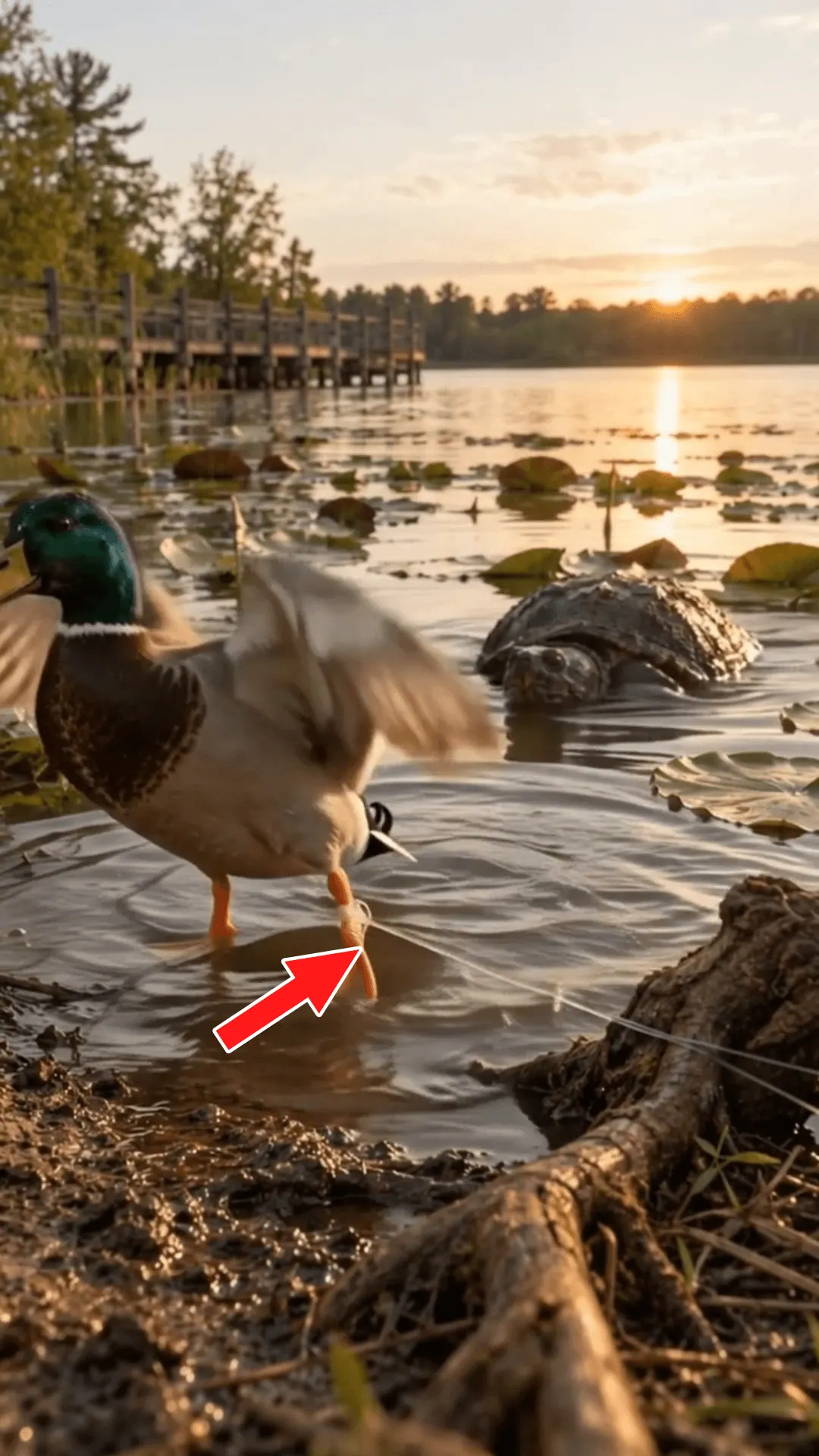
A Sudden Splash at the Waterline
The mallard’s wings beat against the muddy lakebank, sending ripples crashing across the lily pads.
Its orange webbed foot pulled taut beneath the surface, anchored tight by a knot of clear filament. Every frantic kick pulled the synthetic line tighter into the bird’s tender skin.
A few yards out in the murky water, a heavy ridged shell broke the surface. A large snapping turtle drifted forward, its dark snout pointed directly at the splashing duck.
From the wooden boardwalk above, heavy footsteps rattled the planks. A woman wearing utility shorts and a tactical belt aimed the bright beam of an inspection flashlight across the reeds.
The white light cut through the evening gloom, spotlighting the mallard’s frantic struggle and the predator closing the distance.
Stepping Between Predator and Prey
She vaulted down the wooden steps, her boots sinking into the wet mud along the bank.
Keeping the bright beam focused straight onto the turtle’s eyes, she stepped directly into the shallow waterline. She raised her free arm and splashed the surface, creating a visual barrier between the hunter and the trapped bird.
The turtle paused in the shallows. It lifted its head, studied the towering figure, and slowly pivoted its heavy shell back toward deeper water.
With the predator retreating into the lily pads, she turned her focus entirely to the pinned mallard. She dropped to both knees in the soft earth, reaching into a small utility pack strapped to her hip.
She unrolled a thick beige towel across the damp grass to protect the bird’s feathers.
Removing the Invisible Trap
Working with gloved hands, she gathered the duck’s flapping wings against its body. The bird let out a sharp hiss before pressing its chest against the towel.
She kept one firm hand flat over the bird’s back, keeping its heartbeat steady against the cloth. With her other hand, she drew a pair of small medical shears from her belt.
The monofilament line had wound six times around the duck’s lower ankle joint. Clear plastic dug deep into the scaled flesh, cutting off circulation to the spread web.
She slid the blunt safety tip of the shears beneath the tightest loop. With a clean snap of the steel blades, the tension released immediately.
She gently unwound the remaining strands, pulling the sharp coil away from each tiny claw. The mallard relaxed its neck against the terrycloth, stopping its fight as the pressure lifted from its foot.
She neatly bundled the discarded line between her black-gloved fingers, wrapping it into a tight, harmless loop so it could never trap another animal.
Returning to Open Water
She checked the duck’s foot for deep tears, pressing lightly on the joints to ensure full mobility. The bird flexed its toes, opening and closing the web without resistance.
Loosening her grip on the towel, she lifted the mallard by its chest and shifted toward the edge of the reeds.
She set the duck down on the soft slope where the water met the mud. The bird took two quick steps, thrust its chest forward, and launched across the surface with rapid flaps.
It settled smoothly onto the open water, shaking droplets from its glossy green head. She stood quietly along the shoreline with the rolled bundle of fishing line in her hands, watching the duck paddle into the sunset.
Know someone who loves wildlife rescues? Share this story with them today.