

He learned early.
Composure does not mean weakness.
A quiet woman is not always a woman who has nothing to say.
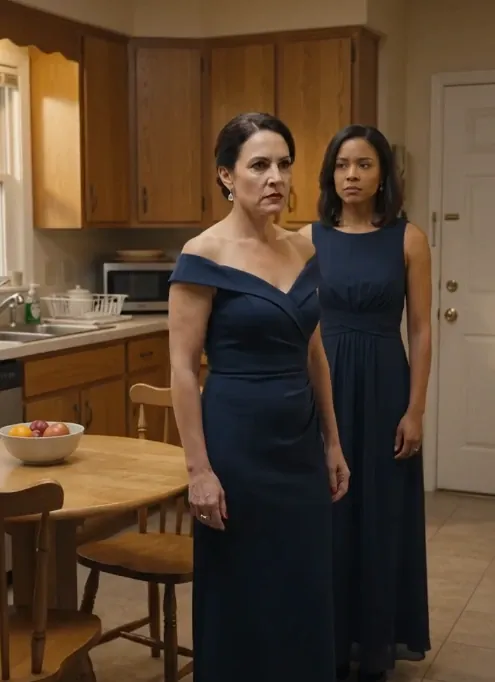
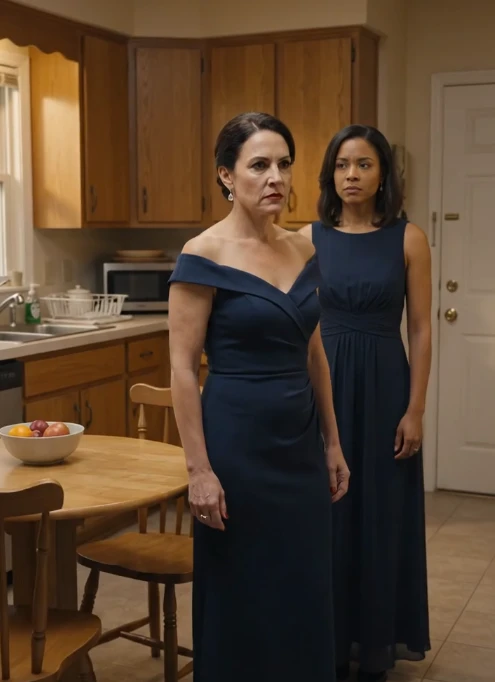
Estelle stood near my kitchen table and began with the word “boundaries.”
She used it beautifully.
That was the dangerous part.
She talked about healthy transitions. The natural restructuring of family roles. The importance of a wife and husband building a private household without outside influence.
Outside influence.
That was what she called me.
Not the woman who raised Coswell after Raymond was gone.
Not the woman who kept the company alive when one bad contract could have buried us.
Not the mother who sat beside him through grief, growth, business failures, first wins, and the kind of pressure young men do not always admit they feel.
Just outside influence.
Imara stood beside her mother and said very little.
That hurt more than I expected.
Sometimes silence is not fear.
Sometimes silence is agreement wearing a softer face.
When she finally spoke, she used my first name.
“Perline.”
No Miss Bass. No acknowledgment. No warmth.
Just Perline.
Flat.
Final.
Like she was practicing how my name would sound once I had been moved from the center of my son’s life to the edge.
I leaned against the counter, hands folded, and let them talk.
Estelle spoke about Coswell’s future like she had already measured the rooms in it and decided where everyone would stand. She mentioned Bassbilt without naming control. She mentioned “operational distance” without saying removal. She mentioned “new priorities” without admitting she meant my son’s decisions should pass through Imara before they ever reached me.
Every sentence was dressed well.
Every sentence had a knife inside it.
I kept my face calm.
Inside, I was hearing Raymond.
Not his voice exactly, but his way of seeing things.
Raymond could sit through an entire meeting without changing expression, then tell me afterward which person had lied, which person had panicked, and which person had underestimated me badly enough to become useful.
That night, Estelle underestimated me.
At the door, she stopped.
She had already done enough damage, but people like Estelle rarely leave before adding one line too many.
She turned back with her hand on my doorknob and looked at me like she was offering mercy.
“After tomorrow,” she said, “you’re no longer family. You’re just his mother.”
Just his mother.
As if motherhood were a lesser position.
As if building a son, burying a husband, holding a company together, and teaching a man how to stand in rooms that wanted him small could be reduced to “just.”
They left.
I closed the door.
For eleven minutes, I sat in Raymond’s chair and listened to the apartment settle back around me.
The kettle had gone quiet. The streetlights outside had already turned the parking lot amber. Somewhere below, a car alarm chirped once and stopped.
My phone was still on the counter.
Still recording.
I pressed stop.
Then I opened Coswell’s name.
I attached the file.
I typed nothing.
No explanation.
No “call me.”
No “I’m sorry.”
No “you need to hear this.”
I sent it at 9:47 p.m.
He read it almost immediately.
Three dots appeared.
Then disappeared.
Then appeared again.
Then nothing.
No call.
No message.
No defense.
No disbelief.
Just silence.
And that silence followed me into the next morning like a second dress I had not chosen to wear.
I got ready for my son’s wedding slowly.
Gray suit. Simple earrings. Hair pinned neatly. Makeup light enough not to look like armor, though that is exactly what it was.
I drove to the venue in Stone Crest with both hands on the wheel and the recording still living between us, unseen but no longer unheard.
The place was beautiful.
I will give Estelle that.
White roses. Cream ribbons. A live band warming up softly near the wall. Photographers catching laughter before anyone realized what kind of day this was about to become.
Estelle stood near the entrance greeting guests with both hands, smiling as if she had not been in my apartment the night before drawing a line through my place in my son’s life.
I took my seat on the groom’s side.
Close enough to see.
Far enough back to disappear.
That was what I thought I would do if I had to.
Disappear.
Keep dignity.
Go home.
Let my son choose his life without forcing him to carry my pain in front of two hundred people.
Then Coswell walked in.
No groomsmen beside him.
No boutonniere.
No rush.
No smile.
He stopped at the guest registry table, picked up the pen, and signed his name slowly.
Then he did something that made the room begin to turn.
He did not go upstairs.
He did not go to the groom’s room.
He walked to the third row on his own side of the aisle and sat down like a guest at his own wedding.
A coordinator hurried over, still smiling because professionals are trained to smile before panic is allowed.
She bent beside him.
He said something quietly.
Her smile vanished.
The whispers began almost immediately.
The best man crossed the room. Spoke to him. Stepped back with one hand over his mouth.
The pastor looked toward the staircase.
Estelle’s face tightened for the first time all morning.
And I sat there, unable to breathe, because I finally understood something about my son’s silence.
He had not ignored me.
He had been deciding.
Then Coswell stood.
The band stopped mid-note.
Two hundred twenty people turned toward him.
And when he walked to the front of that room, calm as Raymond ever was across a boardroom table, everyone understood at once that the wedding had already changed shape.
He looked at the pastor.
Then at the room.
Then at me.
One small nod.
And before Imara ever reached the aisle, my son began to speak
“My mother is not an outside influence.”
Coswell’s voice did not rise.
It did not need to.
The room had become so quiet I could hear the soft mechanical click of one photographer lowering his camera.
Coswell stood beneath an arch of white roses that had taken three people two hours to assemble. His hands were empty. His shoulders were straight.
For one foolish second, I wanted to believe he was about to fix it.
Not the wedding.
Everything.
I wanted him to say there had been a misunderstanding. That Imara had not meant what she said by standing beside Estelle in my kitchen. That Estelle had overstepped. That tomorrow—or next week, or five years from now—we would laugh at how close we had come to letting one terrible conversation destroy something good.
Denial does not always look like refusing the truth.
Sometimes it looks like searching the truth for one sentence you can survive.
Coswell looked toward the staircase.
“I asked Imara to come down before the ceremony.”
Estelle moved first.
“Coswell,” she said pleasantly, “this is neither the time nor the place.”
He turned his head.
“No. Last night was neither the time nor the place.”
That landed differently.
A few people looked at Estelle.
Her smile remained, but something beneath it tightened.
I had seen that expression on developers whose financing had just fallen apart while they were still telling the room everything was fine.
Coswell continued.
“I heard a conversation last night that I was never supposed to hear.”
Estelle’s eyes found mine.
There it was.
Not shame.
Calculation.
She knew immediately.
I did not look away.
“I’m not going to play it here,” Coswell said. “Nobody in this room came to watch my family humiliate one another.”
My chest tightened at the word family.
He still used it.
For the moment.
“But I will say this clearly. Marriage does not erase the people who came before it. It doesn’t convert my mother into a former relative. And it does not transfer authority over my life from one woman to another.”
A chair creaked somewhere behind me.
Then the staircase doors opened.
Imara appeared.
She was already in her wedding gown.
The dress was ivory silk, narrow through the waist, simple in the way expensive things often are. Her veil had not yet been lowered. She had no bouquet.
She looked first at Coswell.
Then at the room.
Then at me.
I watched her understand that the private conversation she had treated as disposable had followed her into a room full of witnesses.
“Coswell,” she whispered.
He looked at her for a long time.
“Did you know what your mother was going to say to mine last night?”
Estelle stepped forward.
“Absolutely not. We are not doing this publicly.”
Coswell did not even glance at her.
“Imara.”
That one word removed Estelle from the conversation more effectively than shouting could have.
Imara swallowed.
“I knew she wanted to discuss boundaries.”
“Did you know she intended to tell my mother she would no longer be family?”
“No.”
Estelle’s face changed.
Only slightly.
But I saw it.
So did Imara.
“Mother—”
“Be careful,” Estelle said.
The words were quiet.
That made them worse.
Coswell’s expression hardened.
“Careful of what?”
Estelle straightened.
“Of destroying your marriage over one emotional conversation.”
“Our marriage hasn’t happened.”
Nobody moved.
Estelle blinked.
Coswell looked at the pastor.
“There will be no ceremony this morning.”
A sound moved through the room.
Not a gasp exactly.
Two hundred twenty people trying not to make one.
My hand closed around the strap of my purse.
I had imagined many things since 9:47 the night before.
I had not imagined this.
Imara stared at him.
“You’re canceling our wedding?”
“I’m postponing a legal commitment until I understand what I’m legally committing myself beside.”
Estelle gave a short laugh.
Too quick.
Too dismissive.
“That is absurd.”
Coswell finally looked at her.
“Is it?”
She stopped smiling.
He turned toward the guests.
“The reception staff will still serve lunch. Everything has already been paid for. Please stay if you’d like. Please go if you’d prefer. I’m sorry you were brought into something private.”
Then he looked at me again.
“Mom, will you come with me?”
Mom.
Not Perline.
Not Mrs. Bass.
Not outside influence.
I stood.
My knees felt less reliable than I wanted them to.
As I walked toward him, I caught sight of the empty space beside the front-row chair reserved for the groom’s mother.
There was a small white rose pinned to it.
I had not noticed it before.
For some reason, that nearly undid me.
Not Estelle’s words.
Not the canceled wedding.
A flower on a chair someone had expected me to occupy.
I kept walking.
We went into a bridal consultation room behind the ballroom.
Coswell entered first. Imara followed. Estelle tried to come behind her.
Coswell held the door.
“I need to speak with Imara.”
“I am her mother.”
“And Perline is mine.”
The use of my first name sounded deliberate.
A mirror.
Estelle heard it.
“So this is punishment.”
“No,” I said.
It was the first thing I had said to her all morning.
She looked at me.
I set my purse on the small table between us instead of gripping it tighter.
“This is access.”
Her brow furrowed.
“You came into my home last night because you believed access to my son belonged to your daughter after marriage. Coswell is deciding who has access to this conversation before marriage.”
I opened the door wider.
“You don’t.”
I closed it gently.
My anger surprised me with how cold it felt.
There was no satisfaction in it.
Only a clean edge.
Inside, Imara sat in front of the vanity without touching anything. Coswell remained standing.
I took the chair near the wall.
For several seconds nobody spoke.
Finally Imara looked at me.
“I didn’t know she would say that.”
I wanted to believe her so badly that I became suspicious of myself.
“Which part?”
She hesitated.
“That you wouldn’t be family.”
Coswell’s jaw moved.
“So you knew about the rest.”
“I knew she was concerned.”
“About my mother?”
“About our marriage.”
“Those aren’t the same thing.”
“Sometimes they are.”
The answer came too quickly.
Imara closed her eyes.
She knew it.
Coswell sat across from her.
“Tell me the truth now.”
She looked at him.
“All of it.”
There was something almost tender in his voice, which made what came next harder to watch.
“If you tell me the truth right now, I am not promising we get married. I am promising I will listen before I decide what this becomes.”
Bargaining.
I recognized it because I had done the same thing after Raymond became ill.
If you eat something, we can go home tomorrow.
If the next scan is better, we can stop talking about wills.
If you make it through this week, I will stop being afraid.
Grief teaches you how many bargains can be made with something that has never agreed to negotiate.
Imara stared at her hands.
“My mother thinks you depend too much on your mother.”
Coswell said nothing.
Still nothing.
That time his eyes shifted toward me.
I felt something move quietly into place.
“Continue,” I said.
Imara looked at me.
“My mother believes Coswell is supposed to receive more of the company after we marry.”
The room seemed to narrow.
Coswell frowned.
“What?”
“I told her I didn’t know.”
“Why would she believe that?”
“I don’t know.”
She answered too fast.
I stood.
Not because I wanted to intimidate her.
Because I suddenly remembered the package.
The tracking message.
Before 7.
The reason I had opened my door at all.
I reached into my purse for my phone.
There were seventeen unread messages.
Three from relatives.
Four from Bassbilt employees who had apparently heard the wedding had stopped.
Two from the venue coordinator.
One from my neighbor downstairs.
And one from my building concierge at 7:18 the night before.
MRS. BASS — DELIVERY LEFT IN PACKAGE ROOM. SIGNATURE REQUIRED. I SIGNED FOR YOU.
My stomach went cold.
Coswell saw my face.
“What is it?”
“The package I was expecting last night.”
“What package?”
I looked at him.
For six months, Bassbilt’s attorneys had been preparing the first major succession transfer since Raymond died.
Fifteen percent of my voting shares.
To Coswell.
A wedding gift was what I had called it privately, though legally it had nothing to do with the marriage.
He did not know.
I had wanted to hand him the documents after the honeymoon.
A symbol that I trusted the man he had become.
The transfer would have increased his position enough to make him the company’s clear successor.
Only four people knew.
Me.
Our attorney.
Our CFO.
And—
I stopped.
Imara watched me too carefully.
“Who told your mother about Bassbilt shares?” I asked.
“I said I don’t know.”
“No.”
My voice remained calm.
“You said you told her you didn’t know how many Coswell would receive.”
Silence.
Coswell turned toward her.
Imara’s eyes filled, but the tears did not fall.
“I saw a draft.”
My fingers went still around my phone.
“Where?”
“At your house.”
I almost corrected her.
Apartment.
My apartment.
Such a small thing to care about.
Such a desperate little defense of normality.
“When?”
“Christmas.”
A flash of memory.
Imara at my dining table.
Coswell opening wine.
Me leaving a Bassbilt folder near the printer because I had been working before they arrived.
Imara carrying dessert plates into the kitchen.
Five minutes, perhaps.
Maybe less.
“I didn’t read everything,” she said.
Coswell leaned back.
“But you read enough.”
“I saw your name. Fifteen percent. Effective after—”
“After execution,” I said.
She went quiet.
Not after marriage.
After execution.
A legal word mistaken for a personal one.
Or deliberately changed.
My phone vibrated.
An email.
Bassbilt General Counsel.
URGENT — CROSS FAMILY HOLDINGS / VERIFICATION REQUEST.
I opened it.
The first sentence was enough.
Perline, please call before signing the succession transfer. Yesterday afternoon we received a third-party lender verification requesting confirmation of Coswell’s anticipated post-transfer ownership percentage.
Coswell came beside me.
I did not want to scroll.
That was the moment denial returned.
Ridiculous, stubborn denial.
I could sit there.
I could close the email.
We could call this wedding family drama and leave corporate matters for Monday.
I could preserve one last version of the day.
My thumb did not move.
Coswell reached toward the screen, then stopped before touching it.
“Mom.”
I scrolled.
The lender had attached supporting documentation.
A projected personal financial statement.
A proposed line of credit.
Nine million dollars.
Borrower: Cross Family Holdings LLC.
Proposed guarantors listed below.
Estelle Cross.
Imara Cross.
And Coswell Bass.
Coswell stared at the page.
“I’ve never seen this.”
Neither had I.
The next attachment was titled:
CONSENT TO USE ANTICIPATED BASSBILT EQUITY AS FINANCIAL SUPPORT.
I opened it.
There were two signatures at the bottom.
Estelle Cross.
And Imara Cross.
Dated twelve days earlier.
Coswell stepped away from the table.
Imara did not.
She simply looked at the document.
Then, very slowly, she removed her engagement ring.
She set it on the vanity.
Not dramatically.
Not as an announcement.
As though her finger had suddenly become too heavy to carry it.
Coswell’s voice was almost a whisper.
“You signed this?”
Imara looked up.
“Yes.”
The room seemed to lose its air.
Then she said the one thing none of us expected.
“But that isn’t the document I signed.”
Coswell looked at her for several seconds.
“What does that mean?”
Imara reached for the phone.
I pulled it back.
Not sharply.
Just enough.
Trust had become something that now required permission.
She noticed.
Her hand returned to her lap.
“The document my mother gave me was two pages,” she said. “It was a financial disclosure authorization. She said the bank needed permission to verify household assets because she was refinancing Cross House.”
“Cross House?” Coswell asked.
“The event property.”
I knew it.
Everyone in Atlanta who had attended an expensive fundraiser in the last ten years knew it.
An old estate in Buckhead converted into a private-events venue. Estelle had built much of her social standing around it.
“Why would your household assets matter to her refinance?” I asked.
Imara stared at the floor.
“They shouldn’t have.”
That answer sounded more truthful than anything she had said yet.
Coswell walked to the window.
Outside, people in wedding clothes crossed the courtyard carrying champagne they no longer knew whether they were celebrating with.
“I asked you if your mother had financial problems,” he said.
Imara’s face tightened.
“I know.”
“You said no.”
“She told me it was temporary.”
“That isn’t what I asked.”
Silence.
“She said Cross House had a cash-flow issue after the renovation.”
“How much?”
“I didn’t know.”
“How much, Imara?”
“Three million.”
Coswell laughed once.
There was no humor in it.
“You call three million temporary?”
“She has property.”
“Apparently she wanted mine.”
“No.”
Imara stood.
“No. That is not what I agreed to.”
Coswell turned.
“You signed something involving assets you did not own.”
“I signed permission to verify assets I expected to share after marriage.”
That sentence changed the room.
Even Imara seemed to hear it after she said it.
I watched my son.
His anger did not show in his face.
It showed in what he stopped doing.
He had been holding her veil where it had fallen across the back of the chair.
He let it go.
The silk slipped quietly to the floor.
“Expected to share,” he repeated.
Imara’s voice dropped.
“I didn’t mean ownership.”
“What did you mean?”
“Security.”
“For whom?”
“For us.”
He waited.
She looked away first.
People reveal more when you refuse to rescue them from silence.
“My mother said you would always choose Bassbilt first,” she whispered. “That if something happened between us, I could walk away with nothing while your family kept everything.”
“My family?”
“I know how that sounds.”
“I’m asking what it means.”
She looked at me.
I understood before Coswell did.
“Me,” I said.
Imara did not answer.
“That was the problem,” I continued. “Not Bassbilt. Me.”
“I never said that.”
“No. Your mother did.”
“I’m not my mother.”
“Then stop hiding behind her.”
The words came out colder than I intended.
For a second, her face looked very young.
I regretted it.
Not enough to take it back.
Coswell sat down.
“If that isn’t the document you signed, we can prove it.”
Imara nodded quickly.
“Yes.”
Hope entered her voice so fast it hurt to hear.
“I signed electronically. My mother sent it from her office.”
“Do you have the email?”
“I think so.”
“Find it.”
She took out her phone.
For the next five minutes, the canceled wedding existed on the other side of the door while the three of us searched an inbox.
That may have been the strangest part of the day.
White roses outside.
A wedding cake downstairs.
And inside, my future daughter-in-law scrolling through messages to find out whether her mother had used her signature to reach nine million dollars.
She found the email.
April 22.
Subject: BANK PAPERWORK — SIGN TODAY.
Two-page PDF.
I read it twice.
Imara had told the truth about one thing.
The document she signed was not the document attached to the lender request.
The first page authorized release of personal financial information.
The second allowed Cross Family Holdings to reference “anticipated household assets” for preliminary underwriting.
Broad language.
Careless language.
But no guarantee.
No specific Bassbilt shares.
No nine million dollars.
Coswell exhaled.
Imara closed her eyes.
“Thank God.”
I did not.
Because something was still wrong.
“Forward it to Bassbilt counsel.”
She did.
Then I asked, “Did you send your mother anything else?”
Imara opened her eyes.
“No.”
I waited.
She looked at me.
“No documents.”
“That wasn’t my question.”
Coswell’s head turned.
Imara’s lips parted.
Silence again.
“I sent her a screenshot.”
“What screenshot?”
She looked at Coswell now.
“The draft from Christmas.”
He stood so abruptly the chair rolled backward.
“You photographed my mother’s private company documents?”
“I panicked.”
“About what?”
“My mother kept saying I was marrying into a situation where everyone knew the rules except me.”
“So you stole them?”
“I took one picture.”
“One was enough.”
She pressed her fingers to her forehead.
“I deleted it afterward.”
“After sending it to her.”
“Yes.”
There are moments when victory loses all resemblance to winning.
I had proof Estelle had altered something.
I had proof Imara had not signed the nine-million-dollar guarantee knowingly.
I also had proof she had photographed confidential papers in my home and sent them to someone who had no right to see them.
Both things could be true.
That was the difficulty.
People want betrayal to arrive cleanly.
One villain.
One victim.
One door to close.
Real life is rarely considerate enough to arrange itself that way.
A knock came.
Coswell opened the door three inches.
It was our general counsel, Dana Pierce.
I had forgotten she was invited.
Raymond hired Dana twenty-three years ago when she was a junior associate who terrified opposing counsel by remembering page numbers nobody else had read.
She entered carrying her handbag and no expression at all.
“I received your email,” she said.
Then she looked at Imara.
“I assume this is now a privileged corporate matter as well as a family catastrophe.”
Under any other circumstances, Raymond would have laughed.
I almost did.
Almost.
Dana examined the documents, forwarded both versions to herself, then looked at Imara.
“Do not delete anything.”
“I won’t.”
“Do not contact your mother about the loan.”
Imara hesitated.
Dana noticed.
“Have you already?”
“No.”
“Good. Keep it that way.”
Coswell folded his arms.
“What happens now?”
“We notify the lender that Bassbilt has not authorized the use, pledge, transfer, or representation of anticipated shares. We state that no transfer has occurred.”
She looked at me.
“Correct?”
My purse sat on the table.
Inside it was my apartment key.
Behind that key, seventeen miles away, was a package containing documents that could make the lender’s representation true.
All I had to do was sign.
I thought of the Christmas dinner when Coswell had stayed late to wash dishes.
“You know I can hire someone for that,” I had told him.
He had smiled.
“You know I can still help my mother.”
A tiny memory.
Four words.
My mother.
I had planned to give him fifteen percent because I believed marriage marked the right moment to let go.
Now marriage had become the reason I could not.
“The transfer has not occurred,” I said.
Dana nodded.
“And will it?”
Coswell looked at me.
There was pain in that look I had not expected.
He knew.
He understood immediately that whatever gift had been waiting for him had just changed.
I removed my car keys from my purse and set them on the table.
“I don’t know.”
That was my anger.
Not taking something away.
Refusing to give away what I was no longer certain I should.
The cake remained.
Nobody touched the top tier.
I drove home alone.
For the first time in eleven years, I forgot to turn off the kitchen light before sitting down.
I noticed it only after dark.
That frightened me more than I wanted to admit.
I made tea.
Then, without thinking, I took out two mugs.
I stared at the second one.
Raymond’s mug.
Blue stripe near the handle.
He had been gone sixteen years.
Still, my hands had remembered a life my mind no longer lived in.
I poured the second cup down the sink.
Then I sat at the table without drinking mine.
My phone continued to light up.
Wedding guests.
Relatives.
Board members.
Three journalists.
Someone had posted a twenty-two-second video of Coswell announcing the ceremony would not happen.
BASSBILT HEIR WALKS OUT ON WEDDING HOURS AFTER FAMILY DISPUTE.
Another:
ATLANTA PROPERTY FAMILY DRAMA ERUPTS AT SOCIETY WEDDING.
I turned the phone over.
At 8:14, Coswell came to my apartment.
For a second, seeing him outside my door brought back the night before so sharply that my hand stopped on the lock.
Then I opened it.
He looked exhausted.
No tuxedo jacket.
Tie gone.
“Can I come in?”
His own mother.
His childhood home had been a different house, long sold.
Still, I hated that he had to ask.
“Yes.”
He entered.
I automatically reached for a mug.
Then stopped.
“Tea?”
“No.”
I put the mug back.
We sat in Raymond’s chairs.
There had been two originally.
After Raymond died, I moved one to the bedroom because seeing them side by side felt unbearable.
I brought it back when Coswell graduated college.
I had never told him why.
He rubbed his hands together.
“Imara is at a hotel.”
I nodded.
“She says Estelle won’t stop calling.”
“Is she answering?”
“No.”
That mattered.
Not enough.
But it mattered.
“She wants me to believe she didn’t know.”
“About the altered document?”
“About what her mother intended.”
I looked at him.
“Those are different questions.”
“I know.”
He lowered his head.
“I keep trying to make them the same one.”
There it was.
Denial passing from mother to son like something inherited.
He wanted a version in which Imara was either innocent or guilty.
Not careless.
Not frightened.
Not ambitious.
Not manipulated.
Not complicit in one part and deceived in another.
Love likes clean verdicts.
Life rarely gives them.
“If she tells you everything,” I said, “will you marry her?”
He took a long time.
“I don’t know.”
“Then don’t promise her that truth earns the wedding back.”
He looked at me.
“That’s what I did this morning.”
“I know.”
“I meant it.”
“I know that too.”
His mouth tightened.
“Mom, I’m sorry.”
I looked toward the kitchen.
The words I wanted were not available.
Not yet.
So I asked the only question that mattered.
“Did you ever tell her about the fifteen percent?”
“No.”
“Did you tell anyone?”
“No.”
“Then Estelle built a nine-million-dollar loan request from a photograph Imara should never have taken.”
“Yes.”
My phone rang.
Dana.
I answered on speaker.
Her voice was clipped.
“Perline, Coswell, I need both of you to listen before either of you responds.”
We did.
“The lender has frozen the Cross Family Holdings application.”
Coswell exhaled.
“That’s good.”
“No,” Dana said. “It’s necessary. I did not say good.”
My fingers tightened around the phone.
“What else?”
“They sent the original submission package.”
A pause.
“There is a personal guarantee attributed to Coswell.”
He went completely still.
“I never signed anything.”
“I know.”
“What kind of signature?”
“Electronic.”
Imara’s words came back to me.
My mother sent it from her office.
Dana continued.
“The lender also supplied authentication data.”
Coswell stood.
“Whose device?”
Dana did not answer immediately.
She did not need to.
The silence had already told us it was bad.
Finally she said, “The signature was authenticated from the same mobile number Imara used on the financial disclosure form.”
Coswell’s face emptied.
I thought of the ring on the vanity.
The photograph at Christmas.
The woman saying thank God when we found the altered page.
Dana’s voice softened by half a degree.
“There is one more problem.”
I closed my eyes.
“What?”
“The authentication code was sent at 11:42 p.m. twelve days ago.”
Coswell stared at nothing.
Dana finished.
“According to the phone records attached by the lender, Imara confirmed it forty-three seconds later.”
Coswell did not go back to the hotel that night.
He slept in my guest room.
At sixty-one, I learned there are some griefs that make a grown son look twelve again without changing his face.
At 6:10 the next morning, I found him sitting at my kitchen table in yesterday’s shirt.
A cup of coffee sat untouched in front of him.
He had always drunk coffee too hot.
Raymond used to warn him.
“Boy, one day your mouth is going to learn patience.”
Coswell would grin and swallow anyway.
That morning, the coffee went cold.
He looked at me.
“She says she can explain.”
Of course she could.
Explanations are the first currency people offer when trust becomes expensive.
“Are you going to listen?”
“Yes.”
I put bread into the toaster.
Normal movement.
Normal morning.
For three seconds I could pretend he was visiting before work.
Then the toaster clicked and neither of us moved to take the bread out.
“At Dana’s office,” I said.
He nodded.
“Not here.”
Another nod.
That was my boundary.
My home had already hosted one ambush.
It would not host the investigation of another.
At nine, the four of us sat around Dana’s conference table.
Me.
Coswell.
Imara.
Dana.
Estelle was not invited.
Imara wore black trousers and a cream blouse. No makeup. No engagement ring.
She placed her phone on the table before anyone asked.
“I approved the code.”
Coswell looked at the window.
Not at her.
Dana folded her hands.
“Tell us why.”
“My mother called me.”
“When?”
“That night.”
“What did she tell you?”
“That the lender had sent a final verification and the previous authorization had expired.”
“Did you read the document?”
“No.”
Coswell laughed quietly.
Imara flinched.
“I know how that sounds.”
“No,” he said. “You know what it did.”
She lowered her head.
“She said if I didn’t confirm it immediately, Cross House could go into default before the weekend.”
“So you did.”
“Yes.”
“Using my name.”
Her eyes lifted.
“I didn’t know it was your signature.”
Dana interrupted.
“You received an authentication message. What did it say?”
Imara looked toward the table.
She remembered.
That was obvious.
“Imara.”
“It said Coswell Bass authorization.”
Nobody spoke.
She continued before we could.
“My mother told me the bank had put his name on it because the disclosure listed us as an engaged household.”
Coswell finally looked at her.
“And that made sense to you?”
“No.”
“Then why did you do it?”
Her face folded inward without tears.
“Because she said she would lose everything.”
There it was.
Not greed.
Not innocence.
Fear.
Old, trained fear.
Imara looked at me.
“When I was thirteen, we lost our house.”
I said nothing.
“She never told people. We stayed with my aunt for seven months and she kept driving me to the same school every morning so nobody would know. She would park around the corner because her car had been repossessed and my aunt’s car was twelve years old.”
Estelle Cross.
Perfect clothes.
Perfect posture.
Perfect rooms.
Suddenly I understood the architecture.
Not enough to excuse it.
Enough to see it.
“When Cross House started failing,” Imara said, “she became that woman again. Checking balances at three in the morning. Calling me about vendors. Saying she would not be humiliated twice.”
Coswell’s voice was low.
“So you let her use me.”
“No.”
“You used my name.”
“I thought I was giving her one more week.”
“With something that wasn’t yours.”
“Yes.”
That one word changed more than denial ever could.
No defense.
No mother to blame.
No softer vocabulary.
Yes.
Imara’s hands trembled once, then steadied.
“I took the photograph at Christmas because I wanted to know what you weren’t telling me. I gave it to her because she told me I was stupid if I married a man without knowing what his mother controlled.”
Coswell’s face tightened.
“I would have told you anything you asked me.”
“I know that now.”
“No. You knew it then.”
She stopped.
That was the sentence she could not bargain around.
Dana slid a document across the table.
“The lender’s forensic team confirmed that the guarantee PDF was assembled in Estelle Cross’s office. Your electronic confirmation authenticated Coswell’s name, but the document itself appears to have been substituted after the original disclosure authorization.”
Imara stared at it.
“Is that fraud?”
Dana’s expression remained neutral.
“That is a question for counsel representing you separately.”
The word separately landed hard.
Families say ours.
Lawyers say separately.
That was when Imara finally cried.
Quietly.
She wiped the tears before they reached her jaw.
“I’ll cooperate.”
Dana nodded.
“You should.”
Coswell stood and walked into the hallway.
I waited a few seconds before following.
He stood near the elevator.
“I still love her.”
I looked at my son.
“I know.”
“That’s the worst part.”
“No.”
He turned.
“The worst part is believing love should answer the question for you.”
He looked back through the glass wall at Imara.
“What would you do?”
I could have answered as his mother.
I could have told him never to speak to her again.
I could have used his hurt to reclaim every inch Estelle tried to take from me.
That temptation was there.
I will not pretend otherwise.
Then I remembered something Raymond told me the first time Coswell came home from school with a bloody lip after defending a friend.
We had disagreed about punishment.
I wanted to march back to the school.
Raymond stopped me at the door.
“If we make every hard decision for him, Perline, one day he’ll be forty and still need us to know who he is.”
I looked at Coswell.
“This one belongs to you.”
His eyes closed briefly.
“I hate that answer.”
“I know.”
“What are you going to do about the shares?”
That one belonged to me.
“I’m not signing the transfer.”
Pain crossed his face.
I let it.
Acceptance is not cruelty.
Sometimes it is simply refusing to lie because the truth hurts someone you love.
“Not now,” I added. “And not because of Imara.”
“Then why?”
“Because I realized I was about to give you fifteen percent of Bassbilt as a wedding gift.”
He frowned.
“So?”
“So Bassbilt is not a wedding gift.”
He went silent.
“It took Raymond and me thirty-seven years to build what exists now. If you are going to control more of it, I need to know it is because you are ready for the responsibility, not because you reached the altar.”
He absorbed that.
Then, unexpectedly, he nodded.
“That’s fair.”
“No. It’s painful.”
He looked at me.
“Those can be the same thing.”
Raymond would have liked that answer.
She went public.
Perhaps she thought she still controlled the story.
People like Estelle often confuse an audience with power.
At 8:03 a.m., a statement appeared through her publicist.
It described the wedding cancellation as “a painful consequence of longstanding interference by business interests in a private relationship.”
No names.
No accusations.
Just enough smoke to point toward me.
At 8:46, another outlet quoted an unnamed source saying I had threatened to disinherit Coswell if he married Imara.
At 9:12, Bassbilt’s board began receiving calls.
At 9:30, Dana asked whether I wanted to release the recording.
“No.”
Coswell looked surprised.
“You have her saying exactly what she intended.”
“I know.”
“Then why not use it?”
“Because she is talking.”
I closed the folder in front of me.
“Let her.”
Silence can make arrogant people generous.
She told a lifestyle columnist there had never been any financial interest in Bassbilt.
At 1:20, her attorney sent the lender a letter claiming Cross Family Holdings had never represented anticipated Bassbilt ownership as security.
At 2:05, Dana received permission from the lender to circulate one email to relevant parties.
Estelle had written it herself three weeks earlier.
The subject line was:
POST-MARRIAGE POSITION.
The body was six sentences.
The fifth sentence ended her.
Once Perline is moved out of the family’s operational circle, Coswell will be free to treat the transferred shares as household capital.
The phrase was almost identical to what she had said in my kitchen.
Operational distance.
Outside influence.
No longer family.
It had never been about boundaries.
Boundaries were the wrapping paper.
The nine million dollars was the box.
At 3:40, Estelle stopped answering journalists.
At 4:15, Cross House announced it was temporarily suspending events.
Imara retained separate counsel.
She provided her phone.
Her emails.
The original PDF.
Every message from her mother.
She did not escape consequence.
Her electronic approval had been reckless.
Her photograph of my confidential papers had been deliberate.
But the evidence also showed Estelle had changed the documents and used her daughter’s fear as efficiently as she had tried to use my son’s assets.
The investigation continued.
There was no dramatic arrest.
No handcuffs outside a mansion.
Real consequences are often quieter.
Accounts reviewed.
Contracts frozen.
Invitations stopped.
People who once returned calls in six minutes suddenly needing three business days.
Reputation does not always collapse with a bang.
Sometimes it simply stops opening doors.
Three weeks after the wedding that did not happen, Imara asked to see me.
We met at Dana’s office.
Not my apartment.
That boundary remained.
She placed a small envelope on the table.
Inside was a check.
Not nine million dollars.
Four hundred eighty-six dollars.
“What is this?”
“The cost of replacing the confidentiality binder and having your counsel review the leak I caused.”
I looked at her.
“Dana told you that amount?”
“I asked.”
I almost smiled.
Almost.
“I’m not taking this.”
Her chin lifted.
“Please.”
“No.”
“Why?”
“Because repayment is not the same as repair.”
She swallowed.
“I know.”
“Good.”
I pushed the check back.
“Then repair what can be repaired.”
Her eyes lowered.
“Coswell ended the engagement.”
I knew.
He had told me two days earlier.
He had not told me how.
I did not ask.
“I’m sorry,” I said.
She looked surprised.
“So am I.”
It was the first apology between us that had no transaction inside it.
She picked up the envelope.
At the door she stopped.
The movement was so similar to Estelle standing at my apartment that my body remembered before my mind did.
Imara turned.
“My mother kept saying you would never let him choose me.”
I said nothing.
“She was wrong.”
“Yes.”
Imara nodded.
“I was wrong too.”
Then she left.
That evening, I went home and opened the package.
Nearly a month had passed since it arrived.
It was still sealed.
I had moved it from the package room to my desk, then from my desk to the cabinet beside Raymond’s chair.
I had refused to open it because part of me believed the documents inside belonged to the life we were supposed to have.
Wedding.
Honeymoon.
Transfer.
Succession.
A straight line.
I cut the envelope open.
The transfer agreement was exactly where it should have been.
Signature tabs marked in yellow.
Fifteen percent.
My name beneath a blank line.
Coswell’s beneath another.
I sat with it until sunset.
Then I called Dana.
“We’re changing the succession plan.”
“To what?”
“Performance-based transfer. Five years. Independent board review.”
She paused.
“And the fifteen percent?”
“Not guaranteed.”
“Coswell may not like that.”
“He already knows.”
Another pause.
“You’re sure?”
I looked at Raymond’s chair.
For years, I had treated preserving the company for our son as the same thing as preserving our family.
They were never the same responsibility.
“Yes.”
I signed nothing.
Six months later, Coswell remained at Bassbilt.
Not as heir apparent.
Chief Development Officer.
Same salary structure as before.
Same performance review.
He complained once about the independent board metrics.
I told him to improve them.
He laughed.
That mattered more than either of us admitted.
Imara moved out of the house she had planned to share with him.
She and Coswell spoke occasionally.
I did not ask what they said.
Some things were his life, not mine.
Estelle sold Cross House before the bank could force the issue.
The sale covered most of the secured debt.
Not all.
Her legal problems continued.
So did the investigation into the altered guarantee.
I never released the kitchen recording publicly.
I gave it to counsel.
That was enough.
There are victories you display.
There are others you keep in a file because becoming the person who humiliates someone simply because you can would mean they changed you more than you were willing to admit.
The following spring, Coswell came to my apartment on a Sunday.
He knocked twice.
Same rhythm he had used since college.
I opened the door.
He held a bakery box.
“No wedding cake,” he said.
I stared at him.
He smiled.
“Too soon?”
“By several years.”
He laughed and came inside.
I went to the kitchen.
Took down one mug.
Paused.
Then reached for a second.
Not Raymond’s.
Coswell’s.
Dark green, chipped at the bottom.
He sat at the table while I made coffee.
Neither of us mentioned Imara.
Neither of us mentioned Estelle.
Neither of us mentioned fifteen percent.
For once, silence was not punishment.
It was simply room.
I set the cup in front of him.
He looked toward Raymond’s old chair.
“You ever miss how things were?”
The question stayed between us.
I thought about the wedding that never happened.
The recording.
The package I refused to open.
The documents that forced all of us to see what we would rather have believed.
“Yes,” I said.
He nodded.
“Me too.”
I sat across from him.
“But I don’t want them back.”
He looked at me.
That was the difference.
Grief had spent months teaching me that missing something did not mean I should rebuild it exactly as it was.
Some structures fail because somebody destroys them.
Others fail because the foundation was carrying weight nobody admitted was there.
Bassbilt had taught me that long before my family did.
Coswell lifted his coffee.
This time he waited before drinking.
Outside, a delivery truck turned into the lot.
For a second, I listened to its tires move across the pavement and remembered another evening, another expected package, another knock at my door.
Then the truck continued past my building.
I did not get up.
Nothing was coming to restore the family I thought I had.
Nothing needed to.
The son across from me was no longer asking me to choose for him.
I was no longer giving away pieces of myself to prove I trusted him.
And somewhere between what we lost and what remained, we had finally learned the difference between being family and owning a place in someone else’s life.
Coswell reached for the bakery box.
“Mom?”
“Yes?”
“You going to help me eat this?”
I looked at the second fork he had already placed beside my plate.
A small thing.
Prepared without asking.
Left there without pressure.
I picked it up.
“Yes,” I said.
And this time, when the room became quiet, nobody mistook the silence for weakness.