
Not at the funeral. Not in the weeks that followed. I’d send her pictures of our twin daughters, hoping she’d say something more, but all I ever got in return was a simple “Thank you.”
And honestly, I understood. If I’d been in her position, I might have done the same.
Because when everything came down to one impossible choice in that hospital room, I was the one who said, “Save the babies.”

That morning, Mary and I had still been arguing about names. She insisted our daughters didn’t need matching names just because they were twins. I joked that maybe we should have settled that question a little earlier. She laughed, then asked me to pass her the water.
I looked at Mary.
“Mary…”
She tightened her grip on my fingers.
“The girls. Obviously, the girls.”
I waited for her to reconsider. I kept hoping someone would step forward and tell us there was another option, some way to save all three of them.
But no one did.
“Please,” she whispered.
And I agreed.
It was the last decision Mary and I would ever make together.
I went home with two newborn daughters and a bag of her belongings. Inside was the sweatshirt she’d worn when she arrived at the hospital. I still haven’t washed it.
Everyone told me the same thing.
“Stay strong. Those girls need you.”
So I did my best to keep going. I got up through the night to warm bottles, recorded how much each baby drank because exhaustion made it impossible to remember, and stood over their cribs for twenty minutes at a time, watching their tiny chests rise and fall.
My sister brought food over, only to find it untouched days later. I lost weight without even noticing. Eventually, my jeans stopped fitting.
And whenever the house grew quiet, the same question returned.
What if I’d made a different choice?
Then, last Thursday, the doorbell rang.
Mary’s mother stood on my porch.
Before she’d even stepped inside, I started explaining myself. I don’t know why. Maybe I’d spent three months rehearsing the words, waiting for the moment I’d finally have to face her.
“I didn’t want to lose her,” I said. “She asked me to choose the girls, and I—I should have done something. I should have at least tried to—”
“I know.”
“No, you don’t understand. I agreed to it.”
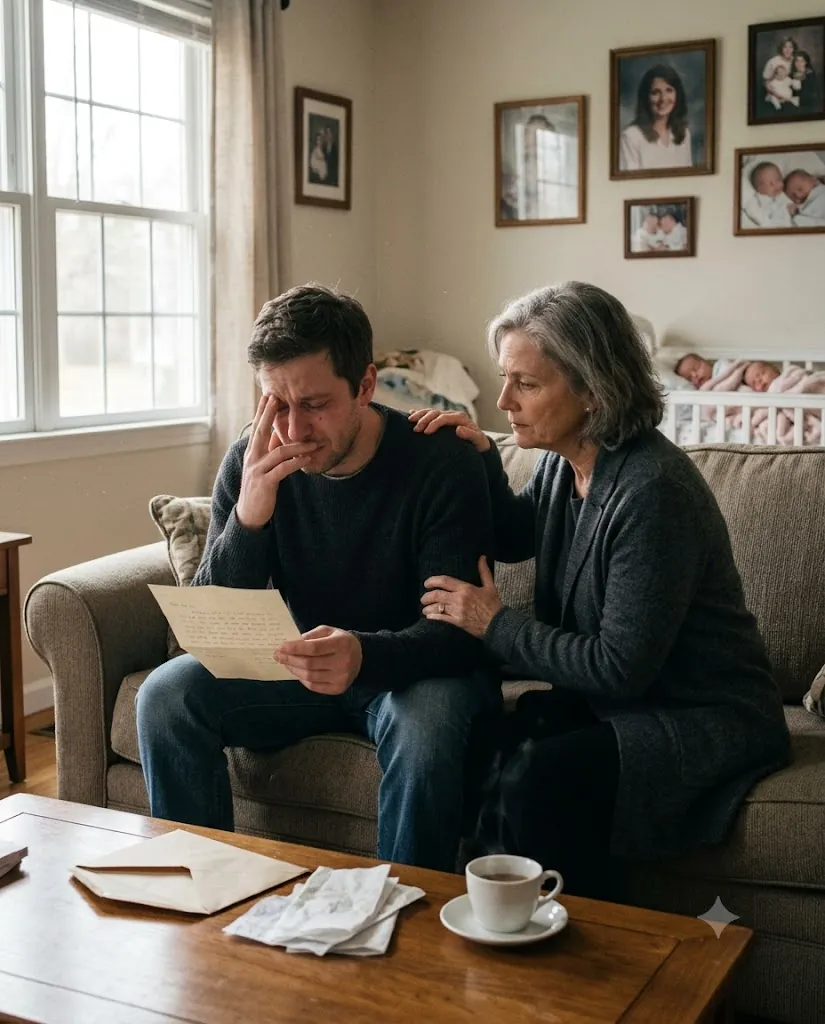
She lowered her eyes to the envelope she was holding tightly in both hands.
“Do you think I stayed away because I blame you?”
I couldn’t answer.
“Mary asked me not to tell you,” she continued. “I promised her I wouldn’t. I thought she’d have time to tell you herself.”
“Read it,” she said quietly.
I unfolded the paper and immediately recognized Mary’s handwriting. She had always drawn tiny hearts above certain letters, a habit she’d carried since childhood. Seeing them again made my chest tighten.
The letter began with a message to her mother.
Mary wrote that she knew her mother loved her, but when she was eight years old, after her father died of a heart attack, she had misunderstood what grief could do to a person.
Her mother had struggled to cope with the loss. Sometimes, looking at Mary’s eyes or watching her smile reminded her too painfully of the man she had lost. One evening, Mary found her mother crying over an old photograph and asked whether she missed her father.
“More than anything,” her mother had answered.
Then Mary asked the question that would stay with her for years.
“More than you want me?”
Her mother hadn’t answered.
She hadn’t meant to reject her daughter. She had simply been overwhelmed by grief. But to an eight-year-old girl, that silence felt like proof that she was somehow less important than the father she had lost.
For years, Mary tried to make herself easier to love. She stopped asking questions about her father, stopped bringing out his photographs, and learned not to ask for too much.
“I thought she was getting better,” her mother whispered as I read. “I didn’t understand that she was trying not to upset me.”
I finally understood why Mary had always been reluctant to ask anyone for help, even over something as simple as a glass of water. I had assumed it was just part of her personality. I had never realized how much of her childhood she had spent worrying about being a burden.
Then I reached the part of the letter about our daughters.
Mary wrote that she already loved the babies more than she could explain, but she was frightened by something she had never fully admitted to anyone.
Not the thought of raising twins.
Not the sleepless nights or the responsibilities of motherhood.
She was afraid of what grief could make people believe.
She knew that if anything happened to her, I might blame myself. She feared I would look at our daughters and see the terrible choice I had been forced to make rather than the children she had wanted so desperately.
She had written:
“He will love them. I know that. He doesn’t know how much he’s already healed in me.”
I stopped reading.

For three months, I had replayed the moment in the hospital when I agreed to save the babies. I had convinced myself that I had failed Mary by not finding another way to save her.
But while I was drowning in guilt, she had been remembering something entirely different.
A conversation we had shared in bed a few weeks before the delivery.
One of our babies had kicked so hard that I could see Mary’s stomach move. I had laughed, but Mary had looked strangely serious.
“If something happened to me, would you ever wish we’d never had them?” she asked.
I had turned toward her, confused.
“What kind of question is that?”
“Please. Just answer.”
“Of course not.”
“Even if you missed me?”
I had kissed her forehead.
“I’d miss you every day. But I’d still love them every day.”
At the time, I thought she was simply frightened by the pregnancy. I told her everything would be fine and assumed the conversation was over.
Now I understood that she had been asking me to promise something much more important.
She needed to know that our daughters would never become reminders of what I had lost, that they would never feel responsible for their mother’s death.
And I had given her that promise without fully understanding why she needed it.
Mary had trusted me.
At the hospital, when she squeezed my hand and told me to save the girls, I had thought she was saying goodbye. Now I wondered whether she was also reminding me of the promise I had made.
I looked up at her mother.
“She trusted me?” I asked.
She nodded through her tears.
“She wanted you to know that. She wanted you to understand that she chose the girls because she wanted them to live. She never wanted you to spend your life believing you had betrayed her.”
I looked down at the letter again.
“Tell him I trusted him,” Mary had written. “Tell him I wanted them.”
Then came the final request to her mother.
“Please don’t disappear. You promised. I want my girls to know they were wanted. Always.”
I lowered the letter to the table.
For the first time, I felt something other than guilt. It wasn’t relief exactly. I still missed Mary so much that some mornings it was difficult to get out of bed.
But I began to understand that missing her and loving our daughters were not opposing feelings.
I could wish with every part of me that Mary were still alive without ever wishing our girls had never been born.
“Why didn’t you come?” I asked her mother.
She wiped her cheeks.
“Every time I looked at their photographs, I saw Mary. I kept thinking she should be holding them. I was ashamed that I couldn’t look at them without feeling that pain, so I stayed away.”
“You knew what she asked you not to do.”
“Yes,” she whispered. “I did exactly what I promised her I wouldn’t do.”
She explained that the previous day, I had sent her a photograph of the girls lying together on a blanket. One was smiling while the other grabbed her sister’s sleeve.
Underneath, I had written that they had started smiling whenever I sang to them.
That small message had reminded her of Mary as a little girl, singing around the house. She suddenly realized she could no longer remember the last time she had sung with her daughter.
She had gone home, opened the drawer where she kept Mary’s letter, and read it again.
Then she imagined the girls growing up and asking why their grandmother had never visited.
She couldn’t bear the thought of having no answer that wouldn’t hurt them.
“So I came,” she said. “I should have come sooner.”
I wanted to forgive her immediately, but I couldn’t pretend that three months of silence hadn’t hurt. I had spent those months struggling to care for two newborns while questioning the most painful decision of my life.
Still, I understood something about her grief that I hadn’t understood before. She had lost her daughter, and rather than face the pain, she had run from the very people who could have helped her remember Mary.
“I can’t promise everything will be okay between us,” I told her. “But the girls deserve to know their grandmother.”
She nodded.
“I’ll earn their trust. If you’ll let me.”

Just then, one of the babies began crying in the nursery. I went to pick her up, and her sister soon woke as well. Before long, I was standing in the doorway with one baby against each shoulder.
Mary’s mother watched us quietly.
“Could I hold one?” she asked.
I hesitated.
She lowered her eyes, and I saw her preparing herself for another rejection.
“These girls can’t spend their lives waiting for you to be ready,” I said. “If you’re going to be in their lives, you have to stay.”
“I know,” she whispered. “I want to.”
I handed her the smaller twin.
She held the baby close, her hands trembling slightly.
“Hello, sweetheart,” she whispered. “I’m your grandma.”
The baby curled her fingers around the collar of her shirt.
For a moment, her grandmother simply stared at her, tears sliding down her face. Then she smiled.
We didn’t repair three months of silence in a single afternoon. But she returned the next morning, and the morning after that.
She learned the girls’ different cries, washed their bottles, and held them while I slept. Sometimes, when one of them reminded her of Mary, I could see the old instinct to withdraw cross her face.
But she stayed.
One afternoon, while feeding the smaller twin, she watched the baby curl her fingers around her thumb.
“Mary used to do that,” she whispered.
Her eyes filled with tears. She glanced toward the door, as if she were about to leave.
Then the baby made a small, impatient sound.
Her grandmother looked down and gently stroked her cheek.
“I’m here,” she whispered.
And this time, she stayed.
A week later, she brought an old family album. Inside were photographs of Mary with missing front teeth, wearing a crooked birthday hat, and riding on her father’s shoulders.
Her mother told me stories I had never heard before. How Mary had demanded one more ride at the park. How her father had pretended to be exhausted just to make her laugh.
We laughed together, and the sound surprised me. It had been so long since talking about Mary had brought anything other than tears.
That evening, I finally took Mary’s sweatshirt out of the hospital bag. It still carried the faint scent of her soap.
For months, I had been afraid that washing it or putting it away would mean letting her go. Instead, I folded it carefully and placed it beside the photograph album.
Her mother watched me.
“She would have liked that,” she said. “She always wanted the girls to know her.”
That night, I sat between the cribs and told our daughters about their mother. I told them how she had argued about their names, how she laughed when I couldn’t find the water she had asked for, and how terribly she sang whenever she thought no one was listening.
They were too young to understand, but I wanted them to grow up surrounded by stories about the woman who had loved them before she ever saw their faces.
I wanted them to know that their mother had chosen them, that their father had never regretted their existence, and that they had never cost me my love for her.
“I miss your mother every day,” I whispered, touching their tiny hands. “But I want you both here. I always have.”
For the first time in three months, I could say those words without hearing the hospital room in my head.
I still wished Mary were here. I always would.
But I no longer believed that choosing our daughters meant I had betrayed her.
I had trusted her final wish, just as she had trusted me to raise the girls she loved so much.
And when the twins were old enough to ask why their mother wasn’t there, I would tell them the truth.
I would tell them that their mother loved them before she had ever held them. I would tell them about her laughter, her stubbornness, and the way she found something good even when life went wrong.
And I would tell them that their grandmother had come back, that grief had made her disappear for a while, but love had brought her home.
Tomorrow, the girls would wake hungry. Their grandmother would come over, and we would continue learning how to live with the loss of Mary without losing the memories that made her who she was.
We couldn’t bring Mary back.
But we could make sure the girls grew up knowing exactly how much they had been wanted.
Always.